One thing to flag: Splash Pro Pools does not take this work on. It goes to a vetted local leak detection pro, reachable at (858) 400-6757.
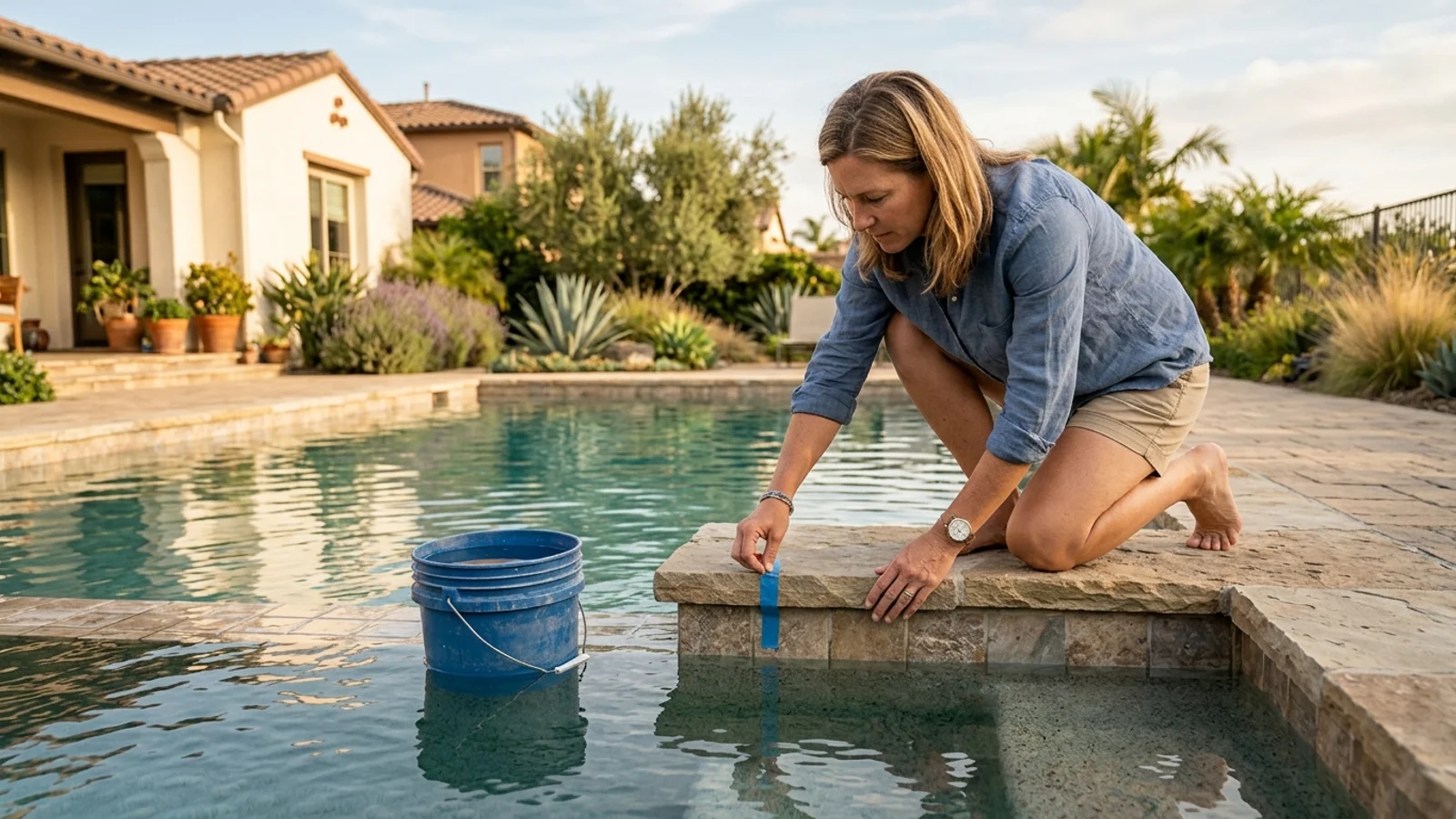
A San Diego pool loses about a quarter inch of water a day to normal evaporation, and closer to half an inch on a hot, dry, windy day. If your water is dropping faster than that with no splashing or backwashing to explain it, you probably have a leak. The fastest way to tell the two apart is a bucket test you can run yourself in 24 hours, with nothing but a bucket and a piece of tape.
This guide covers how much loss is normal here, the exact bucket test that separates a leak from evaporation, the signs that point to a real leak, where leaks usually hide, and what a leak actually costs you in water and chemicals each month.
How much water loss is normal for a San Diego pool?
Every uncovered pool loses water to evaporation, and San Diego’s warm, dry, breezy climate makes that loss higher than average. A quarter inch a day is the normal baseline, and it climbs when the air is hot and dry or the wind picks up, since both pull moisture off the surface faster.
| Conditions | Typical daily loss |
|---|---|
| Mild, humid, calm day | About 1/8 inch |
| Average San Diego summer day | About 1/4 inch |
| Hot, dry, windy (Santa Ana) day | Up to 1/2 inch |
| Uncovered pool running a heater | Higher still |
A quarter inch may not sound like much, but it adds up. A standard 16-by-32-foot pool loses about 80 gallons a day at that rate, roughly 550 gallons a week, and that’s completely normal. The problem isn’t evaporation itself. It’s when the water drops faster than evaporation alone can explain.
How do I tell if my pool has a leak or it’s just evaporating?
Run a bucket test. It’s the single most reliable do-it-yourself check, and it works because evaporation pulls water off an open bucket at the same rate it pulls water off your pool.
- Shut off the auto-fill. If your pool has an automatic filler, close its valve first. Otherwise it tops the pool off overnight and masks the loss.
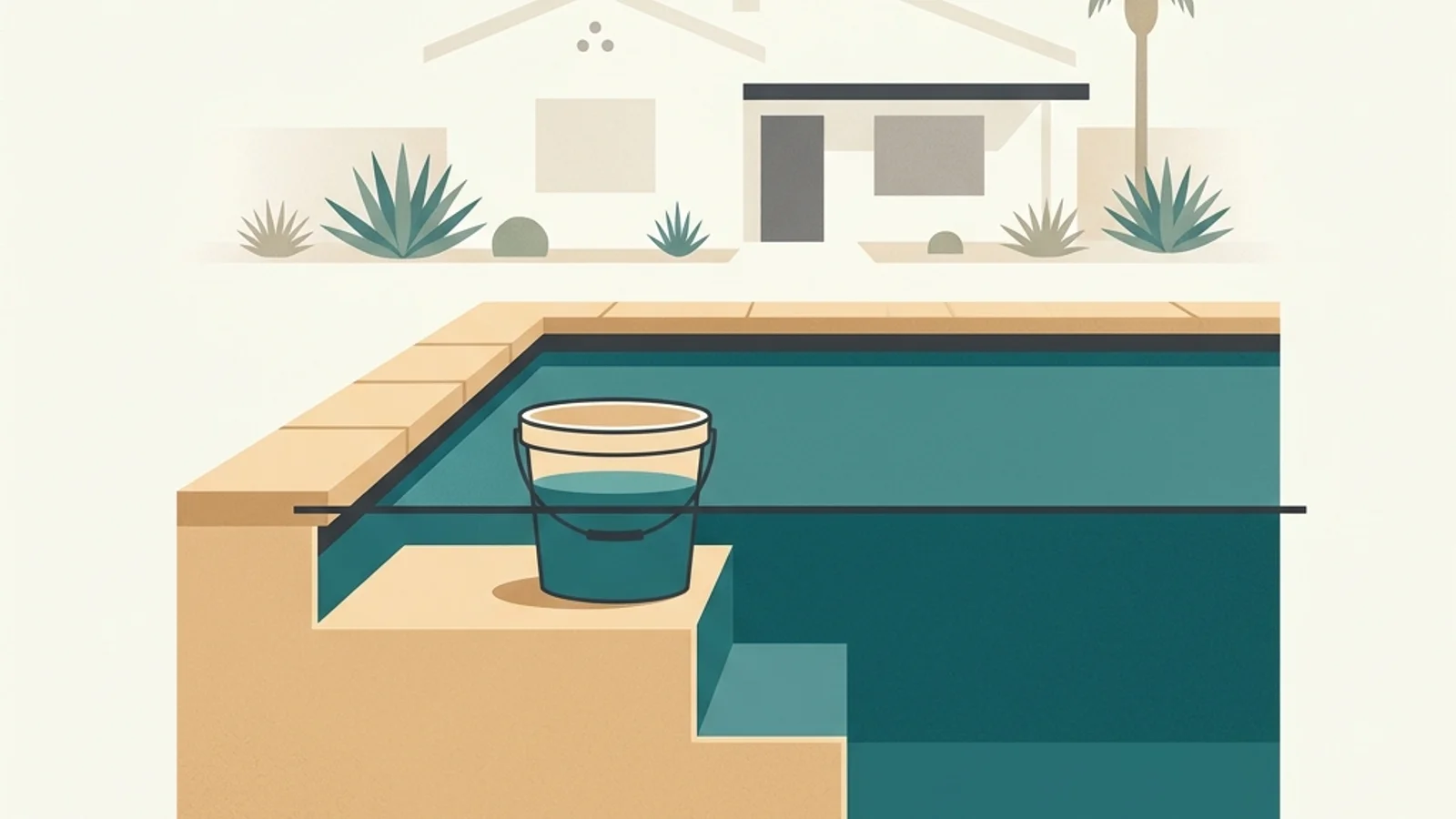
- Fill a bucket with pool water. Set it on the first or second step so it’s partly submerged and exposed to the same sun and wind as the pool.
- Mark both waterlines. Put a piece of tape or a grease-pencil mark at the water level inside the bucket and at the pool’s waterline on the tile.
- Wait 24 hours with the pump running normally. Don’t swim, backwash, or add water during the test.
- Compare the drop. Measure how far the water fell inside the bucket and in the pool.
If the pool dropped about the same as the bucket, it’s evaporation and your pool is fine. If the pool dropped noticeably more than the bucket, that extra loss is a leak. Run it a second time with the pump off if you want to narrow it down: a leak that only shows up when the pump runs usually points to the pressure-side plumbing, while a leak that happens pump-on and pump-off is more often in the shell or skimmer.
What are the signs my pool is actually leaking?
The bucket test is the proof, but a few everyday clues point to a leak before you even measure.
- Water drops more than a quarter inch a day with no swimming, splashing, or backwashing to explain it.
- The auto-fill runs constantly, or your water bill jumped without a change in use.
- Soggy or sunken spots in the deck, lawn, or planters near the pool that stay wet when the rest of the yard is dry.
- Cracks in the plaster, tile line, or deck that seem to be growing.
- Air bubbles in the pump basket or returns, which can mean a suction-side line is drawing air where it should draw water.
- Chemicals and chlorine that never hold, because the water carrying them is steadily draining away.
Any one of these on its own can have another cause. Two or three together, plus a failed bucket test, is a strong sign it’s time to find the source.
Where do pool leaks usually come from?
Leaks tend to show up in a handful of predictable places, and knowing them helps you describe the problem when you call for help.
The skimmer. The throat of the skimmer, where it meets the pool wall, is one of the most common leak points as the surrounding material shifts and separates over the years.
Underground plumbing. The suction and return lines run under the deck and yard. A cracked or loose fitting there is invisible from the surface and is the leak type that most often needs professional detection to pinpoint.
The shell and plaster. Cracks in the plaster or the structural shell, especially around lights, steps, and fittings, let water seep out slowly and steadily.
The equipment pad. Pumps, filters, heaters, and valves all have seals and unions that wear out. An equipment-pad leak is usually the easiest to spot because you can see or hear it, and it’s often a straightforward repair for the equipment team.
The light conduit. Water can travel through the conduit behind a pool light and escape, which is easy to miss and hard to trace without the right tools.
How much water and money does a pool leak waste?
Even a slow leak wastes real water, and in San Diego that shows up on the bill fast. The math starts with how many gallons your pool holds per inch of depth.
| Pool size | Gallons per inch of water | Cost of 1 inch lost* |
|---|---|---|
| 12 x 24 ft | About 180 gallons | $2 to $3 |
| 15 x 30 ft | About 280 gallons | $3 to $4 |
| 16 x 32 ft | About 320 gallons | $3 to $5 |
| 20 x 40 ft | About 500 gallons | $5 to $8 |
*Based on typical San Diego County tiered water rates. Your rate depends on your district and usage tier.
A leak that drops an extra quarter inch a day beyond normal evaporation on a 16-by-32-foot pool is about 80 extra gallons a day, roughly 2,400 gallons a month. That runs $30 to $150 or more on your water bill depending on your district and tier, and it doesn’t count the chlorine, acid, and stabilizer draining out with it. Not sure what a pool holds to begin with? Our guide on how many gallons your pool holds walks through the calculation.
What should I do if the bucket test shows a leak?
First, leave the auto-fill off until the leak is fixed so you’re not quietly paying for the loss. Then find the source rather than living with it, because a small underground or shell leak can wash out the soil beneath the pool and deck and grow into a structural problem that needs full pool repair.
Skimmer cracks and equipment-pad leaks are sometimes a visible do-it-yourself fix. Underground plumbing, shell, and light-conduit leaks are not, since you can’t see them and guessing means digging in the wrong place. That’s where a pro comes in. The pool pros in the Splash Pro Pools network use pressure testing, listening equipment, and dye tests to pinpoint a leak without tearing up your whole yard. Our breakdown of what leak detection costs in San Diego shows what to expect, and you can read how the professional leak detection process works before you book. Coastal pools in areas like La Jolla and Coronado see this often, and there are local pros for leak detection in La Jolla and across the county.
How do I cut down on normal evaporation?
If the bucket test says it’s evaporation, not a leak, you can still slow the loss. The biggest lever is covering the pool when it’s not in use, since almost all evaporation happens at the open surface. A solar or automatic cover can cut evaporation by 90 percent or more, and our pool cover guide breaks down the options and costs. Running the pump and any water features less during the hottest, windiest hours helps too, and topping the pool off on a schedule keeps the water level steady so your skimmer keeps working right, which we cover in the regular maintenance schedule.
Get help finding a pool leak in San Diego
If your bucket test points to a leak, the next step is pinpointing it before it wastes more water or undermines the deck. The pool pros in the Splash Pro Pools network cover all of San Diego County and use professional detection equipment to find leaks accurately, so the repair is targeted instead of guesswork. Call (858) 400-6757 to get matched with a local leak detection pro.
Frequently asked questions
How much water should a pool lose per day in San Diego?
About a quarter inch a day to normal evaporation, and up to half an inch on a hot, dry, windy day. A typical 16-by-32-foot pool loses roughly 80 gallons a day at a quarter inch, which is normal. If your water drops noticeably faster than that with no splashing or heavy use, you likely have a leak.
How do I know if my pool is leaking or just evaporating?
Run the bucket test. Fill a bucket with pool water, set it on a step so the water inside sits at the same level as the pool, mark both waterlines, and wait 24 hours with the pump running normally. If the pool drops more than the bucket, the difference is a leak. If both drop the same amount, it’s evaporation.
How much water can a pool leak waste?
A slow leak can waste hundreds to thousands of gallons a week. Losing an extra quarter inch a day beyond evaporation on a 16-by-32-foot pool is about 80 extra gallons a day, or roughly 2,400 gallons a month. At San Diego water rates that adds $30 to $150 or more to your monthly bill, plus wasted chlorine and chemicals.
Where do most pool leaks come from?
The most common spots are the skimmer throat, the plumbing lines underground, cracks in the plaster or shell, the equipment pad around the pump and filter, and the light conduit. A skimmer or plaster crack is often visible, but underground plumbing and shell leaks usually need professional leak detection equipment to pinpoint.
Should I turn off my pool’s auto-fill if I think I have a leak?
Yes, temporarily. An automatic filler quietly tops the pool off and hides the water loss, so you never see how fast it’s really dropping. Shut the auto-fill valve for a day or two so you can measure the true rate, then run the bucket test to confirm whether it’s a leak or evaporation.
Can a pool leak get worse if I ignore it?
Yes. A small plumbing or shell leak can wash out the soil under the pool and deck, undermine the structure, and turn a simple repair into a major one. It also keeps wasting water and chemicals every day. Once the bucket test points to a leak, it’s worth finding the source quickly.
Frequently asked questions
How much water should a pool lose per day in San Diego?
About a quarter inch a day to normal evaporation, and up to half an inch on a hot, dry, windy day. A typical 16-by-32-foot pool loses roughly 80 gallons a day at a quarter inch, which is normal. If your water drops noticeably faster than that with no splashing or heavy use, you likely have a leak.
How do I know if my pool is leaking or just evaporating?
Run the bucket test. Fill a bucket with pool water, set it on a step so the water inside sits at the same level as the pool, mark both waterlines, and wait 24 hours with the pump running normally. If the pool drops more than the bucket, the difference is a leak. If both drop the same amount, it's evaporation.
How much water can a pool leak waste?
A slow leak can waste hundreds to thousands of gallons a week. Losing an extra quarter inch a day beyond evaporation on a 16-by-32-foot pool is about 80 extra gallons a day, or roughly 2,400 gallons a month. At San Diego water rates that adds $30 to $150 or more to your monthly bill, plus wasted chlorine and chemicals.
Where do most pool leaks come from?
The most common spots are the skimmer throat, the plumbing lines underground, cracks in the plaster or shell, the equipment pad around the pump and filter, and the light conduit. A skimmer or plaster crack is often visible, but underground plumbing and shell leaks usually need professional leak detection equipment to pinpoint.
Should I turn off my pool's auto-fill if I think I have a leak?
Yes, temporarily. An automatic filler quietly tops the pool off and hides the water loss, so you never see how fast it's really dropping. Shut the auto-fill valve for a day or two so you can measure the true rate, then run the bucket test to confirm whether it's a leak or evaporation.
Can a pool leak get worse if I ignore it?
Yes. A small plumbing or shell leak can wash out the soil under the pool and deck, undermine the structure, and turn a simple repair into a major one. It also keeps wasting water and chemicals every day. Once the bucket test points to a leak, it's worth finding the source quickly.
Need this done in San Diego County?
For repair and renovation work like this, we hand you to our trusted partner, Del Rancho Pools.