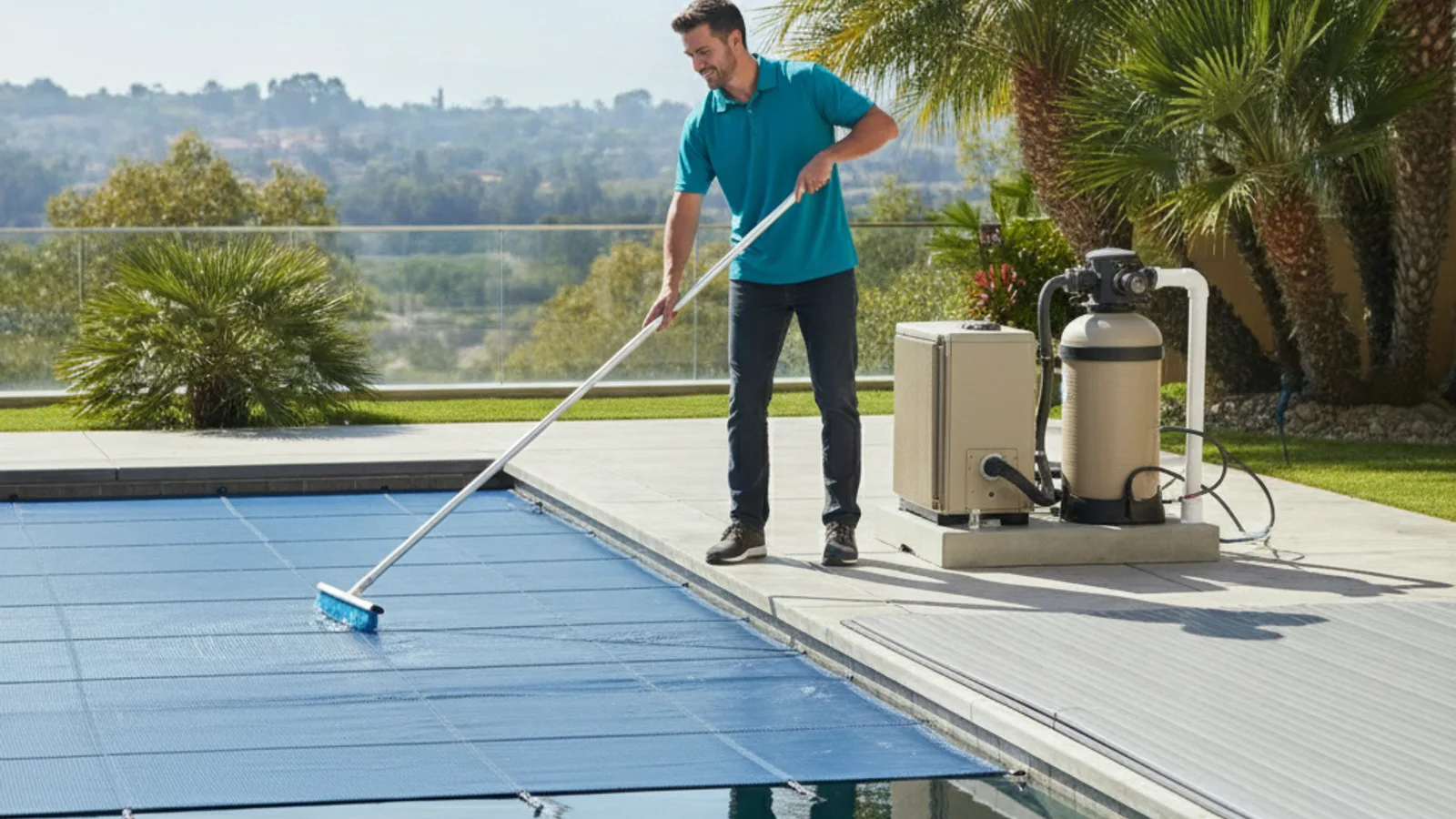
A note on scope: this is equipment installation and upgrades work, which sits outside what Splash Pro Pools does. Call (858) 400-6757 and we’ll match you with a vetted local pro who covers it.
A solar cover, a safety cover, and an automatic cover solve three different problems. A solar cover traps heat and slows evaporation for under $200. A safety cover meets California’s child-drowning-prevention code starting around $1,500. An automatic cover adds push-button convenience starting near $10,000. Most San Diego pool owners only need one of the three, not all three.
This guide breaks down what each cover actually does, what it costs installed in San Diego County, which one counts toward the state’s safety law, and how to tell which one is worth it for your pool.
What’s the difference between a solar cover, a safety cover, and an automatic cover?
A solar cover, also called a solar blanket, is a floating sheet of UV-stabilized bubble material that sits directly on the water. It traps solar heat during the day and slows evaporation at night. It doesn’t attach to anything and can’t support weight, so it’s a heat and water-loss tool, not a safety device.
A safety cover is anchored into the deck with straps or a track system and pulled tight across the water. Mesh and solid vinyl are the two common types, and both are rated under ASTM F1346 to support the weight of a child or pet who wanders onto it. This is the cover California’s pool safety law is actually talking about when it lists an “approved safety pool cover” as one of seven drowning-prevention options, a rule we cover in full in our California pool fence law guide.
An automatic cover is a motorized safety cover that rides on a track along the pool’s edge and opens or closes at the push of a button or a phone app. It carries the same ASTM F1346 safety rating as a manual safety cover, but adds real everyday convenience since nobody has to wrestle a cover on and off by hand.
How much does a pool cover cost in San Diego?
| Cover type | Installed cost | Counts for CA safety code | Cuts evaporation | Adds heat |
|---|---|---|---|---|
| Solar cover (blanket) | $60-$200, plus $150-$400 for a reel | No | Up to 95% | Yes, 5-10°F |
| Mesh safety cover | $1,500-$2,500 | Yes | Modest | No |
| Solid vinyl safety cover | $2,500-$4,000 | Yes | Yes, blocks sun too | No |
| Automatic cover | $10,000-$20,000+ | Yes | Yes, significant | No |
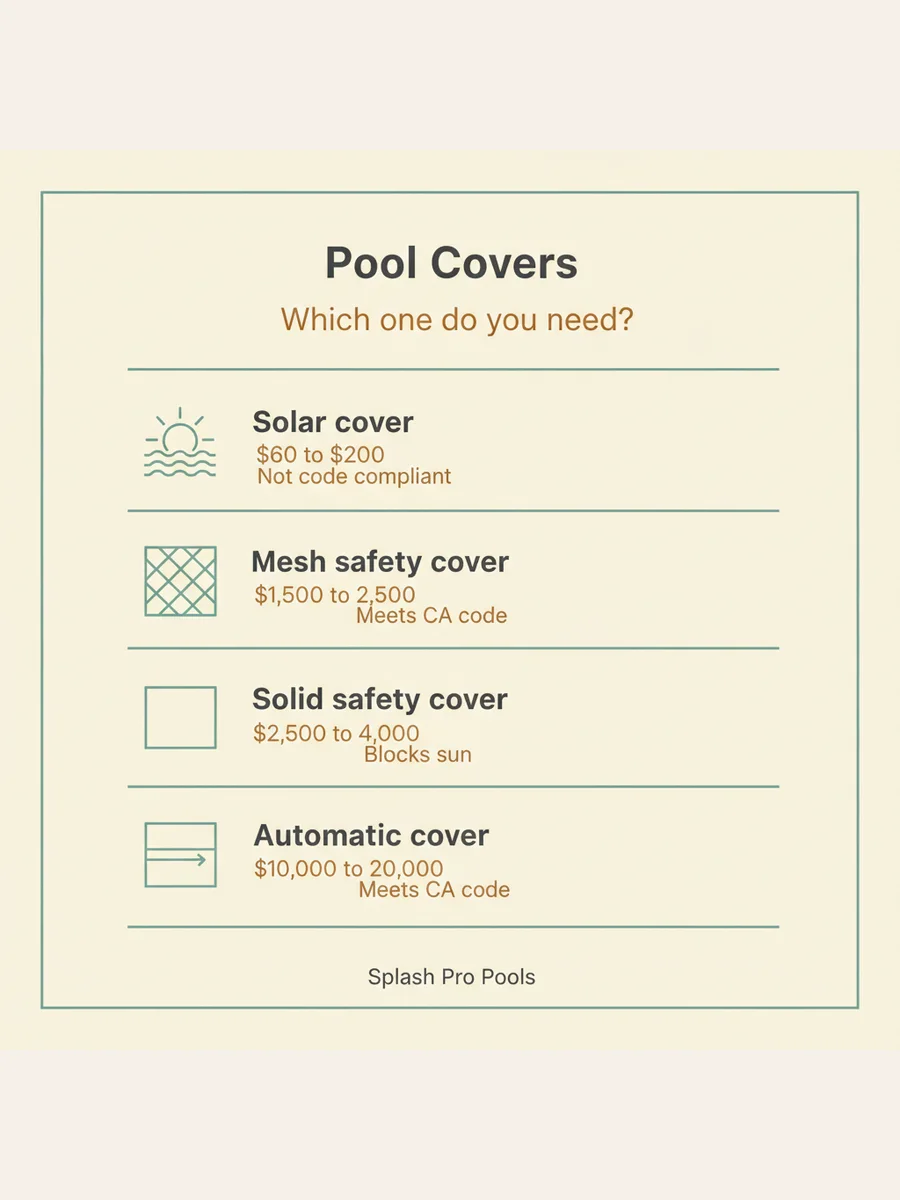
Installed pricing depends on your pool’s exact shape and any deck anchors or track hardware needed. Freeform pools, raised spas, and pools with a lot of steps or a Baja shelf cost more than a straight rectangle, for any cover type.
Does a pool cover count toward California’s safety law?
Sometimes. California requires any newly permitted or remodeled residential pool to have at least two of seven approved drowning-prevention features. A safety cover rated under ASTM F1346, whether it’s a manual mesh cover or a fully automatic one, is one of the seven and can count as one of your two.
A solar cover doesn’t qualify. It floats loose on the surface with nothing anchoring it down, so it offers zero drowning protection even though it’s genuinely good at what it does, trapping heat and cutting evaporation. If you’re trying to hit your two-feature requirement, you need either a rated safety cover or one of the other six options, like an isolation fence or exit alarms. Our California pool fence law guide walks through all seven and what San Diego inspectors actually check.
How much money and water does a pool cover actually save?
Evaporation. San Diego pools typically lose about a quarter inch of water a day to evaporation in summer, more on hot, dry, windy days. Since nearly all of that loss happens at the open water surface, any cover cuts it substantially, and a solar or automatic cover can cut it by 90 percent or more. If your pool is still losing water fast with a cover on, check whether it’s a leak or just evaporation before assuming the cover isn’t working, then call for professional leak detection if the bucket test points to a leak.
Chemicals. Sunlight burns off free chlorine, and an uncovered pool loses more of its sanitizer to UV every day than a covered one. Covering the pool when it’s not in use means less chlorine demand and fewer trips rebalancing pH and alkalinity, which is part of why a well-covered pool runs cheaper over a year. Our full breakdown of annual pool costs in San Diego covers where the rest of that budget goes.
Heat. A solar cover alone typically adds 5 to 10 degrees Fahrenheit and extends the comfortable swim season by weeks on each end. If you want more heat than a cover provides on its own, that’s a job for actual solar heating panels on the roof, a different system entirely, covered in our solar pool heater guide.
Which cover is right for your pool?
You just want lower water and chemical bills, no code requirement to meet. A solar cover with a reel is the cheapest option and pays for itself fast through reduced evaporation and chemical use.
You recently pulled a permit for a new pool or a remodel, or you’re selling a home with a pool. You likely need two approved safety features on file. A mesh or solid safety cover is a straightforward way to check one of those two boxes.
You have young kids, grandkids, or host groups of people who don’t know your pool. A real safety cover, not a solar blanket, is the only cover type that actually stops a child from going under. Pair it with a fence for real peace of mind, not just code compliance.
You want it out of sight and use it daily. An automatic cover is the biggest upfront cost, but it’s the only option that gives you safety code credit, evaporation control, and daily convenience all in one system, since nobody has to manually pull a cover on and off.
What maintenance does a pool cover need?
Solar covers need an occasional rinse and should come off the reel and out of direct sun when the pool’s in heavy use. The bubble material degrades with UV exposure and typically needs replacing every 3 to 5 years.
Mesh safety covers need debris hosed off the top and a seasonal check of the springs and anchor straps. Have a pro retension it once a year so it keeps supporting weight the way it’s rated to.
Solid vinyl safety covers should drain through a built-in cover pump after rain, standing water left sitting on top adds a lot of weight and stresses the anchors. Check that the pump is actually working each fall.
Automatic covers need the track kept clear of leaves and debris, since anything jammed in the track can strain the motor. Don’t set furniture or pool toys on the cover surface, and get the motor and cables inspected annually, this is the system most worth having a pro maintain.
Get help choosing and installing a cover
The right cover depends on your pool’s shape, your budget, and whether you’re solving for heat, code compliance, or convenience, and it’s easy to overpay for a system that doesn’t fix the problem you actually have. The pool pros in the Splash Pro Pools network cover San Diego County and can walk your specific pool through solar, safety, and automatic options before you buy anything. If you’re upgrading other equipment at the same time, our equipment installation team can handle both in one visit. Call (858) 400-6757 to get matched with a local pro.
Frequently asked questions
What’s the difference between a solar cover and a safety cover?
A solar cover is a floating bubble blanket that traps heat and slows evaporation. It can’t support any weight and doesn’t meet California’s safety code. A safety cover is anchored into the deck and rated under ASTM F1346 to support a child or pet, and it counts as one of the two required drowning-prevention features under state law.
How much does a pool safety cover cost in San Diego?
A mesh safety cover installed typically runs $1,500 to $2,500. A solid vinyl safety cover, which also blocks sunlight and helps prevent algae growth, runs $2,500 to $4,000. Both meet the ASTM F1346 rating California counts toward its two-feature safety requirement.
Does a solar cover count toward California’s pool safety law?
No. California’s law requires an approved safety pool cover rated under ASTM F1346 that can support a child’s weight. A solar blanket floats loose on the surface and isn’t rated for that, so it doesn’t count as one of the two required features, even though it’s genuinely useful for heat and evaporation.
How much does an automatic pool cover cost?
A fully automatic, motorized pool cover typically costs $10,000 to $20,000 installed for a standard rectangular pool, more for a large or custom shape. It meets the ASTM F1346 safety rating, cuts evaporation significantly, and opens or closes at the push of a button.
How much water does a pool cover actually save in San Diego?
San Diego pools typically lose about a quarter inch of water a day to evaporation in summer. A cover, especially a solar or automatic one, can cut that by 90 percent or more, since almost all of that loss happens at the exposed water surface.
Do I still need a fence if I have a safety cover?
Not necessarily, but you still need a second approved feature. A safety cover can count as one of California’s two required drowning-prevention features, and homeowners typically pair it with an isolation fence, exit alarms, or a pool alarm as the second.
Frequently asked questions
What's the difference between a solar cover and a safety cover?
A solar cover is a floating bubble blanket that traps heat and slows evaporation. It can't support any weight and doesn't meet California's safety code. A safety cover is anchored into the deck and rated under ASTM F1346 to support a child or pet, and it counts as one of the two required drowning-prevention features under state law.
How much does a pool safety cover cost in San Diego?
A mesh safety cover installed typically runs $1,500 to $2,500. A solid vinyl safety cover, which also blocks sunlight and helps prevent algae growth, runs $2,500 to $4,000. Both meet the ASTM F1346 rating California counts toward its two-feature safety requirement.
Does a solar cover count toward California's pool safety law?
No. California's law requires an approved safety pool cover rated under ASTM F1346 that can support a child's weight. A solar blanket floats loose on the surface and isn't rated for that, so it doesn't count as one of the two required features, even though it's genuinely useful for heat and evaporation.
How much does an automatic pool cover cost?
A fully automatic, motorized pool cover typically costs $10,000 to $20,000 installed for a standard rectangular pool, more for a large or custom shape. It meets the ASTM F1346 safety rating, cuts evaporation significantly, and opens or closes at the push of a button.
How much water does a pool cover actually save in San Diego?
San Diego pools typically lose about a quarter inch of water a day to evaporation in summer. A cover, especially a solar or automatic one, can cut that by 90 percent or more, since almost all of that loss happens at the exposed water surface.
Do I still need a fence if I have a safety cover?
Not necessarily, but you still need a second approved feature. A safety cover can count as one of California's two required drowning-prevention features, and homeowners typically pair it with an isolation fence, exit alarms, or a pool alarm as the second.
Need this done in San Diego County?
For repair and renovation work like this, we hand you to our trusted partner, Del Rancho Pools.