Low pH on a San Diego test kit means the water is acidic, and a matched local pool pro raises it with a measured dose of soda ash or borax, or by aerating until carbon dioxide leaves the water. That is how to raise pH in pool water that has slipped below the CDC’s 7.0 to 7.8 range: test, dose in small steps, circulate, then test again. An El Cajon plaster pool in August does not behave like a Point Loma spa spillover under a June marine layer, even when both sit in the same county.
What actually raises pH in pool water
pH is a hydrogen-ion reading. Add a base, and those ions get consumed. Drive dissolved carbon dioxide out of the water, and the same thing happens, because CO2 sits in the pool as carbonic acid. Either path makes the water less acidic. That is the whole raise.
A licensed pool pro reaches for one of three tools. Sodium carbonate, sold as soda ash or pH increaser, is the strong base. Borax, a borate salt, is the gentler one. Aeration is the no-powder option: returns pointed up, spa jets on, a sheer descent running until CO2 off-gasses and the reading climbs. Baking soda is the fourth bottle people grab, and it is the wrong first pick when pH is the only problem. It is sodium bicarbonate. It builds total alkalinity far more than it lifts pH.
The CDC’s healthy swimming guidance sets the home-pool range at 7.0 to 7.8. Below 7.0, water corrodes pipes and equipment. Above 7.8, chlorine kills germs more slowly. The same page wants chlorine and pH tested at least twice a day, more under heavy use, and it prefers DPD kits over strips. Inland San Diego sun and hard fill make that cadence earn its keep.
A low reading often shows up as plaster that feels chalky or rough, metal fixtures that look tired, and sanitizer that seems to vanish overnight. More chlorine does not fix an acid pool. The water still needs a base, or it needs air stripped through it. If the kit is reading high instead of low, that is a different correction, and it lives on our pool pH too high or too low page.
Trichlor in a feeder pulls pH down over weeks because the tablet is acidic. A week of rain on a La Jolla cover dilutes the same way. A Saturday party adds sweat and urine that chew through chlorine and tug the reading around. None of those are a reason to empty a jug of increaser in one pass. The pro tests first, then doses.
Why San Diego fill water keeps dragging pH around
Every top-off is a chemistry reset, and San Diego yards top off a lot. The San Diego County Water Authority has 22 retail member agencies serving 3.3 million people. Your fill water comes from your own agency, not from one county-wide tap. The minerals, the pH, and the alkalinity in that hose water are what the pool inherits each time the auto-fill kicks on.
Inland East County is the hard case. Santee is served by Padre Dam Municipal Water District, and that supply is very hard. Nearly half of Santee’s housing stock, 47.8 percent, was built before 1978, so a lot of those shells are older plaster sitting in mineral-heavy water. El Cajon in a dry August loses volume to sun all day. The auto-fill replaces it with more of the same hardness. A raise that overshoots on that water is how you get the white crust along the tile line. Pentair’s pool-water guide describes that crust as calcium scaling, the kind that shows up when pH, alkalinity, and hard water stack together.
Coastal yards live on a different clock. Point Loma and La Jolla sit under the marine layer. The water stays cooler. Less volume leaves as vapor, so less fill water arrives to rewrite the test kit. Those same yards love spa spillovers, sheers, and negative edges. All of that aeration strips CO2 and pushes pH up on its own. A salt cell adds its own bubbles. The low-pH call at the beach is often a trichlor feeder, a recent acid add, or a storm week, fighting a pool that already wants to climb.
South Bay and the central city add their own fill. A City of San Diego tap is not an Oceanside tap, and it is not a Vista tap. Fallbrook and Bonsall sit outside the Water Authority’s 2026 member list entirely. The honest move is to treat the hose as a chemical, test what it is adding, and stop assuming one county recipe. Our hard water pool guide is the companion for the mineral side of that fight.
A weekly pool cleaning stop is how most of these yards catch a slide before plaster etches. The pro on that route already knows whether the property is an inland evaporator or a coastal aerator. That local read is the dose.
Soda ash, borax, and aeration, side by side
Soda ash is sodium carbonate. It is a strong base, so pH jumps and total alkalinity comes along for some of the ride. Borax is milder. It lifts pH with a smaller alkalinity bump, which is why a pro reaches for it when the buffer is already stout. Aeration is the clean split: CO2 leaves, pH rises, alkalinity stays. That last path is the answer to the owner who wants pH up and TA left alone.
Baking soda does not belong in this race as a pH tool. It is the alkalinity increaser. Pour it for a low pH reading and you mainly thicken the buffer. The pH barely moves, then the next correction gets harder because the water now resists change.
Shock is not a pH plan either. Calcium hypochlorite is alkaline and can nudge the reading up while it sanitizes. Trichlor and dichlor are acidic and do the opposite. After a shock, the pro tests. The bottle is not a substitute for the kit. The walkthrough for that job is on our how to shock a pool page.
| Method | What it does to pH | What it does to alkalinity | When a pro picks it |
|---|---|---|---|
| Soda ash (sodium carbonate) | Strong lift | Some lift | pH is low and they want a clear jump |
| Borax | Gentler lift | Smaller bump than soda ash | pH is low and TA is already doing its job |
| Aeration (jets, sheers, returns) | Climbs as CO2 leaves | Stays put | They need pH up without feeding the buffer |
| Baking soda (sodium bicarbonate) | Small lift | Strong lift | Alkalinity is the real hole, and pH is secondary |
The pro never dumps two bases on top of each other. One product goes in. The pump mixes the pool. Then the kit comes back out. Mixing powders in a bucket, or stacking soda ash on borax because the first pass felt slow, is how a Santee tile line turns to scale by Thursday.
Water features already running are free aeration. A La Jolla spillover that has been off all week can be the raise, with no powder at all, if TA is already in a useful place. An El Cajon pool with a quiet surface and a trichlor floater usually needs the actual base.
How total alkalinity changes the raise
Total alkalinity is the buffer. It is the carbonate and bicarbonate sitting in the water that soak up acid or base so pH does not whip around. Raise pH in a pool with thin alkalinity and the number jumps, then crashes after the next swimmer load or the next windy fill. Raise pH in a pool with heavy alkalinity and the soda ash seems to do nothing, until it suddenly overshoots.
That is why a matched pro tests both readings from the same sample. Soda ash moves both. Borax moves pH more cleanly. Aeration moves pH and leaves TA where it was. If alkalinity is the hole, baking soda is the tool, and pH is the thing that may follow a little. The full split lives on our pool alkalinity too high or too low page.
San Diego hard fill pushes this around without asking. Padre Dam water into a Santee plaster pool already carries mineral load. Each top-off feeds the buffer. A coastal pool that evaporates less, then takes a rain week, can watch both pH and TA sag together. The correction is not the same bag of powder in both backyards.
Cyanuric acid from tablets also shows up in some alkalinity tests, which is why a pro who sees a long trichlor habit will read the sample with that in mind. The tablet was already pulling pH down. Treating that as a one-time soda-ash event, without looking at the feeder, just schedules next week’s low reading.
Overshooting the raise on East County hardness is the scaling path Pentair describes: high pH, high alkalinity, hard water, white calcium on tile and equipment. The goal is the CDC’s 7.0 to 7.8 window, not a heroic jump past it. Small dose, mix, retest. The buffer decides how big “small” is.
What a pool pro checks before adding base
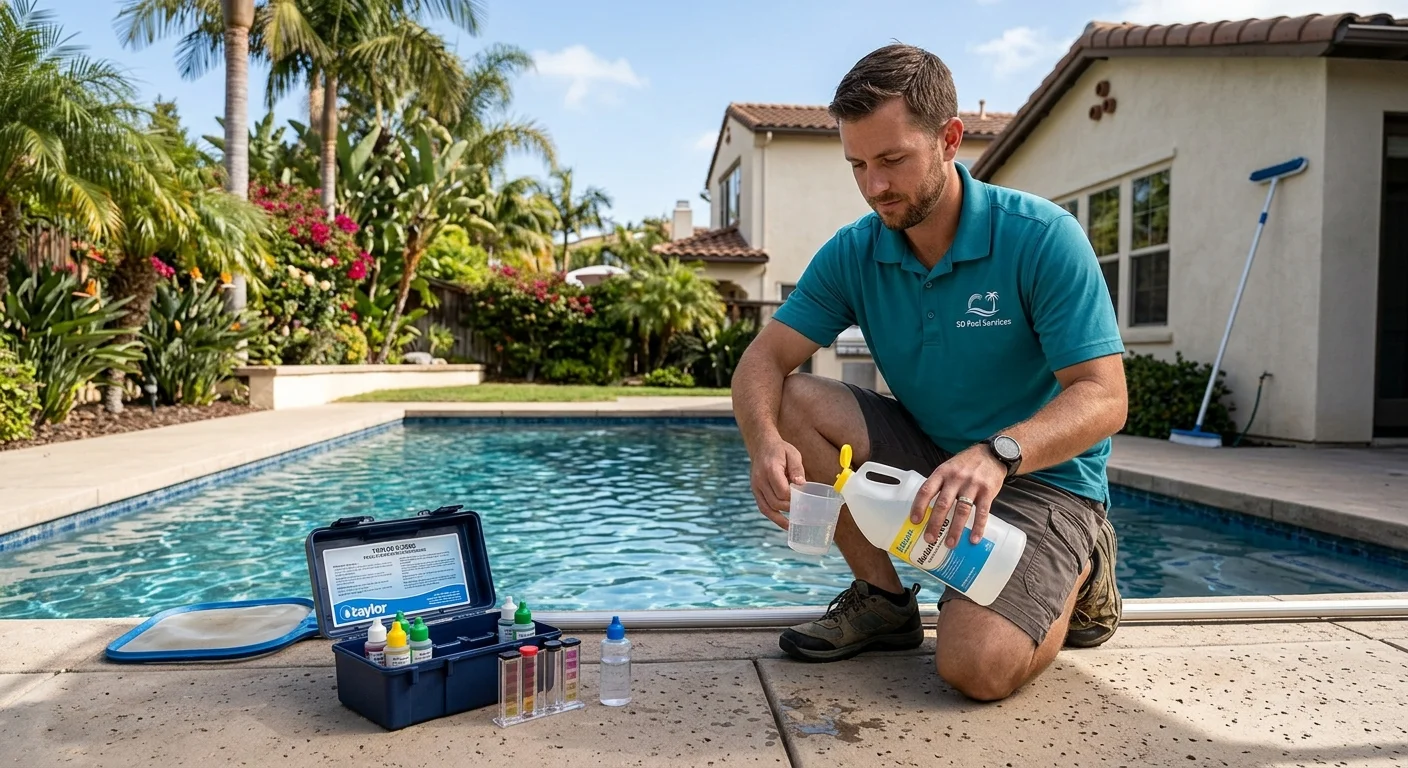
The kit comes out before the scoop. A DPD test on pH and chlorine is the starting pair, because the CDC rates that method above strips, and hard San Diego fill is where strips like to lie. Total alkalinity is the third number in the same sitting. Those three tell the pro whether soda ash, borax, or air is the raise.
Volume is the dose denominator. Angi’s May 2026 saltwater conversion guide puts a 10 by 20 ft inground pool at about 10,000 to 15,000 gallons, and a 20 by 40 ft shell at twice that or more. The pro still measures the actual pool. A wide Baja step and a deep end are not a rectangle on a napkin.
They also read the equipment and the weather. A trichlor feeder explains a slow sink. A salt cell and a running sheer explain a pool that wants to climb. A week of marine layer versus a week of inland Santa Ana heat changes how much fill water arrived. Recent acid, a filter clean, or a party all leave fingerprints. Fiberglass, vinyl, and plaster do not fail the same way when pH sits low. Plaster etches. Metal stains. Heaters and light niches corrode.
If the visit turns into equipment or structural work, that is construction territory. California’s C-53 classification covers swimming-pool contractors, and the CSLB license lookup is how you confirm the person touching the gear. Routine chemical service is a different job from a remodel. Ask for the license number when the work leaves the test kit.
The pro doses, lets the pump turn the pool over, and tests again. They do not stack a second product on a wet first guess. They do not treat a cloudy or green pool as a pH-only event. Clarity first, then the raise. That order keeps soda ash from decorating a dirty pool.
When to call us
Call when the kit keeps reading below the CDC range, when plaster feels rough, or when metal in the water looks worse after every top-off. A matched local pool pro will test pH with alkalinity, pick soda ash, borax, or aeration, and retest after the water has mixed. Call us at (760) 642-1256 and we’ll connect you with a licensed local pool pro.
Frequently asked questions
What happens when pH is too low in a pool?
The CDC's home-pool guidance says water below 7.0 corrodes pipes and equipment. Acidic water also etches plaster and can chew on metal rails, heaters, and light niches. Chlorine is still in the water, but the shell and the plumbing pay for the imbalance. A matched pool pro raises the reading before that damage stacks up.
Does shocking a pool raise pH?
It depends on the shock. Calcium hypochlorite is an alkaline salt, so it can nudge pH up while it sanitizes. Trichlor and dichlor pull the other way because they are acidic. The pro tests after the shock has circulated, then decides whether a separate base is still needed. Guessing from the bottle label is how yards overshoot.
Is pH increaser the same as baking soda?
No. The product sold as pH increaser is usually soda ash, which is sodium carbonate. Baking soda is sodium bicarbonate. Soda ash lifts pH hard. Baking soda mostly lifts total alkalinity and only moves pH a little. Using the kitchen box when pH is the only problem leaves you with a buffered pool that is still acidic.
What naturally raises pH in water?
Carbon dioxide leaving the water is the natural raise. Jets, waterfalls, spa spillovers, and the bubbles on a salt cell all strip CO2, and pH climbs while total alkalinity stays put. Algae does a similar trick by consuming CO2 as it grows. New plaster can leach alkaline material into the water. None of that replaces a test kit.
How often should pool pH be tested?
The CDC asks home-pool owners to test chlorine and pH at least twice a day, and more often when the pool is busy. It also rates DPD kits as more accurate than strips. San Diego sun, hard fill, and weekend swim loads make that schedule practical, not fussy.
Need professional help in San Diego County?
Splash Pro Pools connects San Diego homeowners with pool pros for the work in this post.