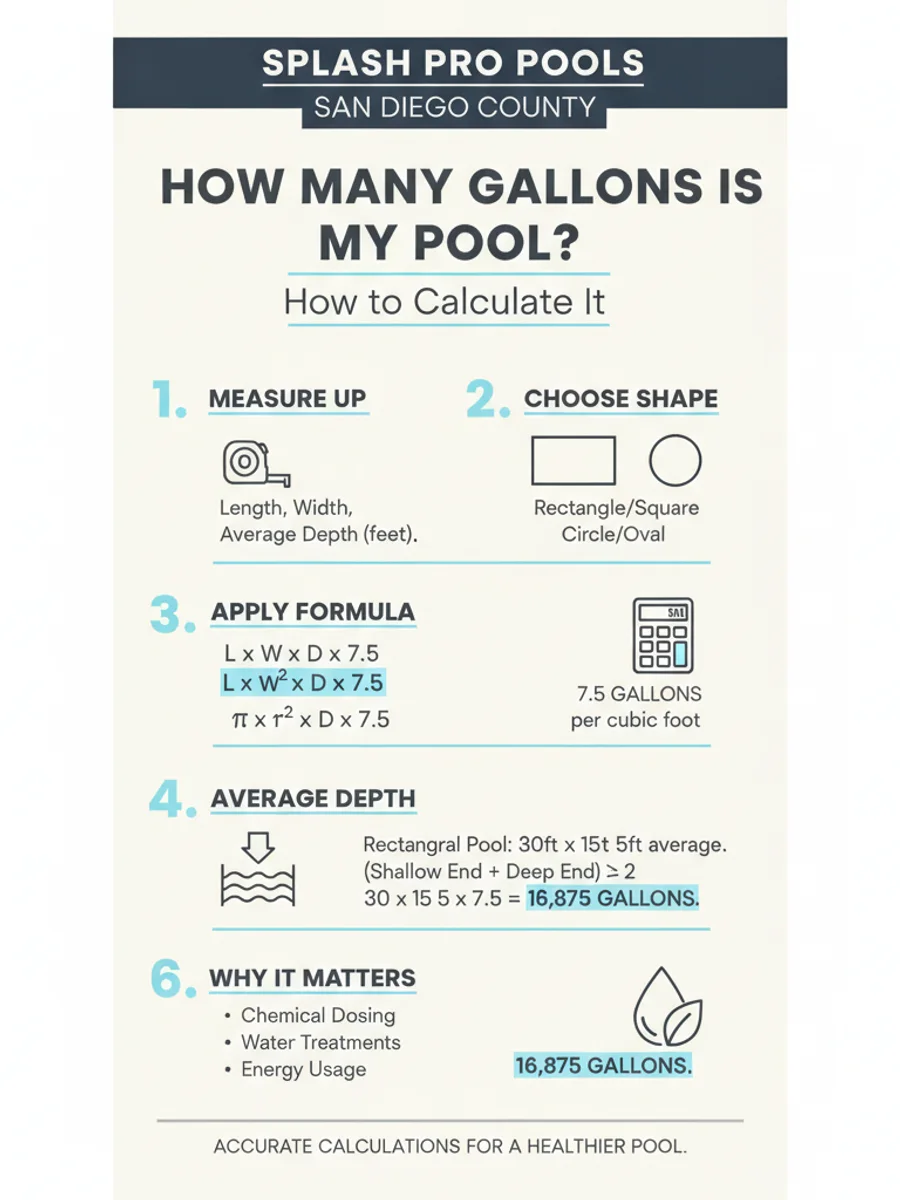
To find how many gallons are in your pool, multiply length x width x average depth x a shape number: 7.5 for a rectangle, 5.9 for a round or oval pool, and about 7.0 for a kidney or freeform shape. A typical San Diego backyard pool holds 15,000 to 20,000 gallons. Knowing the exact number matters because every chemical you add is dosed per 10,000 gallons.
This guide gives you the formula, the shape numbers, a worked San Diego example, and the reason getting the gallons right fixes more pool problems than any single chemical.
How do you calculate how many gallons are in your pool?
You need three measurements: length, width, and average depth, all in feet. Then you multiply them together with a number that matches your pool’s shape. The full formula is length x width x average depth x shape multiplier. The shape multiplier converts cubic feet into gallons and accounts for how much of the rectangle a curved pool actually fills. Measure the water surface, not the deck, and use feet with one decimal place for the closest result.
What is the shape number for each pool?
The shape number does the heavy lifting, so pick the one that matches your pool.
| Pool shape | Shape number | Formula |
|---|---|---|
| Rectangle or square | 7.5 | length x width x avg depth x 7.5 |
| Round | 5.9 | diameter x diameter x avg depth x 5.9 |
| Oval | 5.9 | length x width x avg depth x 5.9 |
| Kidney or freeform | 7.0 | length x width x avg depth x 7.0 |
For a round pool, use the diameter twice, not the radius. For a kidney or freeform pool, measure the longest length and the widest width, then use 7.0 as a close estimate. If your pool is a mix of a rectangle and a rounded end, you’ll land within a few hundred gallons, which is close enough for chemical dosing.
How do you find average depth?
Average depth is the shallow end depth plus the deep end depth, divided by two. If your shallow end is 3 feet and your deep end is 6 feet, your average depth is 4.5 feet. Use that number in the formula, not the 6 foot deep end. A common mistake is plugging in the deepest point, which inflates the gallon count and leads to overdosing chemicals. If your pool has a long flat shallow area and a small deep well, the true average sits a little lower, so round down when you’re unsure.
A worked example for a San Diego pool
Say you have a standard rectangular pool that measures 32 feet long and 16 feet wide, with a 3 foot shallow end and a 6 foot deep end.
- Average depth: (3 + 6) divided by 2 = 4.5 feet.
- Multiply: 32 x 16 x 4.5 = 2,304 cubic feet.
- Convert to gallons: 2,304 x 7.5 = 17,280 gallons.
So this pool holds roughly 17,300 gallons. That’s a textbook mid-size San Diego backyard pool. When a chemical label says “one bag per 10,000 gallons,” you now know you need close to 1.7 bags, not one, which is exactly the gap that leaves algae half-treated.
How many gallons is a typical pool?
Pool sizes in San Diego cluster into a few ranges. A plunge or spool pool usually holds 5,000 to 10,000 gallons. A standard family pool runs 15,000 to 20,000 gallons. A large or deep pool, or one with a big attached spa, can reach 25,000 to 30,000 gallons or more. If you only need a rough starting point before you measure, most suburban San Diego pools sit right around 18,000 gallons. But rough is the operative word, and a two minute measurement beats a guess every time you reach for a chemical.
Why your pool’s gallon count matters
Volume is the number underneath almost everything you do to a pool. Shocking a pool is measured per 10,000 gallons. Raising or lowering pH depends on how much water you’re adjusting. Fixing high or low alkalinity uses baking soda or acid dosed by volume. Salt water pools need a specific pounds-per-gallon salt level to keep the chlorinator working. Even a partial drain to lower cyanuric acid is calculated as a percentage of total gallons. Get the volume wrong and every one of those doses is off, which is why so many stubborn pool problems trace back to a bad gallon estimate.
How much does it cost to fill a pool in San Diego?
Filling a 15,000 to 20,000 gallon pool from a garden hose usually costs about $150 to $300, depending on your water district’s rate. San Diego water is billed per hundred cubic feet, which is about 748 gallons, so a 20,000 gallon fill is roughly 27 units on your bill. A hose takes a day or more to fill a pool and ties up your water. Bulk water delivery costs more per gallon but fills the pool in a few hours, which is why people use it after a resurfacing or a full drain. Either way, knowing your gallons is what lets you compare the two honestly.
Get an exact number from a local pro
You can measure your own pool in a couple of minutes, and for most rectangular pools the formula gets you close. For a curved, freeform, or multi-level pool, an exact number matters more, especially before a big chemical treatment or a water delivery quote. The pool pros in the Splash Pro Pools network cover San Diego County and can measure your pool, log its true volume, and dose every treatment against that number instead of a guess. If your equipment needs a look at the same time, they can handle both in one visit. Call (858) 400-6757 to get matched with a local pro.
Frequently asked questions
How do I calculate how many gallons are in my pool?
Multiply length x width x average depth x a shape number. Use 7.5 for rectangles, 5.9 for round or oval pools, and about 7.0 for kidney and freeform shapes. A 32 by 16 foot rectangle with a 4.5 foot average depth holds roughly 17,300 gallons.
How many gallons is a typical San Diego backyard pool?
Most residential pools in San Diego hold 15,000 to 20,000 gallons. Smaller plunge and spool pools run 5,000 to 10,000, while large or deep pools can reach 25,000 to 30,000 gallons or more. Measuring yours takes about two minutes and gives you a real number instead of a guess.
How do I find the average depth of my pool?
Add the shallow end depth and the deep end depth, then divide by two. A pool that is 3 feet at the shallow end and 6 feet at the deep end has an average depth of 4.5 feet. Use that average, not the deepest point, in the volume formula.
Why does my pool’s gallon count matter?
Every chemical dose is based on volume. Shock, chlorine, acid, alkalinity increaser, and salt are all measured per 10,000 gallons. Guess the gallons and you overshoot or undershoot every time, which is why problems like algae or cloudy water keep coming back.
How much does it cost to fill a pool in San Diego?
Filling a 15,000 to 20,000 gallon pool from a garden hose usually runs about $150 to $300 depending on your water district’s rate. Truck delivery costs more per gallon but fills the pool in hours and skips the days a hose takes.
Is there an easy way to measure an irregular pool?
Break the pool into simple shapes, find the gallons of each, then add them together. For a curved or freeform pool, a local pro can measure it accurately in a few minutes, which matters most when you’re dosing chemicals or quoting a water delivery.
Frequently asked questions
How do I calculate how many gallons are in my pool?
Multiply length x width x average depth x a shape number. Use 7.5 for rectangles, 5.9 for round or oval pools, and about 7.0 for kidney and freeform shapes. A 32 by 16 foot rectangle with a 4.5 foot average depth holds roughly 17,300 gallons.
How many gallons is a typical San Diego backyard pool?
Most residential pools in San Diego hold 15,000 to 20,000 gallons. Smaller plunge and spool pools run 5,000 to 10,000, while large or deep pools can reach 25,000 to 30,000 gallons or more. Measuring yours takes about two minutes and gives you a real number instead of a guess.
How do I find the average depth of my pool?
Add the shallow end depth and the deep end depth, then divide by two. A pool that is 3 feet at the shallow end and 6 feet at the deep end has an average depth of 4.5 feet. Use that average, not the deepest point, in the volume formula.
Why does my pool's gallon count matter?
Every chemical dose is based on volume. Shock, chlorine, acid, alkalinity increaser, and salt are all measured per 10,000 gallons. Guess the gallons and you overshoot or undershoot every time, which is why problems like algae or cloudy water keep coming back.
How much does it cost to fill a pool in San Diego?
Filling a 15,000 to 20,000 gallon pool from a garden hose usually runs about $150 to $300 depending on your water district's rate. Truck delivery costs more per gallon but fills the pool in hours and skips the days a hose takes.
Is there an easy way to measure an irregular pool?
Break the pool into simple shapes, find the gallons of each, then add them together. For a curved or freeform pool, a local pro can measure it accurately in a few minutes, which matters most when you're dosing chemicals or quoting a water delivery.
Need professional help in San Diego County?
Splash Pro Pools connects San Diego homeowners with pool pros for the work in this post.