The inspect-cell light is still on in an El Cajon backyard after the last clean. White crust came off the plates, the coating underneath looks thin, and turning output all the way up does not bring chlorine back. That is the moment how to replace a salt chlorinator cell stops being a later project and becomes the work on the pad.
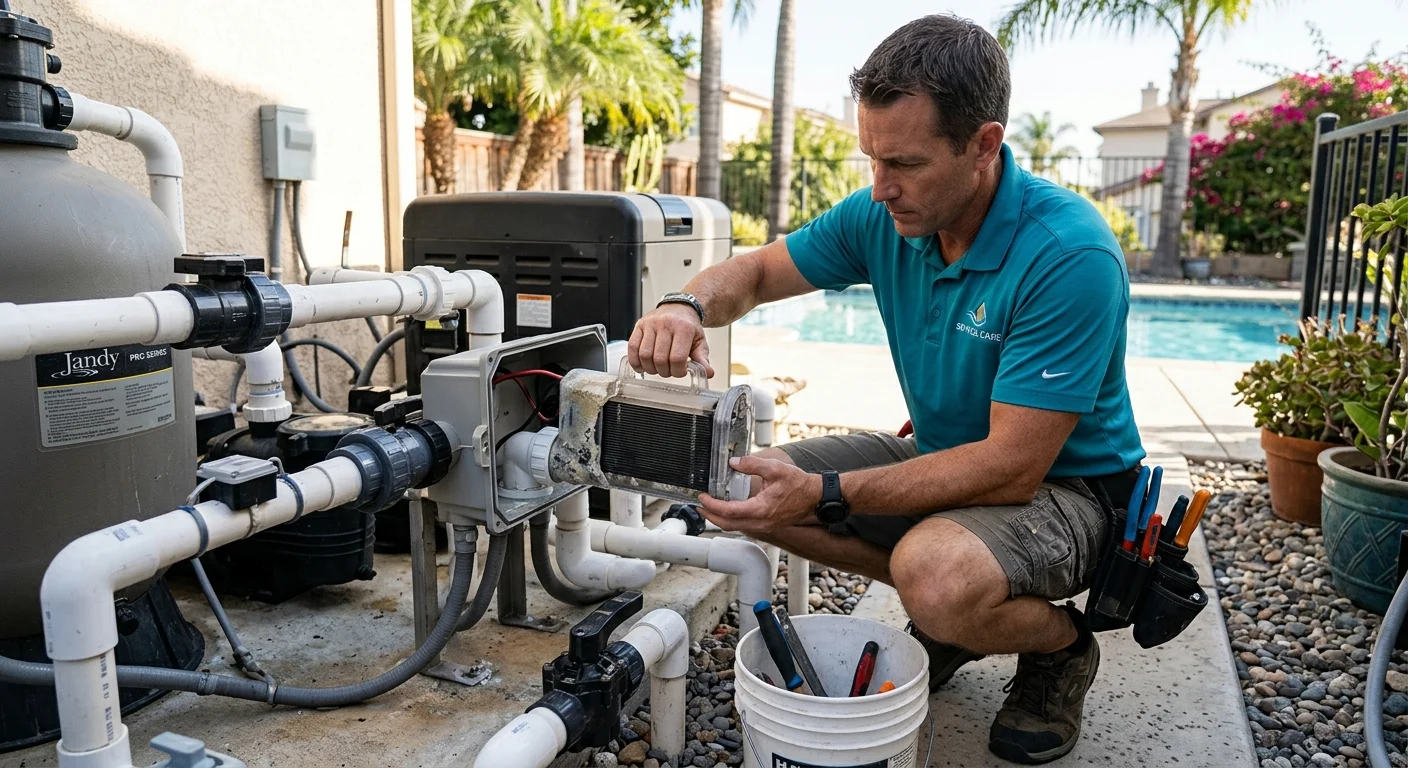
When a salt cell is done and cleaning will not save it
A salt cell is spent when a real clean no longer restores chlorine production. Scale can look like failure. Worn coating is failure. The difference shows up after the plates are clear and the box still reports low output.
Salt water moves across titanium plates. Current splits chloride off the salt, and that chlorine rides the return lines back into the pool. The coating on those plates is the working surface. Acid soaks and polarity reversing knock calcium off so water can touch metal again. They cannot put coating back once it has thinned to bare spots, pits, or gaps between plates.
INYO Pools, in a guide read in August 2026, says an SCG cell can be expected to last 5 or more years if the pool and equipment are maintained properly. That is a retailer estimate, not a promise from this site or from the pro who shows up. A Santee or Escondido pool that runs hard through a long, hot season uses a cell harder than a Point Loma pool sitting under marine layer. Runtime, calcium, and pH decide the real calendar.
HomeGuide’s September 2025 saltwater guide says cells need a mild acid wash every 3 to 4 months unless they are self-cleaning. Self-cleaning units reverse polarity to shed scale. Even those still need a look inside. If the inspect light returns days after a wash, and an independent salt test already shows salt in the water, the cell is asking to come out.
Cloudy water and a chlorine reading that will not climb belong on this list too. Confirm the cell itself before you buy a part. The walkthrough for how to test a salt chlorinator cell is the right stop when the box is still a maybe. Persistent no-output with a clean, well-salted system is covered in salt cell not working. This page starts after those checks.
| After a clean | What it usually means |
|---|---|
| Output returns and the inspect light stays off | Scale was blocking the plates. Keep the cell and watch pH. |
| Plates look thin, pitted, or bare and chlorine stays low | The coating is spent. Plan a replacement. |
| Inspect-cell stays on with a verified salt reading | The cell and its sensor are no longer doing the job. |
| Brand-new cell, unions tight, still no chlorine | Flow, the arrow, and a backwards install are the next look. |
What a pool pro shuts down before pulling the cell
Power dies at the breaker before anyone touches a union. The timer or automation app is not enough. The chlorinator and the pump share a pad, and a live cable on a wet cell is how a simple swap turns into a shock and a ruined board.
A licensed independent pool pro kills the pool equipment breaker, confirms the control box is dark, then unplugs the cell cable. Many connectors are keyed. Forcing a wet plug is how pins bend. The pump stays off so the line can drain down at the unions instead of dumping a column of water across the motor.
Isolation valves, when the pad has them, get closed so the filter and heater are not pushing water through an open joint. Residual pressure comes off at the filter air relief. Then the two unions on the cell housing get backed off. Most are hand-tight. A strap wrench comes out when old plastic has seized. Pipe wrenches chew the nuts and make the next service worse.
Water in the housing is pool water, often a few gallons. It belongs in a bucket, not in the gutter. Inside City of San Diego limits, saline pool water is not allowed in storm drains. Other cities set their own stormwater rules, so the pro treats the pad as a wet work area and keeps salt water on site.
With the cell free, the housing, O-rings, and flow switch get a look. A cracked union, a flattened O-ring, or a flow paddle stuck with scale will make a new cell look dead the first time it powers up. The control box stays on the wall. The part that slides out is the cell. If the board itself is the failure, Angi’s May 2026 saltwater guide puts a control board in a $500-$900 market range, separate from the cell. That is why the pro tests before ordering.
Pool repairs that touch equipment are the kind of job where you ask for a license number. Check it on the CSLB license lookup before work starts.
Unions, orientation, and why the cell can go in wrong
How to remove a salt cell is the union work above. How it goes back in is orientation. A salt cell can be installed backwards. When it is, it makes no chlorine.
The cell body has a molded flow arrow. Water has to enter the plate stack the way the maker designed. Typical pad order is pump, filter, heater, then the cell, then the returns. Filtered water should reach the plates. Debris from an unfiltered line coats them and fools the next “clean cell” warning.
Unions are not a compass. They will often thread down with the cell flipped 180 degrees. The cable may still reach. The box may still power up. Production still fails because water is hitting the wrong end of the plates, and the flow switch may never close. The display then looks like a bad cell, a low-salt error, or a no-flow error on a pump that is clearly running.
Can a salt cell be installed backwards on your brand. Yes, on most of the common San Diego pads. Some cables are keyed so the plug only seats one way. The plumbing is not. The pro lines the arrow with the water path, seats both O-rings dry of grit, and brings the unions up evenly so the housing does not cock and leak.
A clear housing is a gift after the swap. Tiny bubbles in the chamber are chlorine being made. A solid body hides that, so the pro watches the production lights and a test of the water after a run cycle. If the old cell was the only change and chlorine still sits at zero, the next look is the flow switch, the cable, and that arrow.
Match the part number on the old label to the new cell. A cell that physically fits the unions is not automatically the right output or the right connector for that control box. Aftermarket cells exist. The honest check is the model stamped on the old unit, the generator model on the box, and the pool volume, not a guess from the color of the housing.
How San Diego scale shortens the next cell
The new cell fails early for the same reason the old one crusted. San Diego fill water is hard in a lot of inland yards, and salt systems drift pH up as they run. Calcium that stays dissolved in cool, balanced water drops out as white scale on hot plates.
Pentair’s pool water chemistry guide describes that white, chalky calcium on tile and equipment as scaling, driven by high pH, high alkalinity, and hard water. The CDC’s healthy swimming guidance puts pool pH between 7.0 and 7.8. As pH rises above 7.8, chlorine also kills germs more slowly, so the box gets turned up, the cell works longer, and more scale cooks onto the plates.
Escondido, Santee, and El Cajon cook a cell faster than a marine-layer yard in Point Loma or Encinitas. Inland summer water sits warmer. Plates that run hot in hard water grow a crust you can feel with a fingernail. Santee’s fill comes through Padre Dam Municipal Water District, and the water there is very hard. A cell on that pad needs chemistry watched, not just a new part clicked into the unions.
The San Diego County Water Authority has 22 retail member agencies serving 3.3 million people. Your rates and your mineral profile come from your own agency, not one county-wide tap. Fallbrook and Bonsall sit outside that member list. Wherever you are, the refill source is what the new plates will live in.
Scale on the waterline is the same mineral story as scale in the cell. If the tile at the gunite line in El Cajon is already crusted after summer, the cell has been eating that water too. Hard water pool service in San Diego and ongoing salt water pool maintenance are how the next cell lasts. A swap with pH still sitting high is a short loop back to inspect-cell.
Keep cyanuric acid from years of tablets in mind if this pool used to be a chlorine-tab pool and later went salt. Stabilizer does not scale the plates the way calcium does, but it changes how the chlorine you just made behaves in the sun. The cell still has to work. Chemistry around it decides how hard.
What a replacement visit should include
A replacement visit is a matched cell, a dry electrical connection, correct flow direction, and water that will not crust the new plates by next month. The part sliding into the unions is the middle of that list, not the whole list.
Angi’s May 2026 saltwater conversion guide puts generator cell replacement at $700-$1,100. HomeGuide’s September 2025 guide lists salt cells from $200-$1,400. Those are market ranges from named national roundups, dated as above. They are not a quote from Splash Pro Pools, and they are not a warranty. The pro on your pad prices the cell that fits your box, plus any O-rings, cable, or flow switch that failed with it.
Expect the visit to include a water test, not just a wrench. Free chlorine, pH, and salt get read with a kit, not only off the generator’s own sensor. Aging cells lie about salt. Dumping more bags in because the box said so is how you corrode handrails and still have no chlorine. CDC guidance is at least 1 ppm free chlorine in pools, and at least 2 ppm when cyanuric acid is in the water, with pH held in that 7.0-7.8 band.
The new cell gets the arrow right, unions even, cable fully seated, and the pump run until the production lights behave. A clear chamber should show that fine bubble cloud. Output starts at a sensible percentage for the season, not locked at 100% because last month’s dead cell trained everyone to max it. Inland August heat in Escondido asks more of a cell than a June week in Del Mar. The setting should follow the weather and the bather load.
If the generator was the wrong size from the start, swapping the same model repeats the same 100% runtime. That conversation belongs with salt water pool conversion when the box, the cell, and the pool volume were never a match. A conversion is a different job from a cell swap. The cell job is this: pull the spent plates, seat the new ones with the water, and leave chemistry that will not eat them.
Ask the pro for the old cell back. You want to see the plates. Bare metal, heavy bridging, and broken blades are the autopsy. A cell that still looks coated after “no output” points back to flow, salt readings, or the board.
When to call us
When a clean cell still throws low output, or the last install left the arrow fighting the water, a licensed pool pro should handle the swap and the chemistry around it. Call us at (760) 642-1256 and we’ll connect you with a licensed local pool pro.
Frequently asked questions
How long does a salt chlorinator cell last?
INYO Pools, in a guide read in August 2026, says an SCG cell can be expected to last 5 or more years if the pool and equipment are maintained properly. That is a retailer estimate, not a promise. Inland San Diego scale and high pH shorten that window.
How much does it cost to replace a salt chlorinator cell?
Angi's May 2026 saltwater conversion guide puts generator cell replacement at $700-$1,100, and a control board at $500-$900. HomeGuide's September 2025 saltwater package notes salt cells from $200-$1,400. Those are national market ranges, not a Splash Pro Pools price.
Can a salt cell be installed backwards?
Yes. Most cells have a molded flow arrow. Water has to enter the plate stack the way the maker designed. A cell seated against that arrow often shows flow errors and makes no chlorine even though the unions are tight and the box is powered.
What are signs that a salt cell is going bad?
The inspect-cell or low-output light stays on after a real clean, the plates look thin, pitted, or bare, and free chlorine will not climb with output turned up. A box that keeps calling for salt when an independent salt test already shows salt is another tell.
How do you remove a salt cell?
A licensed pool pro kills power at the breaker, unplugs the cell cable, loosens the two unions, and slides the cell out of the housing. O-rings and the flow switch stay with the plumbing and get checked before the new cell goes in.
Need professional help in San Diego County?
Splash Pro Pools connects San Diego homeowners with pool pros for the work in this post.