Pool pump repair Santee homeowners need begins with the symptom, not a guessed part. A whine points toward motor bearings, while rattling suggests debris or impeller damage. Air beneath the basket lid usually means a suction-side leak. Santee’s Padre Dam water runs very hard. Mineral scale can narrow the impeller and volute passages, then wear the shaft seal.
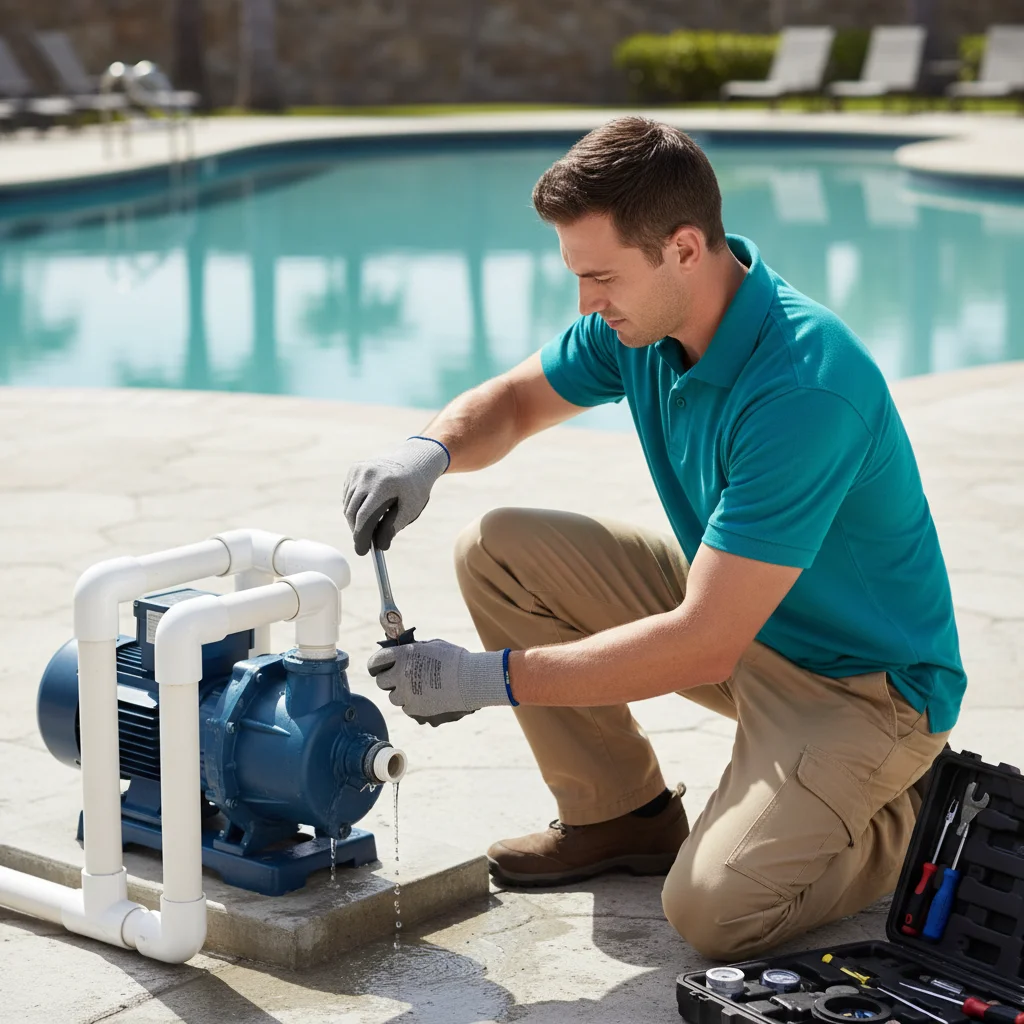
Why Santee’s hard water wears pool pumps
Santee’s very hard water creates extra work inside the pump’s wet end. The community receives water through Padre Dam Municipal Water District. Padre Dam publishes annual water-quality reports for customers who want the current hardness reading for their supply.
Dissolved minerals don’t automatically become scale. Water chemistry determines whether they stay dissolved or attach to equipment. Once deposits form, their rough surface catches more material.
The impeller creates water movement through narrow vanes. Scale along those vanes reduces the open passage and can disturb the impeller’s balance. That restriction makes the motor work against a less efficient water path.
The volute surrounds the impeller and guides water toward the return plumbing. Mineral deposits reduce the space available for that flow. The result can look like a motor problem even when restriction started inside the housing.
The shaft seal sits where the spinning motor shaft enters the wet end. Abrasive scale around that seal wears its mating surfaces. Water can then travel toward the motor and damage its bearings.
Age adds another layer in Santee. Many local pools are 40-50 years old and reaching the point where equipment and plumbing need separate evaluation. About 47.8% of Santee homes were built before 1978. The Census Bureau’s ACS year-built data provides a useful housing-age measure, though a home’s age doesn’t prove when its pump was installed.
An equipment pad in Carlton Hills may combine old plumbing with a newer motor. A Mission Gorge property may have replaced several pieces at different times. The model label, plumbing condition, and repair history matter more than appearances alone.
What each pool pump symptom usually means
The pump’s sound and basket behavior narrow the diagnosis quickly. A changed sound doesn’t identify one guaranteed failure, but it points the inspection toward specific components.
| Pump symptom | Likely cause | Repair or replace signal |
|---|---|---|
| High whine or squeal | Motor bearings are wearing, sometimes after moisture reaches them. | Repair can fit a sound housing. Stacked motor and wet-end wear favors replacement. |
| Grinding or rattling | Debris has reached the impeller, or the impeller is damaged. | An isolated obstruction or impeller problem favors repair. Housing damage changes the decision. |
| Air beneath the clear lid | The lid O-ring, drain plug, union, or suction fitting is pulling air. | A replaceable seal or fitting favors repair. A cracked housing may justify replacement. |
| Pump loses prime | Air enters before the pump, or water can’t reach it consistently. | An isolated suction leak favors repair. Repeated failures may reveal broader plumbing wear. |
| Motor hums but doesn’t start | The capacitor, motor, or electrical supply needs diagnosis. | A single failed component may be repairable. Multiple aging components favor replacement. |
| Water appears between motor and housing | The shaft seal is leaking. | Early seal work may preserve the pump. Bearing damage or a brittle housing changes the calculation. |
A bearing whine usually rises above the pump’s normal motor sound. Our pool pump noise troubleshooting guide explains how whining differs from rattling, humming, and water noise.
Grinding and rattling come from the wet end more often than a clean bearing whine. Debris may have passed through the basket and reached the impeller. A damaged impeller can produce a similar sound, so guessing from the deck isn’t enough.
Air beneath the clear basket lid points toward the suction side. The lid O-ring is the first and most common place to look. A dry, pinched, dirty, or damaged ring can stop the lid from sealing evenly.
Drain plugs, unions, threaded fittings, and cracked plastic can create the same symptom. The bubbles may disappear briefly after priming, then return as the pump runs. Our guide to a pool pump that won’t prime covers that pattern in more detail.
A motor that hums without turning needs a different diagnosis. The capacitor may not be starting the motor, or the rotating assembly may be stuck. Read the humming pump troubleshooting guide before comparing repair options.
A local pro can inspect these symptoms through the Santee pool repair service. Splash Pro Pools makes the referral. The independent professional diagnoses the pump and provides the repair scope.
Pool pump repair Santee: repair or replace
Repair makes sense when the failure is isolated and the remaining pump is sound. Replacement makes more sense when age, damage, and energy use have become one combined problem.
A lid O-ring, shaft seal, capacitor, or damaged impeller can be a focused repair. A motor swap can also make sense when the wet end remains solid. The housing shouldn’t be cracked, warped, or brittle.
An older single-speed pump deserves a broader comparison. Santee has many 40-50-year-old pools, and some still pair older plumbing with original-style equipment. Replacing one failed part may preserve a unit whose other components are already worn.
Single-speed pumps run at one fixed speed whenever they’re on. Variable-speed pumps can run longer at a lower, quieter setting when the system is sized and programmed correctly. That changes both equipment noise and electricity use.
Timing matters under local electricity plans. SDG&E’s residential pricing plans divide electricity use into time-based periods. A programmable pump can shift suitable circulation away from higher-priced periods, depending on the home’s rate plan.
That doesn’t make every older pump an automatic replacement. A sound housing with one failed component may still justify repair. A cracked wet end, repeated seal failures, bearing damage, and an aging motor together make replacement easier to defend.
The pool equipment service in Santee provides the upgrade path when replacement wins. The pro should identify the failed component, describe the condition of the remaining pump, and explain any plumbing changes required.
Price follows the scope. HomeGuide’s July 22, 2025 pool repair guide lists labor at $45-$70 per hour, depending on location, season, and repair type. The final Santee quote also moves with pump access, model compatibility, parts, and the amount of plumbing involved.
A motor-only repair should be scoped differently from a complete pump replacement. Variable-speed controls and programming add work that a simple seal change doesn’t require. A written diagnosis lets you compare the same job across proposals.
For ongoing local care after the repair, visit the Santee pool service hub. Regular equipment observation can catch a changed sound, air leak, or seal drip before several components become involved.
Frequently asked questions
How do I know if my Santee pool pump needs repair?
A changed sound, water leak, trapped air, or repeated loss of prime points toward a pump problem. Whining, rattling, humming, and visible bubbles lead to different components. A diagnosis should identify the failed part before pricing the work.
Why does my pool pump keep losing prime?
A suction-side air leak is usually interrupting water flow. The pump-lid O-ring is the most common starting point. Drain plugs, unions, fittings, and housing cracks can create the same behavior.
Is a noisy pool pump always a bad motor?
No, the type of noise matters. A high whine often comes from motor bearings. Grinding or rattling can come from debris or a damaged impeller inside the wet end.
How much does pool pump repair cost in Santee?
The total changes with the failed part, pump condition, access, and repair scope. HomeGuide’s July 22, 2025 guide lists pool repair labor at $45-$70 per hour. A matched local pro can separate labor, parts, plumbing, and replacement options in a scoped quote.
Should I replace an older single-speed pool pump?
Replacement becomes stronger when an older single-speed pump has multiple worn components or a damaged housing. A younger pump with one isolated failure may remain a sound repair candidate. The decision should compare the entire wet end, motor, plumbing, and controls.
Splash Pro Pools connects Santee homeowners with licensed, independent local pool professionals. Call (858) 400-6757 and we’ll match you with a local pro who can inspect the pump and explain the next step.
Frequently asked questions
How do I know if my Santee pool pump needs repair?
A new whine, grinding sound, water leak, air under the basket lid, or repeated loss of prime points toward a pump problem. The exact symptom helps a local pro separate an isolated repair from broader equipment wear.
Why does my pool pump keep losing prime?
A suction-side air leak is usually interrupting the water flow. The pump-lid O-ring is the most common starting point, followed by drain plugs, unions, fittings, and cracks in the housing.
Is a noisy pool pump always a bad motor?
No. A high whine often comes from motor bearings, while grinding or rattling can come from debris or a damaged impeller. The sound and its location guide the diagnosis.
How much does pool pump repair cost in Santee?
The total depends on the failed part, pump condition, access, and whether the job involves a targeted repair, motor swap, or complete replacement. HomeGuide's July 22, 2025 guide lists pool repair labor at $45-$70 per hour.
Should I replace an older single-speed pool pump?
Replacement becomes the stronger choice when an older single-speed pump has a brittle housing, several worn components, or repeated failures. A sound pump with one isolated problem may still be a good repair candidate.
Need professional help in San Diego County?
Splash Pro Pools connects San Diego homeowners with pool pros for the work in this post.