One thing to flag: Splash Pro Pools does not take this work on. It goes to a vetted local pool repair pro, reachable at (858) 400-6757.
A healthy pump should prime in 30 seconds to a minute. If it takes more than 2 to 3 minutes, shut it off so it does not run dry. Low water below the skimmer and a suction-side air leak are the usual causes. Call (858) 400-6757.
This is one of the most common issues we see in San Diego backyards. A pump that won’t prime can’t filter, heat, or chlorinate your water. The good news is that the fix is often simple. Before you panic, let’s walk through the exact diagnostic sequence pool technicians use to get things flowing again.
Why a pump loses prime in the first place
A pool pump is designed to push water with incredible force, but it’s not very good at pulling it. It relies on a solid, unbroken column of water from the pool to the pump, this is its “prime.” When air gets into the suction-side plumbing (the pipes coming from the pool), it breaks that column of water. The pump’s impeller just spins in the air, unable to grab the water and push it forward.
Think of trying to drink from a straw with a hole in it. You can suck all you want, but you’ll mostly get air. That’s exactly what your pump is doing when it loses prime.
So, where does this air come from? In our experience, it’s almost always one of these four culprits:
- Low Water Level: If the water in your pool drops below the halfway point of the skimmer opening, the skimmer will start gulping air along with water. This is the first thing to check.
- A Bad Seal: The most common offender is the large o-ring on the pump’s strainer lid. If it’s old, cracked, or dry, it will let air seep in. Other seals, like those on drain plugs or plumbing unions, can also fail.
- A Clog: A skimmer basket packed with leaves or a clogged pump basket can starve the pump for water, causing it to pull in air from any weak point it can find.
- Loose Fittings: Plumbing fittings, especially the threaded unions connecting pipes to the pump, can vibrate loose over time, creating a small air leak.
Understanding that you’re hunting for an air leak is 90% of the battle. The other 10% is following a logical process to find and fix it.
The 5-step prime-recovery sequence
When pool techs arrive at a San Diego home with a pump that won’t prime, we don’t just start randomly tightening things. We follow a specific, methodical sequence. This process isolates the problem quickly and prevents the pump from being damaged by running it dry.
Here’s the exact sequence you can follow:
Step 1: Kill the Power Before you touch anything, go to your main circuit breaker panel and switch off the breaker that controls your pool pump. Don’t just rely on the timer or automation system. Safety first, always.
Step 2: Check the Basics This step solves the problem 50% of the time. First, walk over to your pool and check the water level. It needs to be at least halfway up the skimmer opening. If it’s low, add water. Next, clean out the skimmer baskets and the pump’s own strainer basket. Make sure there’s no debris blocking the flow of water.
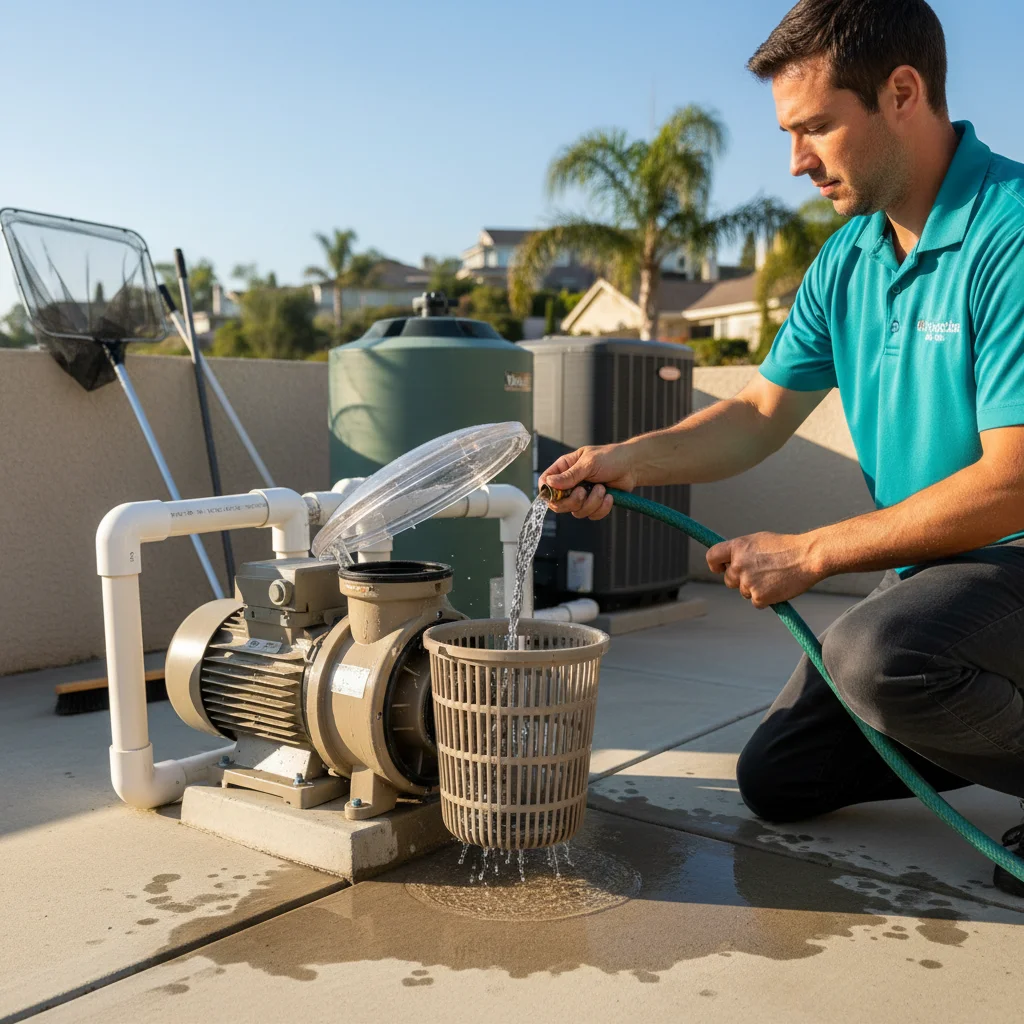
Step 3: Manually Fill the Pump With the power still off, remove the clear lid on your pump. Grab a garden hose and stick it directly into the pump’s strainer pot. Let the water run until the pot is completely full and overflowing. You’re manually creating the prime that the pump is failing to achieve on its own.
Step 4: Seal and Restart Quickly but carefully, put the pump lid back on. Make sure the o-ring is seated correctly in its groove. Tighten the lid until it’s hand-tight plus a quarter turn. Don’t use tools or you risk cracking the lid or collar. Now, walk back to the breaker and turn the pump’s power back on. It helps to open the air relief valve on top of your filter to let trapped air escape.
Step 5: Watch and Wait Look through the clear pump lid. You should see the water start to move and the pot should fill completely within about 30 to 60 seconds. You’ll see some bubbles at first, but then it should clear up into a solid rush of water. If it primes, you’re done. If it churns with foamy water for a minute and then the water level drops again, you have an air leak. Turn the pump off and proceed to the next section. Never let a pump run dry for more than a couple of minutes, it can destroy the motor’s shaft seal.
Air leaks: where to look and how to seal them
If the manual prime didn’t hold, it’s confirmed: your pump is sucking air from somewhere between the skimmer and the pump itself. Now the real detective work begins. Go through these common air leak locations one by one.
The Pump Lid O-Ring
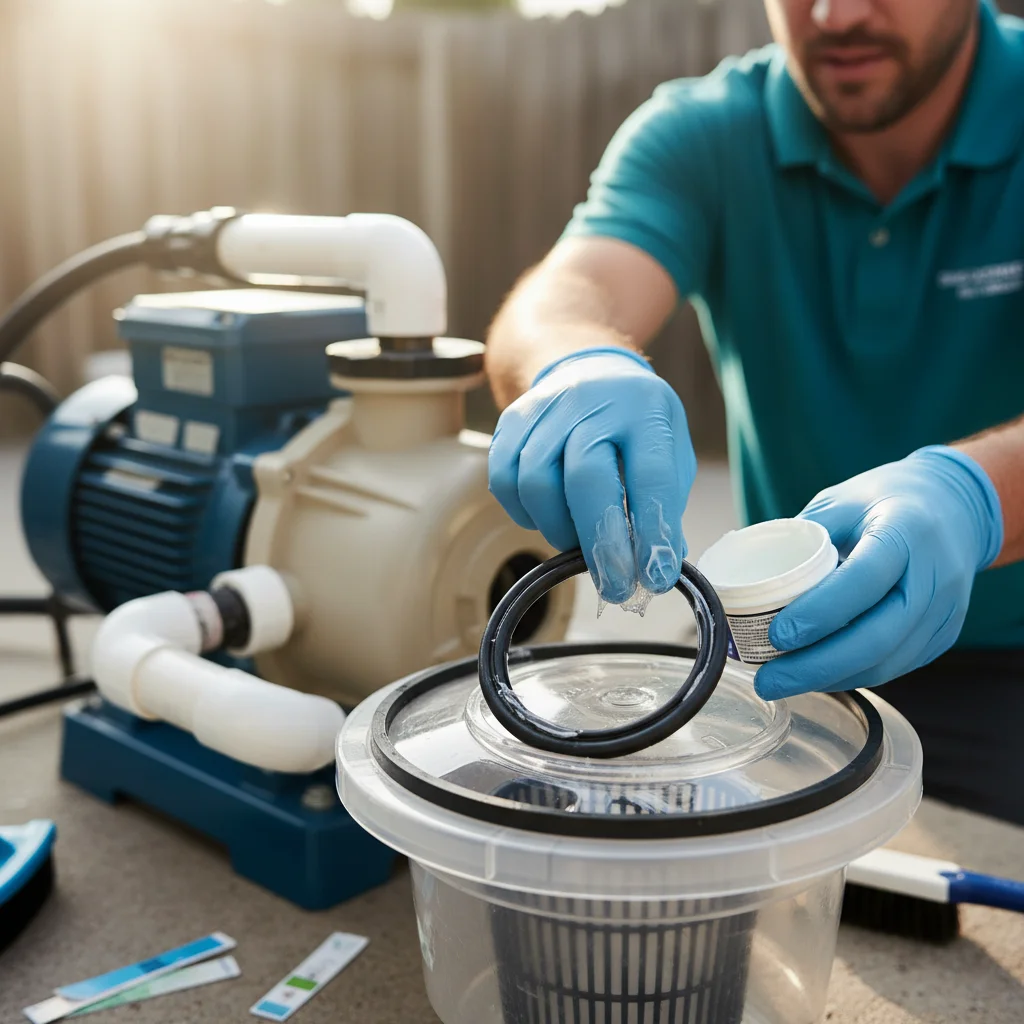
This is culprit number one. Turn the power off again. Remove the pump lid and take out the large o-ring. Inspect it closely. Is it flattened, cracked, or brittle? If so, it needs to be replaced. They’re inexpensive and a critical part of your pool pump repair guide. If it looks okay, wipe it and the groove it sits in with a clean cloth. Apply a thin layer of a silicone-based o-ring lubricant. Do not use Vaseline or petroleum-based products, as they will cause the rubber to swell and fail. Re-seat the o-ring and tighten the lid properly.
The Pump’s Drain Plugs
Most pumps have one or two drain plugs on the strainer housing used for winterizing. These plugs have small o-rings on them. Check to make sure the plugs are hand-tight. If you see any dripping, remove the plug, inspect the o-ring, and apply some lubricant before tightening it back up.
Suction-Side Plumbing Unions
Look at the pipe that goes into the front of the pump. Many modern installations use threaded unions for easy pump removal. These can sometimes vibrate loose. Try to tighten them by hand. If you can turn the large nut even a little, it was too loose and likely your leak source. Don’t overtighten with a wrench.
Valves Before the Pump
If you have valves (like Jandy or Pentair 3-way valves) that control flow from the skimmer and main drain, they can also be a source of air leaks. The o-rings on the valve lid and on the diverter stem inside can wear out. A tell-tale sign is bubbles appearing in the pump pot when you turn the valve handle. Rebuilding these valves is a common repair.
If you’ve checked all these spots and still can’t find the leak, you might have a cracked underground pipe. This is less common in San Diego’s climate but can happen, especially with older plumbing. At this point, it’s time to call a professional.
When a stuck check valve is the real culprit
There’s one more sneaky cause of a pool pump losing prime that can fool a lot of homeowners. It’s a stuck check valve.
A check valve is a one-way gate, usually installed after the pump and before the filter or heater. Its job is to stop water from flowing backward through the system when the pump turns off. This is especially important if your pool equipment is located uphill from the pool. Without a check valve, the entire weight of the water in the filter, heater, and elevated pipes would rush back and drain out of the pump pot, causing it to lose prime every single time it shuts down.
The symptom of a faulty check valve is very specific: the pump primes perfectly well when you start it manually, runs great, but the next time the system is scheduled to turn on, it fails to prime.
What happens is that a small piece of debris, a pebble, a bit of plaster, a chunk of a disintegrating skimmer basket, gets lodged in the check valve’s flapper, holding it slightly open. This allows water to slowly drain back to the pool, emptying the pump.
Fixing this usually involves opening the check valve housing (if it has a serviceable lid) and clearing the obstruction. On older systems without modern unions, it might even require cutting the PVC pipe, which is a job best left for a professional. If your priming problems are intermittent like this, a stuck check valve is a very likely suspect.
When to call us
You’ve checked the water level, cleaned the baskets, lubricated the o-ring, and tightened all the fittings. You’ve tried to prime the pump twice, and it still won’t catch. Now is the time to stop. Continuing to run the pump while it’s dry can cause the motor to overheat and melt the shaft seal, turning a simple air leak into a major repair that requires a full motor disassembly.
If you’re feeling frustrated or you’ve spent more than an hour on it without success, it’s a good sign to get a professional involved. Pool technicians have specialized tools, like pressure testing rigs, that can pinpoint a hidden air leak in minutes. We can also correctly diagnose and repair more complex issues like a bad valve or a failing underground pipe.
Don’t let a stubborn pump ruin your weekend swim. The health of your entire pool depends on good circulation. For fast, expert help with any pool equipment issues in San Diego County, we’re here to help.
Call us at (858) 400-6757 and we’ll connect you with a vetted local pool pro.
Frequently asked questions
How long should it take for a pool pump to prime?
A healthy pump should prime within 30 seconds to a minute. If it takes longer than 2-3 minutes, shut it off to prevent overheating and start troubleshooting for an air leak or clog.
Can a pool pump lose prime if the water level is too low?
Absolutely. If the water level in your pool drops below the skimmer opening, the pump will suck in air instead of water, causing it to lose prime. This is one of the most common causes.
Why is my pump basket not filling with water?
If the pump basket isn't filling, it's a classic sign of a priming issue. The pump isn't pulling enough water to fill the housing, usually due to an air leak on the suction side, a clog, or a low water level.
Is it bad to run a pool pump without water?
Yes, it's very damaging. Running a pump dry causes the motor to overheat and can melt the shaft seal, leading to a serious leak and expensive repairs. Always shut it off if it fails to prime.
Need this done in San Diego County?
For repair and renovation work like this, we hand you to our trusted partner, Del Rancho Pools.