Before you read on: this sits outside what Splash Pro Pools does. We hand it to a vetted local pool repair pro, reachable on (858) 400-6757.
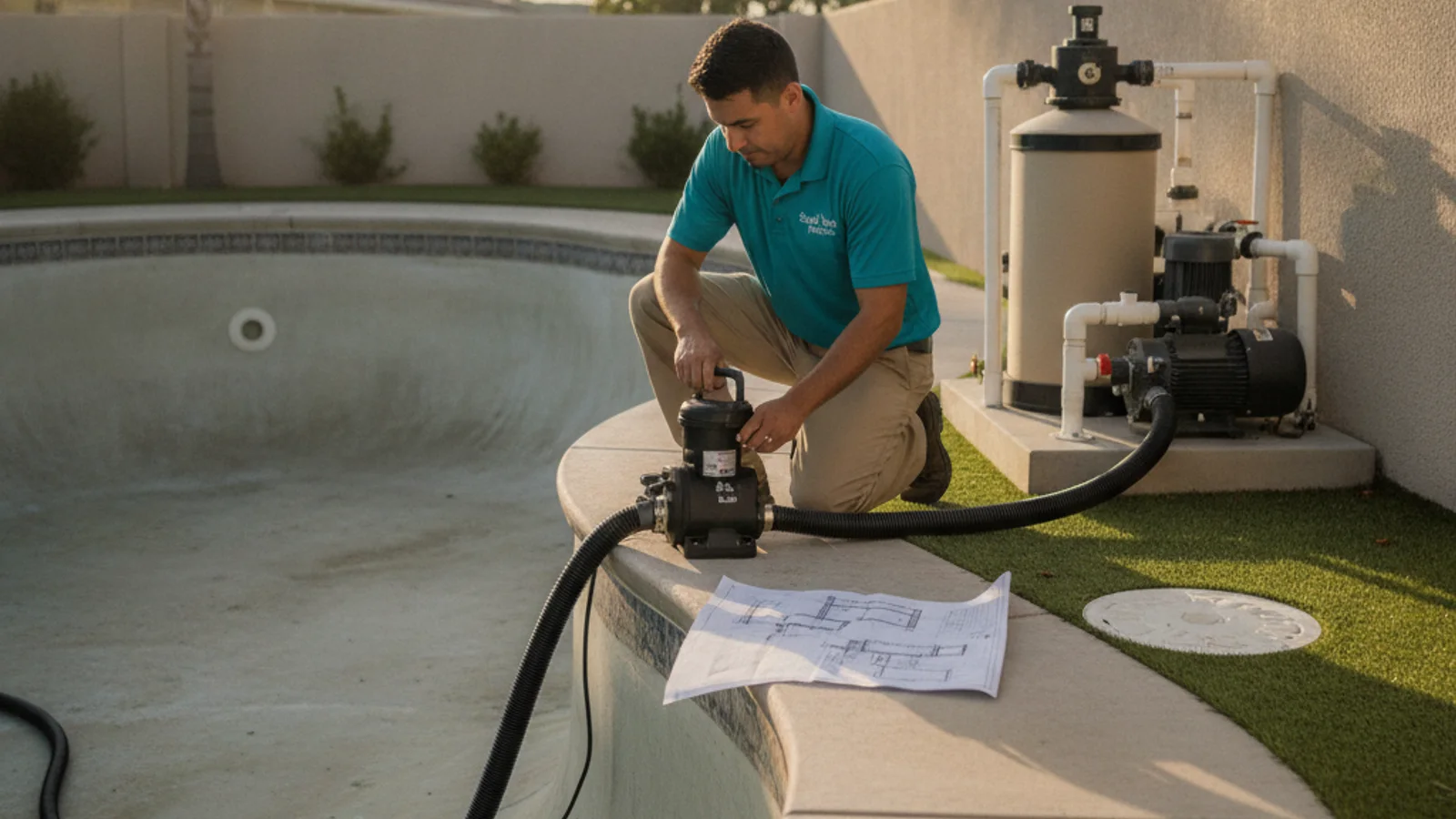
To drain a pool, you run a submersible pump into the deep end and discharge the water to a sewer cleanout, per local code, not the storm drain. The bigger issue is what happens after: an empty pool shell can float or crack from groundwater pressure pushing up from below, so most San Diego pools should only be fully drained by a pro, or partially drained instead.
This guide covers when a drain actually helps, when it can wreck your shell, the sewer rules that apply here, and the difference between a partial and a full drain.
Can you drain a pool yourself?
Yes, but it’s riskier than it looks. Renting a submersible pump and running a hose to a cleanout is mechanically simple. The danger isn’t the pumping, it’s what an empty shell does once the water and its weight are gone. If your pool sits within a couple miles of the coast, in an area like La Jolla, Del Mar, Coronado, Mission Beach, or Imperial Beach, the groundwater table can be high enough that an empty pool floats or cracks within days. A local pro checks the water table and the shell’s relief valve before draining a single gallon. If you’re inland in El Cajon, Poway, or Escondido, the risk is lower but not zero, especially right after a rainy stretch.
Why do empty pools pop out of the ground?
Groundwater around and under the shell pushes up all the time. Pool water sitting inside the shell weighs it down and balances that pressure. Drain the pool and you remove the counterweight, so the upward pressure has nothing to push against. In a bad case, the whole shell lifts out of the ground, cracks the plaster, or shears the plumbing. Pools built with a hydrostatic relief valve in the main drain avoid this because groundwater can escape through the valve instead of building up underneath. Older pools without one sometimes need a temporary hole drilled at the main drain to relieve that pressure before a full drain starts.
When should you drain a pool in San Diego?
A full drain makes sense for resurfacing or a replaster, for an acid wash to strip stained plaster, or when water chemistry is too far gone for chemicals to fix, most often cyanuric acid that’s climbed too high. What a full drain is not for here is winterizing. That’s a cold-climate habit. San Diego pools run year-round, so there’s no seasonal reason to empty one just because summer’s over.
When should you NOT drain your pool?
Skip a full drain if the water table is high and it’s rained in the last week or two, if there’s no hydrostatic relief valve and nobody’s checked for one, or if a partial drain would solve the actual problem. High cyanuric acid or high total dissolved solids usually only need a partial drain and refill, not emptying the whole shell. Full drains without a plan for groundwater are how a routine cleanup turns into a cracked pool and a much bigger bill.
How to drain a pool step by step
- Turn off the pump, filter, heater, and any automation before you start.
- Confirm there’s a hydrostatic relief valve, or have one checked, especially near the coast or after rain.
- Set a submersible pump in the deep end and run the discharge hose to a sanitary sewer cleanout.
- Never route the discharge to a storm drain, gutter, or street.
- Monitor water level continuously. Don’t leave the pool unattended while it drains.
- As soon as the shell is empty for its purpose, whether that’s an acid wash, resurfacing, or a repair, refill it. Don’t leave a pool empty longer than the work requires.
- Refill with delivered water or a hose, then rebalance chemistry before use.
Where does the drained water go? San Diego rules
Pool water in San Diego goes to the sanitary sewer, not the storm drain. That’s because chlorinated or salt pool water can harm the watershed and, ultimately, the ocean if it reaches storm drains, which don’t get treated the way sewer water does. In practice that means running the discharge hose to a sewer cleanout on the property, not into the street or a gutter. Dechlorinating the water first is good practice before it goes down the line. Rules and permitting can vary by jurisdiction and water district, so check with your city or local water district before a full drain, particularly for a large pool that will send thousands of gallons down at once.
Partial drain vs full drain: which do you need?
| Partial drain | Full drain | |
|---|---|---|
| Typical use | High cyanuric acid, high TDS, general water refresh | Resurfacing, acid wash, structural repair |
| Water removed | A few thousand gallons | 15,000 to 25,000+ gallons |
| Hydrostatic risk | Minimal, shell stays mostly full | Real, especially near the coast |
| Time empty | Hours | Days, until work is finished |
| Best approach | Homeowner or pro | Pro, with relief valve checked first |
If you’re not sure which one you need, a local pro can test your water and tell you in a few minutes whether a partial drain fixes it.
Get it drained the right way
Draining a pool without checking groundwater risk is how a simple chemistry fix turns into a cracked shell and a resurfacing bill nobody wanted. The pool pros in the Splash Pro Pools network cover San Diego County and know which neighborhoods carry real hydrostatic risk before they ever start a pump. If your equipment needs a look before a drain, our equipment page covers what a pro checks first. Call (858) 400-6757 to get matched with a local pro who’ll tell you straight whether your pool needs a partial drain, a full drain, or no drain at all.
Frequently asked questions
Can I drain my own pool in San Diego?
You can rent a submersible pump and do it yourself, but a full drain carries real risk. San Diego’s coastal water table can push an empty pool shell up out of the ground, cracking it. Most homeowners are better off calling a local pro, especially within a few miles of the coast or after rain.
Why do empty pools pop out of the ground?
Groundwater under and around the shell creates hydrostatic pressure. With water inside the pool, that pressure is balanced. Drain the pool and remove the counterweight, and the pressure can lift, crack, or float the shell, especially in high water table areas near the coast.
Where does the water go when you drain a pool in San Diego?
It goes to the sanitary sewer, not the storm drain. Local code requires pool water to discharge into a sewer cleanout so chlorine and salt never reach the storm system, which flows straight to the ocean. Check with your city or water district before you start.
Should I drain my pool for the winter in San Diego?
No. Winterizing is a cold-climate practice for pools that would otherwise freeze. San Diego pools run year-round, so a full drain is only needed for resurfacing, an acid wash, or water chemistry that a partial drain can’t fix, like very high cyanuric acid.
How much water does a full pool drain waste?
A typical residential pool holds 15,000 to 25,000 gallons or more, and a full drain sends all of it down the sewer. If your only issue is high cyanuric acid or total dissolved solids, a partial drain of a few thousand gallons often solves it for far less waste.
What is a hydrostatic relief valve and do I need one?
It’s a valve in the main drain that lets groundwater pressure escape instead of pushing up on an empty shell. Pools without one, especially older builds near the coast, may need a temporary relief hole drilled before a full drain. A local pro can check this before you start.
Frequently asked questions
Can I drain my own pool in San Diego?
You can rent a submersible pump and do it yourself, but a full drain carries real risk. San Diego's coastal water table can push an empty pool shell up out of the ground, cracking it. Most homeowners are better off calling a local pro, especially within a few miles of the coast or after rain.
Why do empty pools pop out of the ground?
Groundwater under and around the shell creates hydrostatic pressure. With water inside the pool, that pressure is balanced. Drain the pool and remove the counterweight, and the pressure can lift, crack, or float the shell, especially in high water table areas near the coast.
Where does the water go when you drain a pool in San Diego?
It goes to the sanitary sewer, not the storm drain. Local code requires pool water to discharge into a sewer cleanout so chlorine and salt never reach the storm system, which flows straight to the ocean. Check with your city or water district before you start.
Should I drain my pool for the winter in San Diego?
No. Winterizing is a cold-climate practice for pools that would otherwise freeze. San Diego pools run year-round, so a full drain is only needed for resurfacing, an acid wash, or water chemistry that a partial drain can't fix, like very high cyanuric acid.
How much water does a full pool drain waste?
A typical residential pool holds 15,000 to 25,000 gallons or more, and a full drain sends all of it down the sewer. If your only issue is high cyanuric acid or total dissolved solids, a partial drain of a few thousand gallons often solves it for far less waste.
What is a hydrostatic relief valve and do I need one?
It's a valve in the main drain that lets groundwater pressure escape instead of pushing up on an empty shell. Pools without one, especially older builds near the coast, may need a temporary relief hole drilled before a full drain. A local pro can check this before you start.
Need this done in San Diego County?
For repair and renovation work like this, we hand you to our trusted partner, Del Rancho Pools.