Keep CYA at 30 to 50 ppm on a chlorine pool, or 60 to 80 on salt. Above 90 ppm, chlorine stops working and a partial drain is the only real fix. No reducer chemical reliably replaces that drain. Call (858) 400-6757.
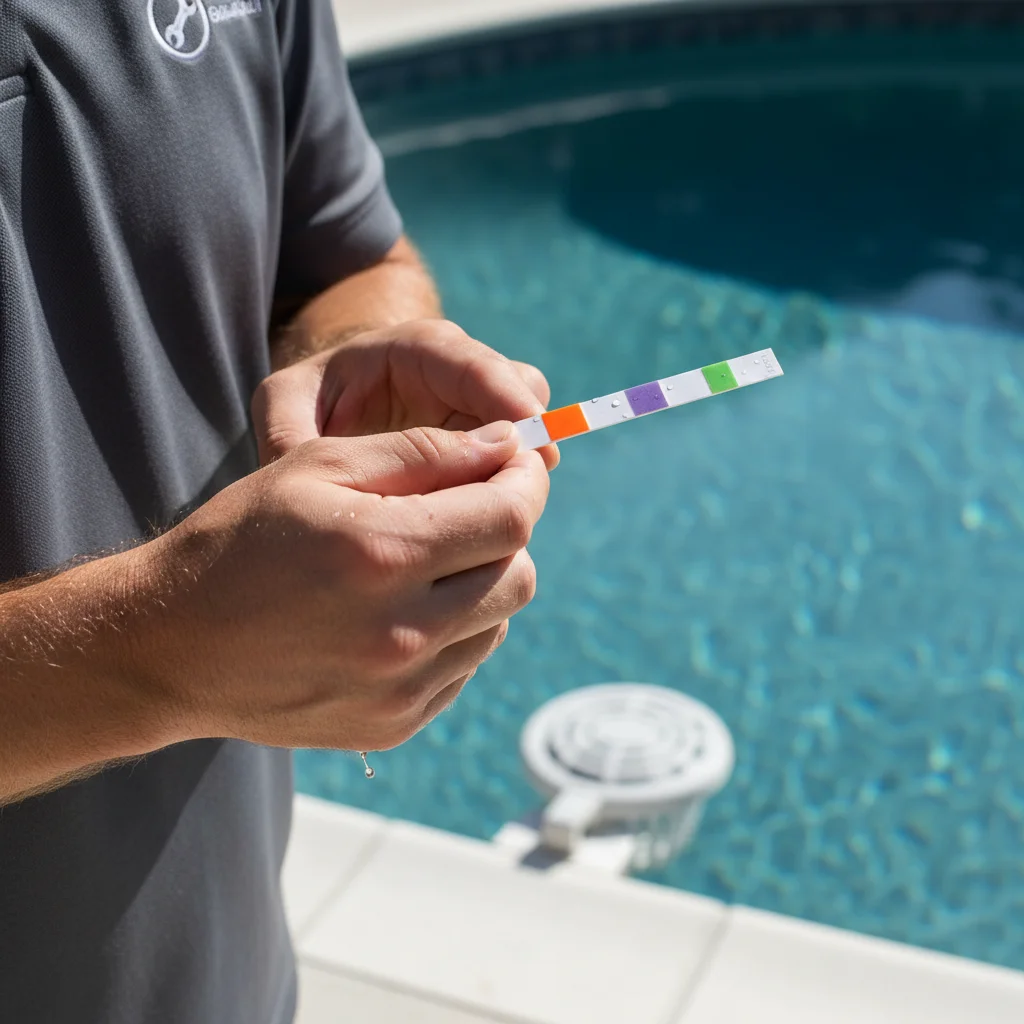
What cyanuric acid does and why San Diego pools run high
Cyanuric acid (CYA) is a pool stabilizer. Its job is to shield chlorine from UV degradation. Without it, the San Diego sun can burn off a full dose of free chlorine in two to four hours. With it, chlorine lasts all day. That’s the upside.
The downside: CYA never leaves the water on its own. It doesn’t get consumed by sunlight, it doesn’t evaporate, it doesn’t get filtered out. It just stays, and concentrates.
San Diego makes this worse for two reasons. First, our climate is hot and dry. Pool water evaporates fast, easily an inch or more per week during summer. When water evaporates, everything dissolved in it stays behind. CYA included. You top off with fresh water, but the CYA concentration keeps climbing.
Second, most San Diego pool owners use trichlor pucks. They’re convenient, they’re cheap, and they’re everywhere at hardware stores. The problem is that trichlor contains about 57% CYA by weight. Every puck you drop in adds more stabilizer on top of more stabilizer. Over a single season, a pool using trichlor exclusively can go from 0 ppm to well over 100 ppm without a single intentional dose of stabilizer.
The sweet spot for CYA is 30-50 ppm in a traditionally chlorinated pool. Salt pools run a bit higher, 60-80 ppm. Once you clear 90 ppm, the chlorine in your water becomes increasingly bound and ineffective. At 150 ppm, you could have 5 ppm of free chlorine and it’s doing almost nothing useful.
How to test CYA correctly (and what “locked chlorine” means)
Test strips can give you a rough read on CYA, but they’re not precise enough to make a drain decision. For that, you want a proper turbidity test, either a good liquid test kit with a CYA comparator tube (Taylor K-2006 is the standard) or a drop-off at a pool supply store for a full water analysis.
Using the turbidity tube
Fill the comparator tube to the top, add reagent, and mix. Then slowly pour the diluted sample out while looking straight down into the tube at the black dot on the bottom. Stop when the dot disappears. Read the number on the tube at the water line. If the dot vanishes before you hit the 30 ppm mark, your CYA is very high, the tube runs out of scale around 100 ppm, so anything above that shows as “gone immediately.”
One important note: always test CYA in the shade. Direct sunlight makes the water appear cloudier than it is and can throw your reading off.
What “locked chlorine” actually means
Chemistry people call it the chlorine-to-CYA ratio, or the CYA-adjusted chlorine demand. The short version: CYA molecules bond weakly to chlorine molecules and hold them in a less reactive state. Most of your “free chlorine” reading on a test strip is actually bound chlorine that’s slow to sanitize.
At 30 ppm CYA, roughly 1 in 300 chlorine molecules is fully active at any moment. At 100 ppm CYA, that fraction drops dramatically, you’d need to run free chlorine above 10 ppm just to get the same sanitizing power you’d have at 3 ppm with proper CYA levels.
This is why pools with very high CYA can develop green water and algae blooms even when the test strip shows chlorine is present. The chlorine is there, it’s just locked up and mostly useless.
The only real fix: partial drain and refill
There’s a rumor that you can add a product to chemically neutralize CYA. Some companies sell “CYA removers” or “stabilizer reducers.” The honest answer: none of them work reliably at scale. University and industry research hasn’t validated them for full pool use, and the testimonials online are all over the place.
The fix that actually works is dilution. You drain out a portion of your high-CYA water and replace it with fresh water, which has zero CYA. The more you drain, the more your CYA drops.
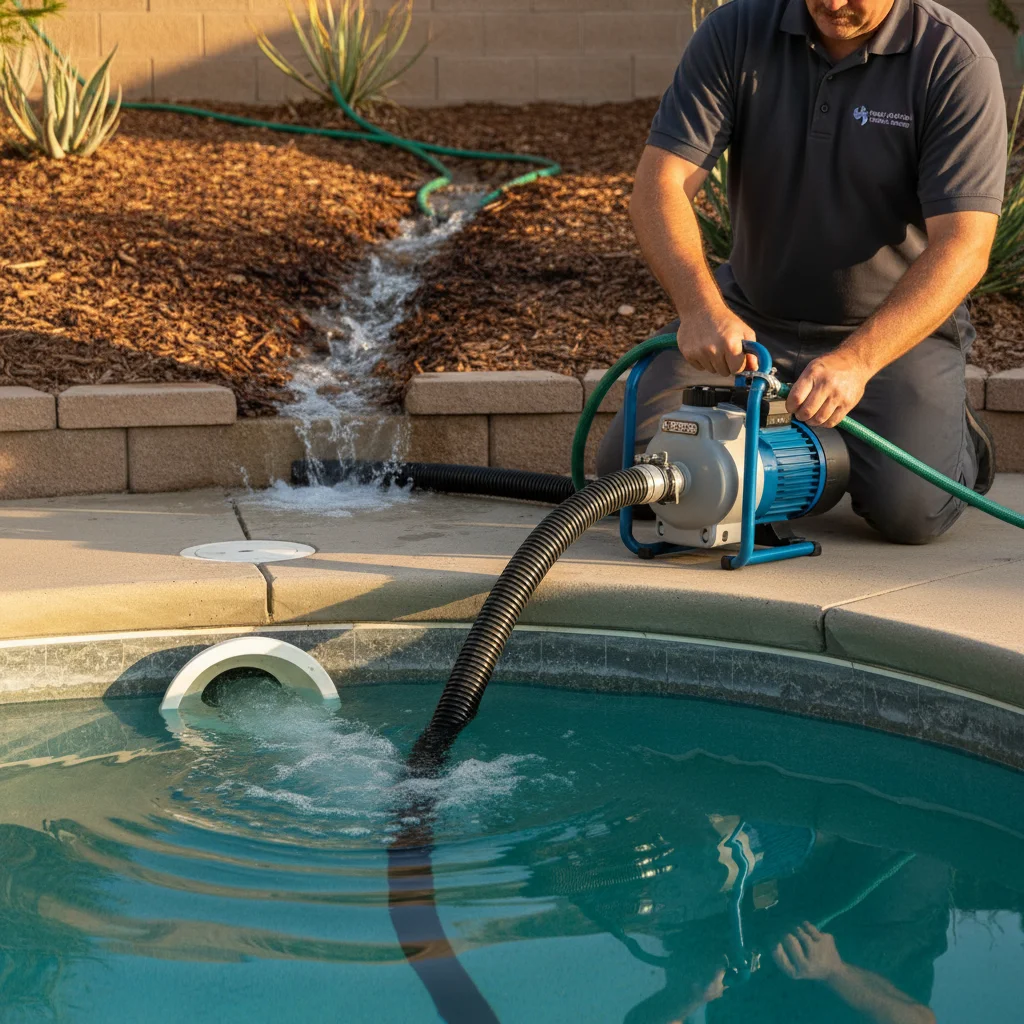
This isn’t glamorous work, but it’s straightforward. You need a submersible pump (rental is fine, or a pool tech brings one), a discharge hose, and a plan for where the water goes. In San Diego, you can discharge pool water to your side yard, a permeable area, or the sanitary sewer, but not directly to the storm drain. Check San Diego County’s stormwater guidelines before you discharge anywhere unfamiliar.
One practical tip: lower your water before you drain so you have room to add fresh water right away. You don’t want the pool sitting at a low level for long, especially if you have a vinyl liner (rare here but not unheard of) or a fiberglass shell.
How much to drain based on your CYA level
The math here is simple dilution. If you want to go from 150 ppm to 50 ppm, you need to replace two-thirds of your water. For a 20,000-gallon pool, that’s about 13,300 gallons out and 13,300 gallons back in.
Here’s a quick reference for common situations:
Starting at 100 ppm, target 50 ppm: You need to replace 50% of your water. A 20,000-gallon pool means 10,000 gallons out and in.
Starting at 150 ppm, target 50 ppm: Replace 67% of your water. That’s 13,400 gallons on a 20,000-gallon pool.
Starting at 200 ppm, target 50 ppm: Replace 75% of your water, 15,000 gallons on a 20,000-gallon pool. At this level, a full drain and refill might actually be more practical and give you a clean slate for plaster inspection and chemical balance.
San Diego tap water from the San Diego County Water Authority runs roughly 300-400 ppm total dissolved solids and near-zero CYA, so refill water won’t move your CYA reading.
After the refill, retest CYA before adding any stabilizer. Also rebalance your pH, alkalinity, and calcium hardness, diluting your water resets everything, not just CYA.
Habits that keep CYA from creeping back up
Once you’ve done the work of a partial drain, the last thing you want is to be back at 150 ppm by next spring. A few habit changes make a big difference.
Switch to unstabilized chlorine for maintenance. Liquid chlorine (sodium hypochlorite) and cal-hypo granules add no CYA to your water. You can still use trichlor pucks occasionally, but if every chlorine dose comes from pucks, CYA will climb regardless. Consider pucks a supplement, not a primary sanitizer.
Shock with liquid chlorine. A lot of San Diego pool owners reach for dichlor shock, it’s easy and dissolves fast. But dichlor also carries about 56% CYA by weight. One heavy shock with dichlor can add 10-15 ppm of CYA on its own. Use a cal-hypo shock or liquid chlorine instead. Our guide on how to shock a pool walks through the right products for each situation.
Test CYA every 4-6 weeks during swim season. Most people test pH and chlorine weekly but forget CYA for months. By the time they test it, it’s already at 120 ppm and climbing. Catching it at 70 ppm means a small correction (or just switching chlorine products), not a drain.
Account for evaporation top-offs. Every time you add water to compensate for evaporation, you’re not adding CYA, that’s good. But you are diluting your calcium, alkalinity, and pH buffers. San Diego water is moderately hard, so topping off regularly can actually help keep TDS in check. This is one place where our dry climate works in your favor, as long as you’re not adding CYA-containing chemicals to replace what evaporated.
Consider a weekly pool cleaning service. One of the most common reasons CYA spirals out of control is that pool owners top off chlorine with whatever’s available and don’t track cumulative chemical load over a season. Regular professional service includes chemistry tracking, not just a reading today, but a pattern over time that catches CYA creep before it becomes a drain event.
When to call us
If your CYA is above 150 ppm, or if you’ve already tried adjusting and the water still won’t clear, it’s worth getting a professional involved. A partial drain on a large pool involves significant water volume, proper discharge handling, and full rebalancing afterward, small mistakes get expensive fast. We serve pools throughout San Diego County and can handle the drain, refill, and complete chemical reset in a single visit.
Call us at (858) 400-6757 and we’ll connect you with a vetted local pool pro.
Frequently asked questions
What is the ideal cyanuric acid level for a pool?
The ideal range is 30-50 ppm for chlorine-sanitized pools. If you use a saltwater chlorine generator, aim for 60-80 ppm. Above 90 ppm, chlorine efficiency drops significantly and a partial drain is the only fix.
Can I add a chemical to lower cyanuric acid without draining?
No product on the market reliably removes CYA from pool water without draining. Products marketed as 'CYA reducers' have inconsistent results. A partial drain and refill with fresh water is the only proven method.
How long does a partial pool drain and refill take?
A typical residential pool in San Diego (15,000-20,000 gallons) takes 4-8 hours to partially drain with a submersible pump, depending on pump size and how much water you're removing. Refill time depends on your water pressure.
Why do San Diego pools get high CYA so fast?
San Diego's hot, dry climate causes significant evaporation year-round, often 1-2 inches per week in summer. When water evaporates, CYA stays behind and concentrates. Using trichlor pucks adds more CYA with every dose of chlorine, compounding the problem fast.
Will high CYA turn my pool green?
High CYA doesn't directly cause algae, but it locks up your chlorine so it can't sanitize effectively. That chlorine lock is what leads to algae blooms and a green pool. Solving the CYA problem is often step one in fixing a green pool.
Need professional help in San Diego County?
Splash Pro Pools connects San Diego homeowners with pool pros for the work in this post.