A note on scope: this is equipment installation and upgrades work, which sits outside what Splash Pro Pools does. Call (858) 400-6757 and we’ll match you with a vetted local pro who covers it.
A salt cell that’s stopped making chlorine almost always comes down to one of four things: the salt level is too low, the water is too cold, the plates are coated in calcium scale, or the cell is simply worn out. Test your salt level first. It takes under a minute and rules out the most common cause immediately.
This guide covers checking salt and temperature, cleaning a scaled cell, reading your control panel’s warning lights, and knowing when a cleaning won’t save the cell.
Why isn’t my salt cell making chlorine?
Before you open anything up, here’s what we see most often, roughly in order:
- Low salt level. Salt is the raw material the cell converts into chlorine. Run below about 2,500 ppm and output drops or stops, no matter how healthy the cell is.
- Cold water. Most cells cut off chlorine production below roughly 60°F by design, not by failure. This is the one cause that isn’t actually a problem.
- Calcium scale on the plates. San Diego’s hard tap water leaves mineral deposits on the titanium plates inside the cell. Scale insulates the plates electrically, and output falls as it builds up.
- A worn-out cell. Every salt cell has a finite plate life. Once it’s exhausted, cleaning won’t bring output back.
- Low or no water flow. A clogged filter, closed valve, or air-bound pump can starve the cell of flow, and most systems won’t generate chlorine (or will flash a flow error) without it.
If your pump itself isn’t running on schedule, that’s a different problem upstream of the salt system: see our guide to a pool timer not working.
How do I check my salt level first?
Salt level is the fastest thing to rule out and the most common fix.
- Test with a strip or digital meter. A salt test strip from any pool store gives a rough reading in seconds; a digital salt meter is more precise if you have one.
- Compare to your system’s target range. Most residential chlorinators want 2,700 to 3,500 ppm. Check your control panel or owner’s manual for the exact number, since it varies slightly by brand.
- Add pool-grade salt if you’re low. Pour it in slowly around the perimeter, run the pump to circulate, and retest after a few hours. Salt takes time to fully dissolve.
If your salt level was already in range, move on to temperature and the cell itself.
Why does my salt cell stop working in cold water?
This one catches a lot of San Diego homeowners off guard because it looks like a failure but isn’t. Most chlorinators are programmed to stop generating chlorine once water drops below roughly 60°F. Cold water slows the electrolysis reaction that produces chlorine, and manufacturers build in a cutoff rather than let the cell strain to work at a fraction of its rated output.
San Diego pools rarely sit that cold for long, but an unheated pool on a cool winter morning can trip it temporarily. If your control panel shows a “cold water” or similar low-temperature indicator and the water genuinely is cold, the system is doing exactly what it’s supposed to. It’ll resume once the water warms back up, and running your pool heater or waiting out the cold snap are the only real fixes here, not a repair.
How do I know if my salt cell is scaled or dirty?
Pull the cell and look at the plates. A light dusting of white or gray film is normal and usually rinses off with a garden hose. Heavier buildup, thick, flaky, crusty white deposits coating the plates, is calcium scale, and it’s the single biggest reason salt cells underperform here. Our hard San Diego tap water carries more dissolved calcium than most regions, and that calcium plates out onto the cell’s electrodes over time the same way it scales a showerhead.
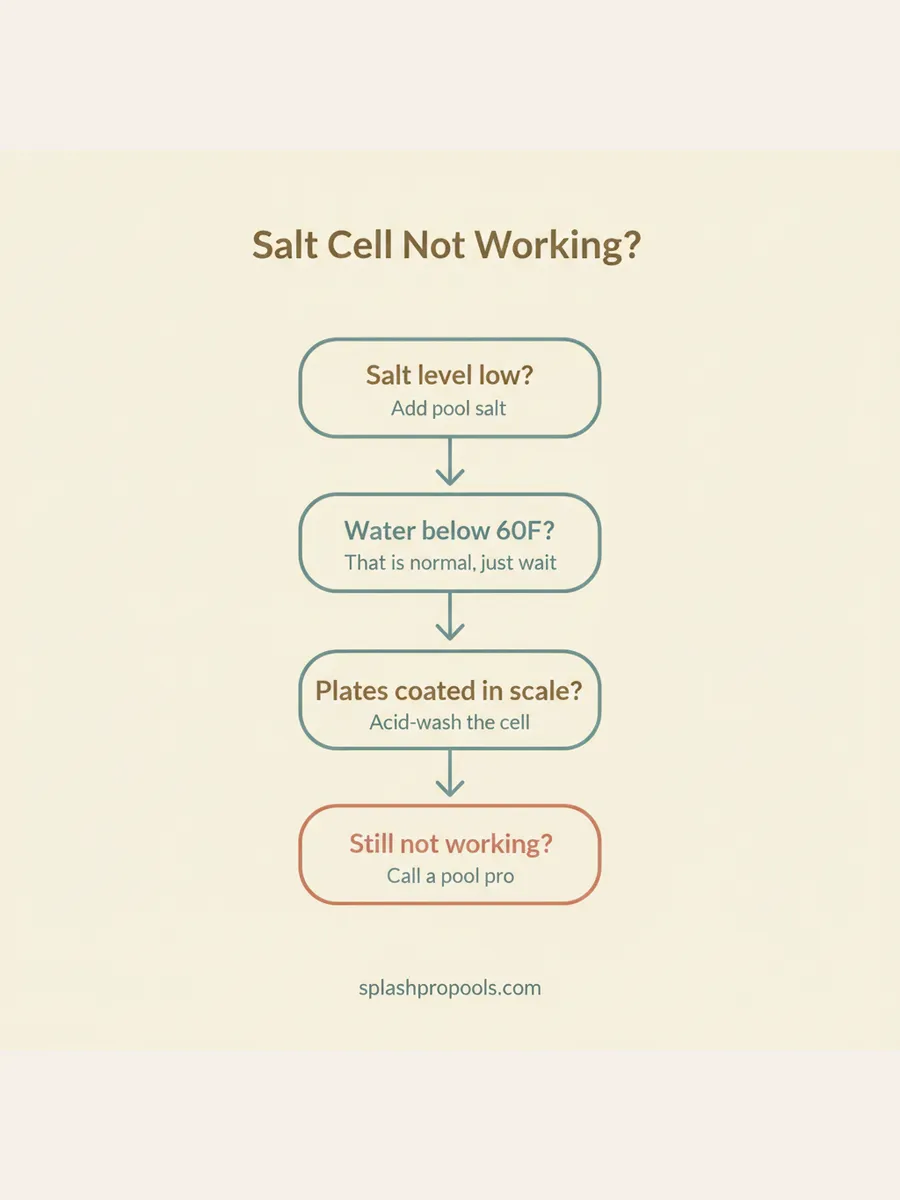
Scale acts as insulation. It blocks the electrical current the plates need to split salt into chlorine, so output drops even though the cell itself is otherwise healthy. If you’ve never cleaned your cell, or it’s been more than 2 to 3 months, start there before assuming the cell is dead.
How do I clean a salt cell myself?
- Cut power at the breaker. Always kill power before removing anything from the equipment pad.
- Remove the cell from its housing. Most cells twist-lock or unclamp from the flow chamber. Note the orientation before you pull it.
- Rinse first. Light scale often comes off with a firm hose spray directed between the plates.
- Acid-wash heavier scale. Mix one part muriatic acid to four parts water in a plastic bucket (acid into water, never the reverse), submerge the cell 5 to 15 minutes until the bubbling stops, then rinse thoroughly with clean water.
- Inspect the plates before reinstalling. They should look clean and intact, not pitted, flaking, or visibly worn thin.
- Reinstall and restore power. Watch the control panel for a normal chlorine output reading over the next cycle.
Wear gloves and eye protection any time you’re working with muriatic acid, and do this outdoors with good ventilation.
What do the warning lights on my salt system mean?
Every brand labels these a little differently, but the categories are consistent across most residential systems:
| Indicator | What it usually means | What to do |
|---|---|---|
| Low salt / add salt | Salt level below target range | Test and add salt |
| High salt | Salt level above target range | Dilute with fresh water |
| Check cell / inspect cell | Reduced output, often scale-related | Pull and inspect the plates |
| Low flow / no flow | Pump not delivering water through the cell | Check pump, filter, and valves |
| Cold water / low temp | Water below the cell’s operating threshold | Normal behavior, not a fault |
If you’re seeing an error your panel doesn’t explain in plain terms, your owner’s manual (or the brand’s support site) has the exact code list for your model.
When does a salt cell need replacement instead of cleaning?
Most residential salt cells are rated for 7 to 10 years, but San Diego’s hard water routinely cuts real-world life to 3 to 5 years without regular cleaning. A cell is worth replacing rather than cleaning again when:
- A full acid cleaning doesn’t restore normal chlorine output
- The plates look pitted, flaking, or visibly thinning rather than just scaled
- The cell is past its rated lifespan and cleanings are getting more frequent
- The control panel shows a persistent cell fault that clears and returns within days
| Fix | Typical cost | Notes |
|---|---|---|
| Add salt / retest | $10-$20 | Bag of pool-grade salt, no labor needed |
| DIY acid cleaning | $0-$15 | Just the cost of muriatic acid if you do it yourself |
| Professional cell cleaning | $75-$150 | Includes inspection and a proper acid bath |
| Cell replacement | $400-$800 installed | Parts vary by brand and output capacity |
For the full picture on why our water is hard on salt systems and what a conversion runs, see our salt water pool conversion guide.
When should I call a professional?
Testing salt, rinsing a lightly scaled cell, and reading your control panel’s warning lights are all reasonable to handle yourself. Call in a pro if the cell shows heavy scale you can’t fully clear with an acid bath, if output stays low after a proper cleaning, if you’re not comfortable handling muriatic acid, or if you suspect a flow or wiring issue rather than the cell itself.
Get help with a salt system problem in San Diego
A salt cell that won’t chlorinate usually traces back to salt level, temperature, scale, or age, and most of that you can check yourself in a few minutes. If you’ve ruled those out and the water still isn’t holding chlorine, that’s exactly the kind of pool equipment work the pool pros in the Splash Pro Pools network handle across San Diego County, alongside routine salt water pool maintenance to keep the next cell lasting longer. Call (858) 400-6757 and we’ll connect you with a vetted local pool pro.
Frequently asked questions
Why is my salt water pool not producing chlorine?
The four most common causes, in order of how often we see them: salt level too low, water temperature below the cell’s cutoff (most cells stop below about 60°F), calcium scale coating the plates, or a cell that’s simply worn out near the end of its 7 to 10 year life. Test your salt level first since it’s the fastest thing to rule out.
What salt level does my pool need for the cell to work?
Most residential salt chlorinators need 2,700 to 3,500 ppm of dissolved salt to generate chlorine efficiently. Below about 2,500 ppm, output drops off or stops entirely and many systems display a low salt warning. A test strip or digital salt meter tells you exactly where you stand in under a minute.
Why does my salt cell stop working in cold weather?
This is normal, not a malfunction. Most salt chlorinators automatically shut off chlorine production once water drops below roughly 60°F because cold water slows the electrolysis reaction and the manufacturer builds in a cutoff to protect the cell. San Diego pools rarely stay that cold for long, but a chilly winter morning can trigger it temporarily.
How do I clean calcium scale off a salt cell myself?
Shut off power at the breaker, remove the cell from its housing, and inspect the plates. Light white buildup usually rinses off with a garden hose. Heavier scale needs a diluted acid bath, one part muriatic acid to four parts water in a plastic bucket, cell submerged 5 to 15 minutes until the bubbling stops, then a thorough rinse. Wear gloves and eye protection, and never mix acid into water backwards.
How long does a salt cell last, and when should I replace instead of clean it?
Most salt cells are rated for 7 to 10 years, but San Diego’s hard water accelerates scaling and often cuts real-world life to 3 to 5 years without regular cleaning. If a full acid cleaning doesn’t restore chlorine output, or the plates look worn, pitted, or flaking rather than just scaled, the cell needs replacement rather than another cleaning.
Frequently asked questions
Why is my salt water pool not producing chlorine?
The four most common causes, in order of how often we see them: salt level too low, water temperature below the cell's cutoff (most cells stop below about 60°F), calcium scale coating the plates, or a cell that's simply worn out near the end of its 7 to 10 year life. Test your salt level first since it's the fastest thing to rule out.
What salt level does my pool need for the cell to work?
Most residential salt chlorinators need 2,700 to 3,500 ppm of dissolved salt to generate chlorine efficiently. Below about 2,500 ppm, output drops off or stops entirely and many systems display a low salt warning. A test strip or digital salt meter tells you exactly where you stand in under a minute.
Why does my salt cell stop working in cold weather?
This is normal, not a malfunction. Most salt chlorinators automatically shut off chlorine production once water drops below roughly 60°F because cold water slows the electrolysis reaction and the manufacturer builds in a cutoff to protect the cell. San Diego pools rarely stay that cold for long, but a chilly winter morning can trigger it temporarily.
How do I clean calcium scale off a salt cell myself?
Shut off power at the breaker, remove the cell from its housing, and inspect the plates. Light white buildup usually rinses off with a garden hose. Heavier scale needs a diluted acid bath, one part muriatic acid to four parts water in a plastic bucket, cell submerged 5 to 15 minutes until the bubbling stops, then a thorough rinse. Wear gloves and eye protection, and never mix acid into water backwards.
How long does a salt cell last, and when should I replace instead of clean it?
Most salt cells are rated for 7 to 10 years, but San Diego's hard water accelerates scaling and often cuts real-world life to 3 to 5 years without regular cleaning. If a full acid cleaning doesn't restore chlorine output, or the plates look worn, pitted, or flaking rather than just scaled, the cell needs replacement rather than another cleaning.
Need this done in San Diego County?
For repair and renovation work like this, we hand you to our trusted partner, Del Rancho Pools.