A white crust at the waterline can survive brushing and leave clean tile looking permanently hazy. If you’re asking “how much does bead blasting pool tile cost,” San Diego quotes rise with tile length, scale thickness, access, surface condition, media choice, and cleanup. A short, lightly scaled run should cost less than a long perimeter with raised walls and fragile grout.
What bead blasting takes off waterline tile
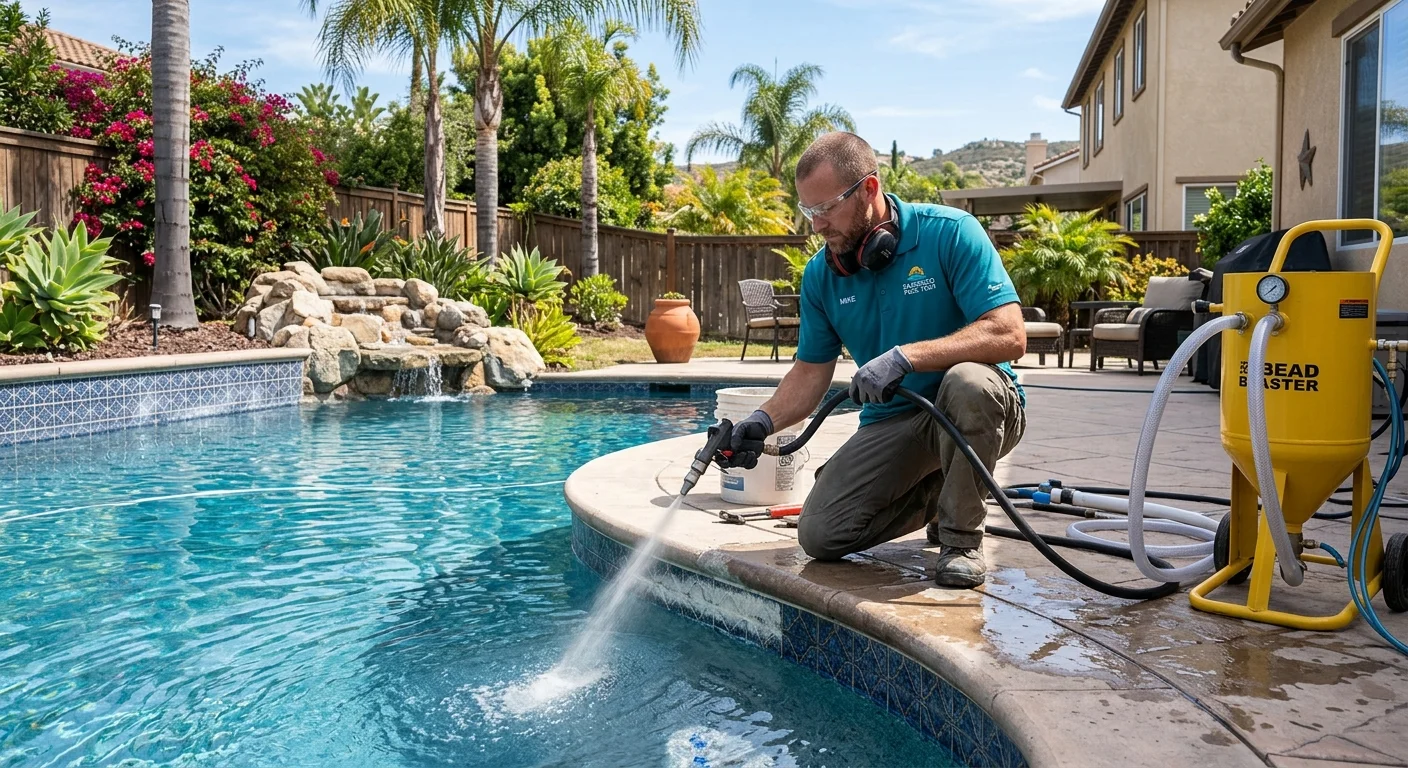
Bead blasting targets mineral scale bonded to the tile surface. A blasting machine sends small, rounded media against the deposit. Each controlled impact breaks the brittle crust while the operator moves along the waterline.
That makes bead blasting different from ordinary brushing. A brush works on loose residue and recent film. Blasting addresses deposits that have hardened into a rough band. The goal is to remove the buildup without changing the tile beneath it.
Waterline scale develops where pool water repeatedly wets the tile and evaporates. The water leaves dissolved material behind. Over time, that material can become a chalky haze, a gritty ridge, or a dense white crust. The exact appearance depends on the water and the tile’s history.
Bead blasting doesn’t repair damaged tile. It can’t replace missing glaze, fill cracked grout, or restore a pattern already worn away. A mark that remains after the deposit is removed may be damage within the surface rather than material sitting on top.
That’s why a pool professional starts with a small, inconspicuous test patch. Older glaze, glass accents, decorative patterns, and patched grout can react differently. The test reveals how the deposit releases and whether the surface becomes dull, scratched, or loose.
Our guide to pool tile calcium cleaning in San Diego explains how mineral deposits differ from other waterline stains. A pro offering pool tile and calcium cleaning can identify the deposit before choosing a treatment.
How tile length and scale change bead blasting cost
The quote follows the amount and difficulty of the work. Pool gallons don’t describe that workload very well. The measured waterline length gives a better starting point because every section must be accessed, treated, and cleaned.
Pool shape matters too. A freeform pool can carry more tile than a simple rectangle with a similar swimming area. An attached spa creates another waterline. Raised bond beams, spillways, steps, and tiled columns add surfaces that may require separate positioning and protection.
Scale thickness changes the pace. A light band may release with a controlled pass. Thick, layered crust can require slower movement and repeated attention. The operator may also adjust the media or machine settings after seeing how the deposit responds.
Access affects setup and cleanup. A wide deck provides more working room than a narrow strip behind landscaping. Tight gates, stairs, glass fencing, outdoor kitchens, and delicate deck finishes can require added protection. Tile beneath a spillway may also be harder to reach evenly.
Surface condition adds another variable. Loose grout, cracked tile, faded decoration, and prior repairs deserve slower work. A low price isn’t useful if the scope ignores those areas or assumes every tile can accept the same treatment.
Cleanup belongs in the quote. Spent media and scale fragments need containment and removal. The proposal should explain surface protection, debris collection, rinsing, and any filter-related cleanup included afterward.
For broader context, our San Diego pool tile cleaning cost guide covers the variables shared by several cleaning methods. Compare proposals based on the same measured tile band and the same cleanup scope.
Comparing bead blasting, hand cleaning, and acid methods
No method wins every pool tile job. The right choice depends on the deposit, tile finish, grout condition, access, and size of the affected area.
| Method | Best fit | How it removes buildup | What shapes the quote | Main caution |
|---|---|---|---|---|
| Bead blasting | Continuous mineral crust on tile that passes a test patch | Controlled media impact fractures deposits at the surface | Tile length, buildup, access, media choice, protection, and cleanup | Aggressive settings can dull delicate finishes or disturb weak grout |
| Hand cleaning | Small or isolated deposits that remain reachable | Direct scrubbing or scraping works one section at a time | Labor rises as the affected area and deposit hardness increase | Abrasive tools and cleaners can mark some tile finishes |
| Acid-based tile treatment | Mineral deposits that respond to the selected chemistry | A chemical reaction softens or dissolves the deposit | Surface protection, chemical handling, containment, and cleanup | The wrong product or contact time can damage tile, grout, or nearby metal |
Hand cleaning can make sense for a small patch. It isn’t automatically the least expensive option across a long perimeter because every inch requires direct labor. It can also produce uneven results when one section carries much thicker scale than another.
Acid-based tile cleaning needs a clearly defined scope. The product, concentration, contact time, and containment plan all matter. A full-pool acid wash is a different service that treats an exposed interior finish. It shouldn’t be treated as another name for waterline tile cleaning.
Bead blasting works through controlled impact rather than chemical reaction. Its quality depends on the operator’s surface judgment, media choice, machine control, and cleanup. A proposal should identify the actual method instead of using “blast” as a catch-all term.
The best comparison begins with the deposit itself. If two professionals identify different materials or surface conditions, their methods may differ for a valid reason. The test patch helps settle that difference before the full waterline is treated.
San Diego water and the return of mineral scale
San Diego doesn’t have one countywide fill-water profile. The San Diego County Water Authority says its 22 retail member agencies serve the region. Rates, water information, and drain rules come from the homeowner’s actual provider and city.
Pool history matters just as much as the provider. Water evaporates, but dissolved minerals remain. Replacement water brings another dissolved load. Repeated evaporation and refilling can increase the material available to form deposits at the waterline.
Exposure also changes from yard to yard. A Santee pool sitting in open afternoon sun has a different setting from a sheltered Point Loma courtyard. Covers, wind, shade, splash patterns, and refill habits can all change where the crust forms and how quickly it returns.
Chemistry plays a role as dissolved calcium moves out of the water and forms solid scale. Higher pH can encourage that process. The CDC’s healthy swimming guidance recommends keeping pool pH between 7.0 and 7.8. That range supports water treatment and swimmer protection, but it isn’t a promise that scale will never form.
Bead blasting removes material already attached to the tile. It doesn’t correct the water pattern that helped create the deposit. After cleaning, the pro can test the pool, inspect the fill-water history, and explain which maintenance changes fit that specific pool.
That follow-up matters across San Diego County. Two pools on nearby streets can have different service histories, chemistry, exposure, and refill patterns. Citywide assumptions can’t replace a surface inspection and current water testing.
Reading pool tile-cleaning proposals
A strong proposal makes competing tile-cleaning quotes easy to compare. It defines the surface, method, limits, and cleanup before work starts.
-
The scope should record the measured waterline and identify included spas, spillways, raised walls, steps, and decorative sections.
-
The method should name the blasting media or chemical process and explain why it fits the tile and deposit.
-
The test-patch terms should identify where testing occurs and how the result affects the remaining work.
-
The water and cleanup plan should describe tile exposure, surface protection, debris collection, rinsing, and filter-related tasks.
-
The exclusions should separate cleaning from cracked-tile replacement, grout repair, coping work, and permanent surface damage.
The test patch deserves particular attention on an older pool. Tile glaze can be worn, and grout can weaken before the mineral band becomes obvious. A controlled sample shows whether the deposit releases cleanly or exposes an underlying defect.
The proposal should also state what happens if the test reveals dulling, scratching, or grout movement. One pro may recommend changing media. Another may move to hand cleaning or stop before permanent damage occurs. Those choices affect the scope and final price.
Compare totals only after the proposals describe the same work. One quote may cover the main pool but exclude the attached spa. Another may include containment and filter cleanup while treating repairs separately. Those aren’t equal bids until the boundaries match.
If the proposal includes tile replacement, grout repair, coping, or other construction, verify the contractor’s license number through the California Contractors State License Board. Get any repair scope in writing instead of allowing it to disappear inside a general cleaning line.
When to call us
Call when scale covers long tile runs, the grout looks fragile, or competing proposals recommend different methods. A licensed local pool pro can inspect the surface, test a small area, and define the cleaning scope. Call us at (760) 642-1256 and we’ll connect you with a licensed local pool pro.
Frequently asked questions
How much does bead blasting pool tile cost in San Diego?
The quote depends on the tile length, scale thickness, access, tile condition, blasting media, and cleanup scope. A measured proposal is more useful than a generic flat rate.
Is bead blasting safe for older pool tile?
Older tile and grout need a small test patch first. The result shows whether the chosen media and pressure will clean the deposit without dulling glaze or disturbing grout.
Does bead blasting require draining the whole pool?
Not necessarily. The working tile band must be exposed, but the pool professional should explain the water-handling plan in the proposal.
Is bead blasting the same as an acid wash?
No. Bead blasting uses controlled abrasive impact on tile deposits. A full acid wash is a separate treatment for an exposed pool interior.
Need professional help in San Diego County?
Splash Pro Pools connects San Diego homeowners with pool pros for the work in this post.