San Diego tap water often arrives at 300 to 400 ppm calcium. Scale can show in months. Light carbonate can come off a ceramic tile with care; hard silicate needs bead blasting, usually 2 to 4 hours, swim the same day. Repeat every 1 to 2 years. Call (858) 400-6757.
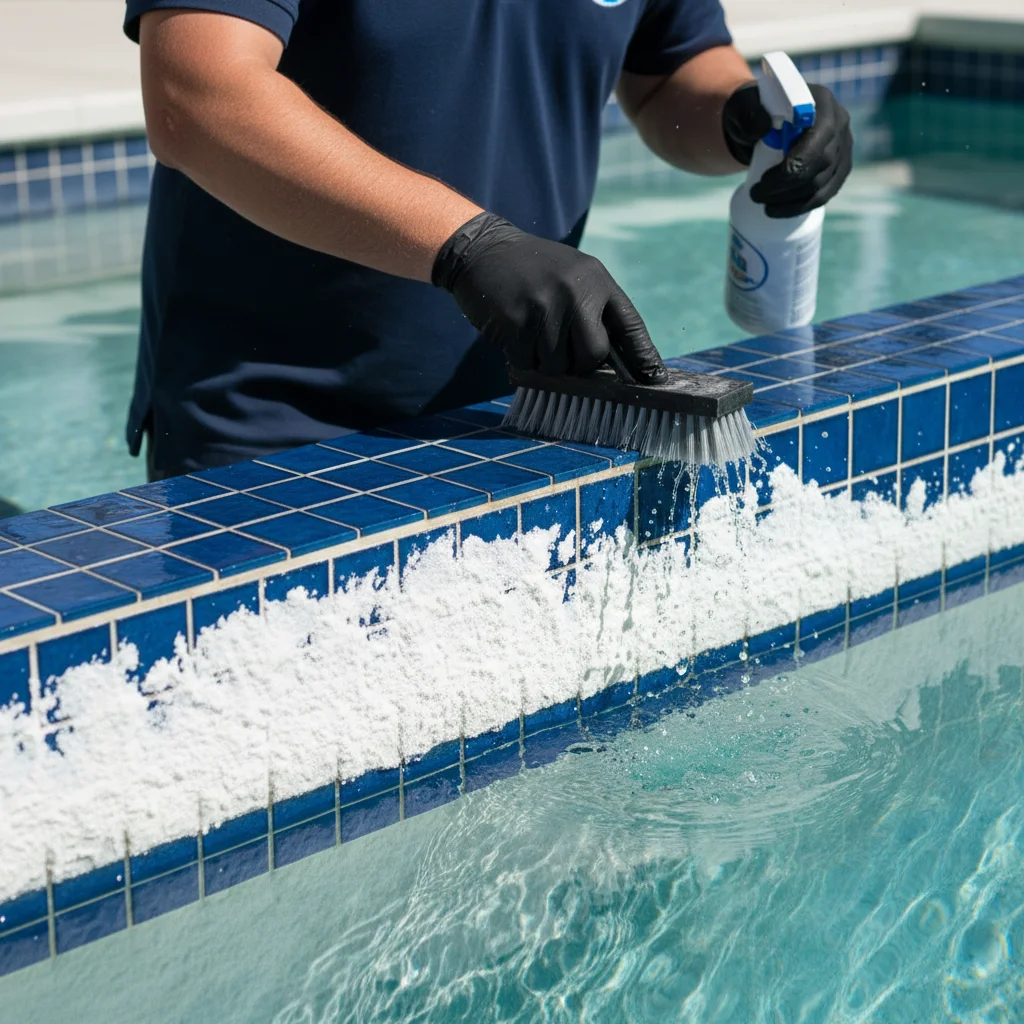
Why San Diego tap water leaves a white line on your tile
San Diego’s water comes from a blend of imported Colorado River water and Northern California sources managed by the San Diego County Water Authority. Both sources are naturally high in dissolved minerals, calcium and magnesium chief among them. By the time that water reaches your pool, it’s already carrying a heavy mineral load.
Add our climate to the picture. San Diego averages around 266 sunny days a year. That sun evaporates pool water constantly, especially in summer. When water evaporates, it leaves minerals behind. Those minerals concentrate at the waterline, the exact spot where water meets tile, and crystallize into the white or gray crust you see.
Calcium hardness in San Diego tap water commonly measures between 300 and 400 parts per million. The ideal range for pool water is 200 to 400 ppm. You’re often starting near the top of that range on fill day. A few weeks of evaporation and top-offs can push hardness well past 500 ppm. At that point, scale doesn’t just form, it cements itself onto tile.
East County pools tend to get hit hardest. If you’re in Spring Valley or El Cajon, your water supply often runs on the harder end of the county’s range. It’s one reason searches for “pool calcium removal Spring Valley” and “ceramic tile deep cleaning El Cajon CA” are so common, homeowners there see scale accumulate faster than their neighbors closer to the coast.
The good news: calcium scale on tile is a maintenance problem, not a structural one. It’s fully removable. The bad news: the longer it sits, the harder it gets, literally.
Calcium silicate vs. calcium carbonate, they’re not the same
Not all calcium scale is created equal. The type you’re dealing with determines how it gets removed, and confusing the two leads to damaged tile or wasted money.
Calcium carbonate
This is the early-stage stuff. It’s white, often powdery or chalky, and usually appears within the first year of neglect. Calcium carbonate is water-soluble under the right conditions and responds to mild acid treatments. It comes off with less aggressive methods, sometimes even a pumice stone on ceramic tile works, with patience.
If you look at your waterline and can scrape it off with a fingernail or a plastic scraper, there’s a good chance it’s carbonate.
Calcium silicate
This is the version that gives pool owners real trouble. Calcium silicate is harder, often gray or white-gray rather than pure white, and forms when calcium bonds with silicates in the water or pool plaster over time. It takes months or years to develop fully, and once it does, it won’t respond to acid alone or any reasonable DIY effort.
Silicate scale requires mechanical removal, meaning abrasion under controlled pressure. Trying to chip it off with a scraper risks cracking tile. Pouring muriatic acid on it and hoping for the best will damage your grout and spike your pool’s pH without removing the scale. This is the scale type that needs professional equipment.
If you’ve got both on the same pool, which is common in older San Diego pools, a good pool service treats them in the right order with the right tools. Our pool tile cleaning service starts with an assessment, so the pro knows exactly what’s being dealt with before anything gets touched.
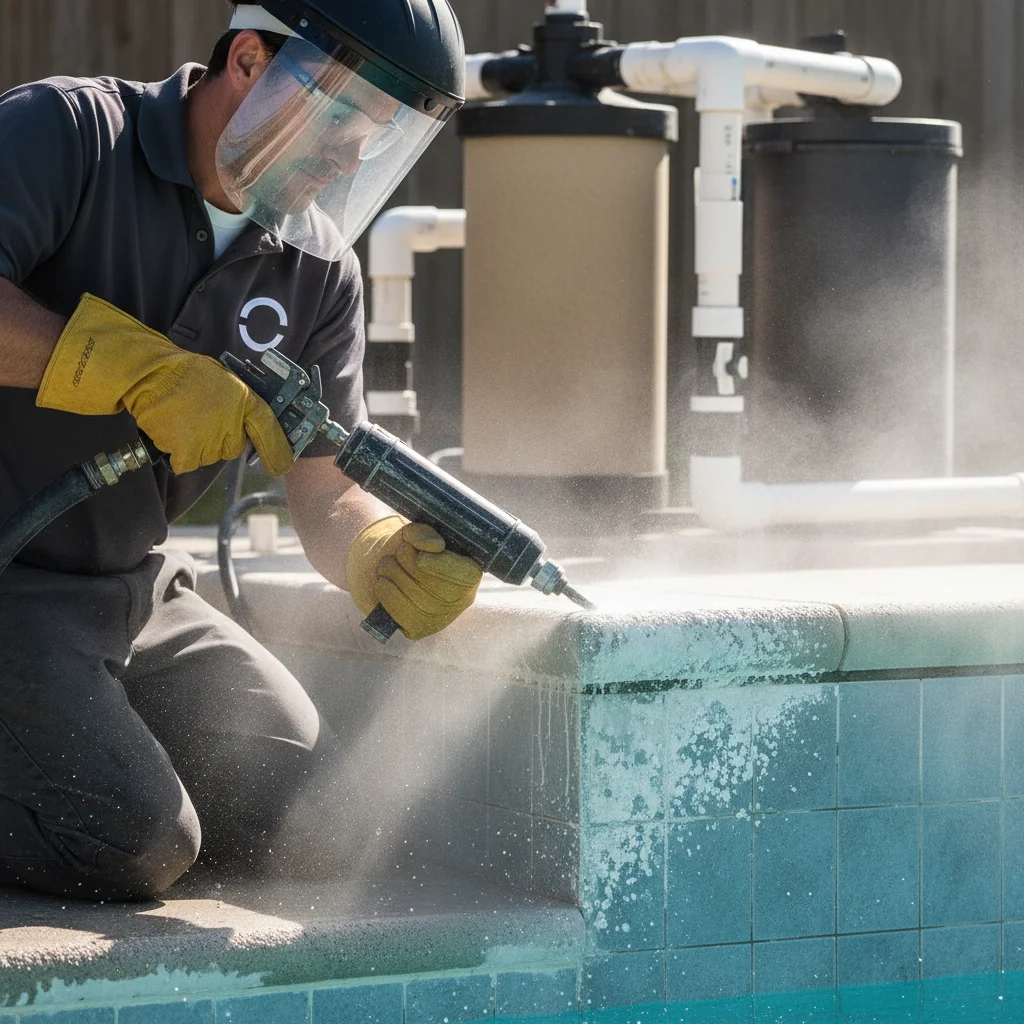
Bead blasting, glass blasting, and pumice: what pros use when
Professional tile calcium removal isn’t one-size-fits-all. The right method depends on the scale type, the tile material, and how bad the buildup is.
Sodium bicarbonate bead blasting
This is the most common method for moderate to heavy calcium carbonate and light silicate deposits. Pros use fine sodium bicarbonate media propelled by a low-pressure blaster aimed at the waterline. The beads strip scale off the tile surface without scratching glass, ceramic, or porcelain. The media dissolves in the pool water and actually provides a mild pH buffer. No draining required in most cases.
Bead blasting is efficient, tile-safe, and leaves a clean surface. For most San Diego pools, it’s the right call.
Glass bead blasting
For pools with glass tile, increasingly popular in La Jolla and Rancho Santa Fe, the pro switches to fine glass beads. Glass tile is beautiful, but it’s also more susceptible to micro-scratching from the wrong media. Glass beads are denser and rounder, which means they knock off scale without leaving surface haze. It’s a slower process but the right one for high-end tile.
Pumice stone
Pumice gets used manually for very light scale on ceramic tile in tight spots, or for touch-ups between full cleanings. It’s labor-intensive and only appropriate for mild calcium carbonate on surfaces that won’t scratch. Pumice isn’t recommended for glass tile, ever. Even careful hand application can leave permanent marks.
What pros avoid
Muriatic acid isn’t used as a primary removal method. It’s sometimes part of a final rinse to neutralize residual alkalinity, but using it to blast off scale destroys grout, risks etching tile, and dumps a large acid load into pool chemistry that takes hours to correct. Any company offering a “quick acid wash” as their tile cleaning solution is cutting corners.
DIY methods that ruin tile (and what to do instead)
The appeal of handling it yourself is understandable. A bottle of calcium remover from the pool store looks like a reasonable starting point. Here’s what actually happens with the most common DIY approaches.
Vinegar and household acid cleaners work on the lightest surface deposits if caught early. If your scale is thick enough to be visible from three feet away, these products won’t touch it. You’ll spend an afternoon scrubbing and end up with the same crust plus a pH problem in your water.
Muriatic acid applied directly to tile is the most damaging DIY choice we see. Homeowners dilute it, pour it along the waterline, and sometimes do get scale to soften, but they also etch the tile glaze, dissolve grout, and create a low-pH spike that can damage pool equipment and irritate skin. Repairing etched tile often costs more than the original cleaning would have.
Wire brushes and metal scrapers on glass or porcelain tile leave scratches that catch future scale even faster. Once the glaze is compromised, you’re in a losing cycle.
What to do instead: if the scale is fresh and light, a pumice stone rated for pools (not hardware store pumice) used with water on ceramic tile is reasonable. Work small sections, don’t dry-scrub, and stop if you see scratching. If the scale is thick, gray, or has been there more than a season, call us. The risk of tile damage far outweighs the cost of professional cleaning.
It’s also worth reading our post on hard water and San Diego pools, understanding the root cause helps you choose the right prevention strategy and avoid repeating the same cycle after a cleaning.
How to slow calcium buildup between cleanings
You can’t eliminate scale formation entirely in San Diego, but you can slow it significantly with consistent water chemistry management.
Keep calcium hardness in range. Test monthly. If hardness climbs past 400 ppm, a partial drain and refill with fresh water dilutes the mineral concentration. It’s the most effective reset available. Don’t wait until it’s at 600 ppm, by then, scale is already forming aggressively.
Manage pH tightly. Scale forms faster in high-pH water. Keep pH between 7.4 and 7.6. If it drifts above 7.8 regularly, investigate why, it could be a CO₂ issue, heavy bather load, or an alkalinity imbalance.
Use a sequestering agent. Sequestrants bind to dissolved calcium and keep it suspended in water rather than letting it crystallize on surfaces. They don’t remove hardness, but they slow deposition significantly. Add a maintenance dose monthly, especially in summer when evaporation peaks.
Brush the tile weekly. A soft nylon brush along the waterline breaks up early-stage deposits before they harden. It takes two minutes. This alone can extend the time between professional cleanings by six months or more.
Consider a water softener or mineral filter on your fill line. These reduce the incoming mineral load before water enters the pool. If you’re filling frequently due to evaporation or splash-out, this investment pays off quickly. The EPA WaterSense program has resources on efficient water use that apply here too.
If you’re on a weekly service plan, your technician should be monitoring these numbers at every visit. If they’re not, that’s a gap worth addressing. Our pool tile cleaning service pairs well with ongoing maintenance, a clean tile surface is easier to protect than one already coated in scale.
When to call us
If your tile has visible white or gray buildup more than a few millimeters thick, has been accumulating for more than one season, or if you’ve tried DIY methods that haven’t worked, it’s time for professional removal. Attempting to force off hardened silicate scale without the right equipment risks cracking tile and damaging grout, repairs that run well beyond the cost of a cleaning.
Call us at (858) 400-6757 and we’ll connect you with a vetted local pool pro.
Frequently asked questions
Why does my San Diego pool get calcium buildup so fast?
San Diego tap water is naturally hard, with calcium hardness levels often between 300 and 400 ppm right out of the tap. As pool water evaporates in our dry, sunny climate, calcium concentrates and deposits on tile at the waterline. Pools can develop visible scale in as little as a few months without preventive treatment.
Can I remove calcium from pool tile myself?
Light calcium carbonate scale can sometimes be loosened with a pumice stone on ceramic tile, but you risk scratching glass or porcelain tile. Calcium silicate, the gray, rock-hard crust that forms after months or years, requires professional bead or glass blasting to remove safely. DIY acid washes can etch tile, damage grout, and throw pool chemistry off badly.
How long does professional pool tile calcium cleaning take?
Most residential pools in San Diego can be cleaned in two to four hours. The timeline depends on the size of the pool, the type of tile, and how thick the scale has built up. You can usually swim again the same day once the water chemistry is balanced.
What is bead blasting and is it safe for my tile?
Bead blasting uses fine sodium bicarbonate or glass beads propelled at low pressure to strip calcium scale off tile without scratching the surface underneath. It's safe for glass, ceramic, and porcelain tile when done correctly. The media dissolves or is vacuumed out of the water, and it actually helps buffer pool pH slightly.
How often should I have my pool tile professionally cleaned in San Diego?
Most San Diego pools benefit from a professional tile cleaning once every one to two years, depending on water hardness, evaporation rate, and how well calcium hardness is managed week to week. Pools in East County cities like El Cajon and Spring Valley, where water tends to run harder, often need annual service.
Need professional help in San Diego County?
Splash Pro Pools connects San Diego homeowners with pool pros for the work in this post.