How to increase free chlorine in a San Diego pool is a kit-and-floor problem. The CDC home-pool page (May 10, 2024) wants at least 1 ppm free chlorine, or 2 ppm once cyanuric acid or dichlor/trichlor is in the water. A matched local pool pro tests with DPD, names what spent the residual, then adds sanitizer. This is not an algae shock.
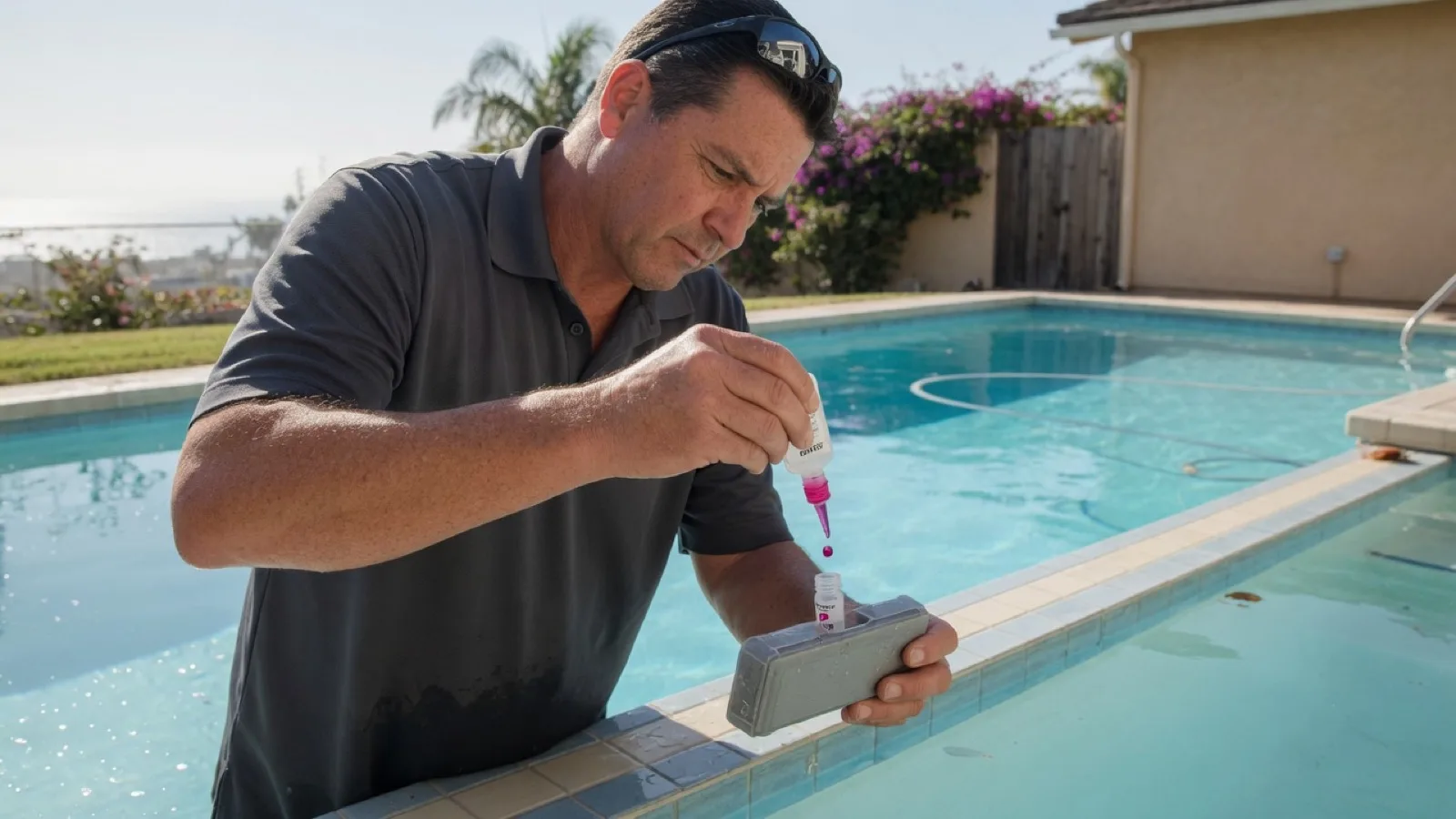
Read free, not the smell
Taylor Technologies (May 15, 2025) defines free chlorine as the sanitizer still ready to work, combined chlorine as the leftover after it has reacted, and total chlorine as the sum. When free and total are equal, combined is near zero. The CDC sets the free-chlorine floor. Combined chlorine is a different job, on free chlorine vs total chlorine.
Test at least twice a day, more under heavy use. DPD over strips. If the sample is above 10 ppm, DPD can bleach out and read false low or 0. Do not chase that ghost with another jug until the test is real.
pH still has to sit in 7.0 to 7.8. As pH rises above 7.8, the CDC says chlorine kills germs more slowly. Below 7.0, water corrodes pipes and equipment. Acid handling is on muriatic acid for pools.
What spends free chlorine here
The CDC names pee, poop, sweat, dirt, sunlight, and jets. San Diego sun is the afternoon spend. A Saturday guest list is the bather spend. Santa Ana dust is dirt in the water; that event page is Santa Ana winds and your pool. Inland heat plus a salt cell that is scaled is a generation problem, not a missing-jug problem: salt cell not working.
Taylor’s low-FC picture is cloudy water, green walls, and a musty odor. That is a sanitizer floor, not a proof of one algae type. The algae kill, when it is actually algae, is how to shock a pool.
At 1 ppm free chlorine, pH 7.5, 77°F, and no cyanuric acid, the CDC’s kill times are E. coli under 1 minute, Hepatitis A about 16 minutes, Giardia about 45 minutes, Cryptosporidium about 15,300 minutes (10.6 days). Times lengthen when cyanuric acid is present. That is why the floor steps from 1 ppm to 2 ppm once stabilizer is in the water.
Add sanitizer, then retest
A matched pro uses unstabilized liquid chlorine when CYA is already in range, because dichlor and trichlor feed more stabilizer. The raise for missing CYA is a different page: how to raise cyanuric acid. There is no published dose on this site for “X ounces per 10,000 gallons.” The label on the jug in the hand, the measured gallons, and the CDC floor are the inputs.
A weekly pool cleaning stop is how most yards catch a falling residual before the walls go green.
When to call us
Call when the kit reads below the CDC floor two days running, when DPD went to zero after a party, or when someone is about to dump shock bags at a pool that only needed its sanitizer back. A matched local pool pro will test free and total, then raise the residual this water is actually missing.
Frequently asked questions
What should free chlorine be in a pool?
The CDC home-pool page (May 10, 2024) wants at least 1 ppm free chlorine in pools, and at least 2 ppm if cyanuric acid or dichlor/trichlor is in the water. Hot tubs sit at least 3 ppm with no cyanuric acid.
Why is my free chlorine low?
The CDC lists pee, poop, sweat, dirt, sunlight, and droplet-making jets as chlorine consumers. Taylor Technologies (May 15, 2025) names cloudy water, green walls, and a musty odor when free chlorine drops below the recommended threshold.
Is raising free chlorine the same as shocking?
No. This page is getting back to the CDC floor. Shock is an oxidizer dose for combined chlorine or algae. Taylor says combined chlorine should ideally be under 0.4 ppm, and a shock is due when total exceeds free by more than 0.4 ppm.
Can a DPD kit lie about a low reading?
Yes. If chlorine in the sample is more than 10 ppm, the CDC says a DPD test might bleach out and show a false low or 0 ppm. A matched pro dilutes the sample or uses a kit meant for that range before pouring more sanitizer.
Does stabilizer change the target?
Yes. With cyanuric acid, dichlor, or trichlor in the water, the CDC raises the pool floor from 1 ppm to 2 ppm because chlorine lasts longer in the sun but works more slowly against germs.
Need professional help in San Diego County?
Splash Pro Pools connects San Diego homeowners with pool pros for the work in this post.