Muriatic acid for pools is a pH-down tool in a matched pro’s kit, not a weekend science experiment. The EPA’s pool-chemical alert lists it next to hypochlorites and says those products are incompatible. A San Diego yard uses it to pull high pH back toward the CDC’s 7.0 to 7.8 window. It is not the same job as a drained acid wash.
What muriatic acid is doing in the water
pH above 7.8 is the CDC’s slow-kill zone. Below 7.0, water corrodes pipes and equipment. A pro who sees a high reading reaches for an acid labeled for pools, often muriatic (hydrochloric) acid, and doses from the product label. Follow that label for the amount.
Dry acid (sodium bisulfate) is a different bottle some labels offer. The SDS and the label on the container in hand win. Baking soda is the wrong pick here. It raises alkalinity. The raise for low pH is how to raise pool pH. The high-or-low overview is pool pH too high or too low.
An acid wash of drained plaster is a separate, messier job: pool acid wash. Do not treat this page as permission to pour acid on an empty shell.
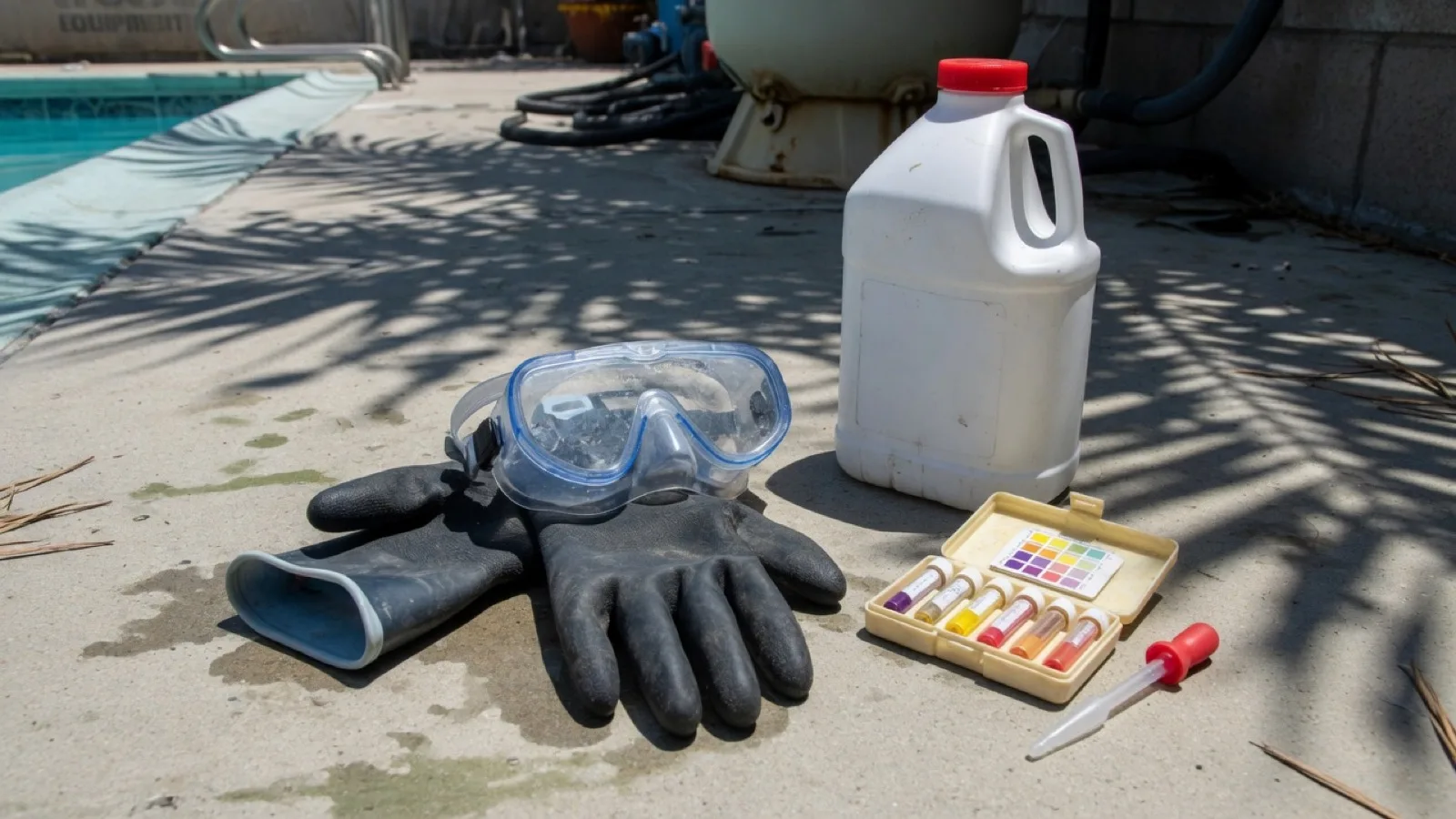
EPA mixing, wetting, and PPE
EPA 550-F-01-003, “Safe Storage and Handling of Swimming Pool Chemicals” (March 2001), is guidance, not a city ordinance. It still names the hazards. Pool chemicals may become a hazard when wetted by a small quantity of water or when improperly mixed. A limited volume of water added to the chemical can raise temperature and release toxic gas. The most common pool chemicals are inherently incompatible. Mixing can ignite nearby combustibles and release chlorine gas. Muriatic acid is on the alert’s partial list, along with sodium hypochlorite, calcium hypochlorite, and chlorinated isocyanurates.
Keep containers closed and dry, off the floor, away from doors, windows, and leaks. Separate incompatibles. Do not store liquids above other incompatible substances. Do not mix old chemical with fresh even of the same type. Dedicated tools. Keep gasoline, oily rags, and motors out of the storage area.
For handling, the EPA lists chemical goggles and liquid-impervious gloves and boots as a minimum, and a face shield plus impervious apron for frequent or extended work. Consult the SDS. This is not a DIY mixing recipe. It is why a matched pro treats the jug as a hazardous product, not a grocery item.
How a pro lowers pH without an acid wash
Test first, DPD, twice a day per the CDC, sample away from the jets. Alkalinity decides how hard the pH will move. The pro doses, circulates, retests. They do not stack acid on top of a chlorine dump. Inland hard fill in Santee and El Cajon will try to walk pH and alkalinity around after every top-off. Coastal aeration from sheers and salt cells walks pH up on its own, which is a common reason a La Jolla pad sees this bottle more often than a covered spa.
A weekly pool cleaning route is how most yards get that correction without storing a gallon of acid in the garage.
City of San Diego acid-cleaning waste
Inside City of San Diego limits, San Diego Municipal Code §43.0304 and §43.035(e)(3) ban pool and filter waste from the storm drain. The City’s February 2016 fact sheet says backwash and acid-cleaning waste may never enter the storm drain, that filters should be cleaned over absorbing landscape, and that backwash fluids must be pH 7 to 8 before a legal sanitary-sewer connection. Penalties can reach $10,000 per day per incident. Other cities write their own rules.
If the work becomes a drained wash or a plaster job, ask for the C-53 license and confirm it on the CSLB lookup.
When to call us
Call when pH stays above the CDC window, when a jug of acid is already in the garage next to the chlorine, or when someone has proposed an acid wash and you need the chemistry job separated from the drain job. A matched local pool pro will test, dose from the label, and keep that acid away from the rest of the shelf. Dry, separated storage is on how to store pool chemicals.
Frequently asked questions
What is muriatic acid used for in a pool?
A matched pro uses it to lower high pH, and sometimes as part of a drained acid wash on plaster. Those are different jobs. The wash is a construction-adjacent service on its own page. This page is the chemistry dose, with the product label in charge of the amount.
Can I mix muriatic acid with chlorine?
No. The EPA's March 2001 pool-chemical alert says the most common pool chemicals are inherently incompatible, and mixing can release chlorine gas and ignite nearby combustibles. Muriatic acid is on that alert's partial list next to hypochlorites. Keep them apart.
What protective gear does the EPA mention?
EPA 550-F-01-003 lists chemical goggles and liquid-impervious gloves and boots as a minimum for chemical handling, and a face shield plus impervious apron for frequent or extended handling. Follow the product SDS on top of that.
Where does acid-cleaning waste go in San Diego?
Inside City of San Diego limits, backwash and acid-cleaning waste may never enter the storm drain. The City's February 2016 fact sheet says those fluids go to the sanitary sewer through a legal connection after pH 7 to 8, or stay on absorbing landscape. Other cities set their own rules.
Is this how I raise pH?
The other direction. Low pH gets soda ash, borax, or aeration. High pH is where muriatic acid or a dry acid labeled for pools comes in. The raise page is separate.
Need professional help in San Diego County?
Splash Pro Pools connects San Diego homeowners with pool pros for the work in this post.