Heads up before you read: Splash Pro Pools keeps pools clean; spa and hot tub repair is a different trade. Call (858) 400-6757 and we’ll match you with a local pro who handles it.
Most hot tub repairs in Vista run $150 to $900, with heater work and pump replacements making up the bulk of calls. Vista’s 12-14 gpg water supply from Vista Irrigation District accelerates mineral scaling faster than softer coastal markets, which changes both how often things fail and which parts wear first.
This post focuses on what we see on North County Inland spa calls specifically: the Shadowridge 80s-90s builds, the mineral load, and the inland heat. It’s not a repeat of the county-wide overview. For a broader look at San Diego spa repair costs across more brands and failure types, our San Diego hot tub repair guide covers that ground.
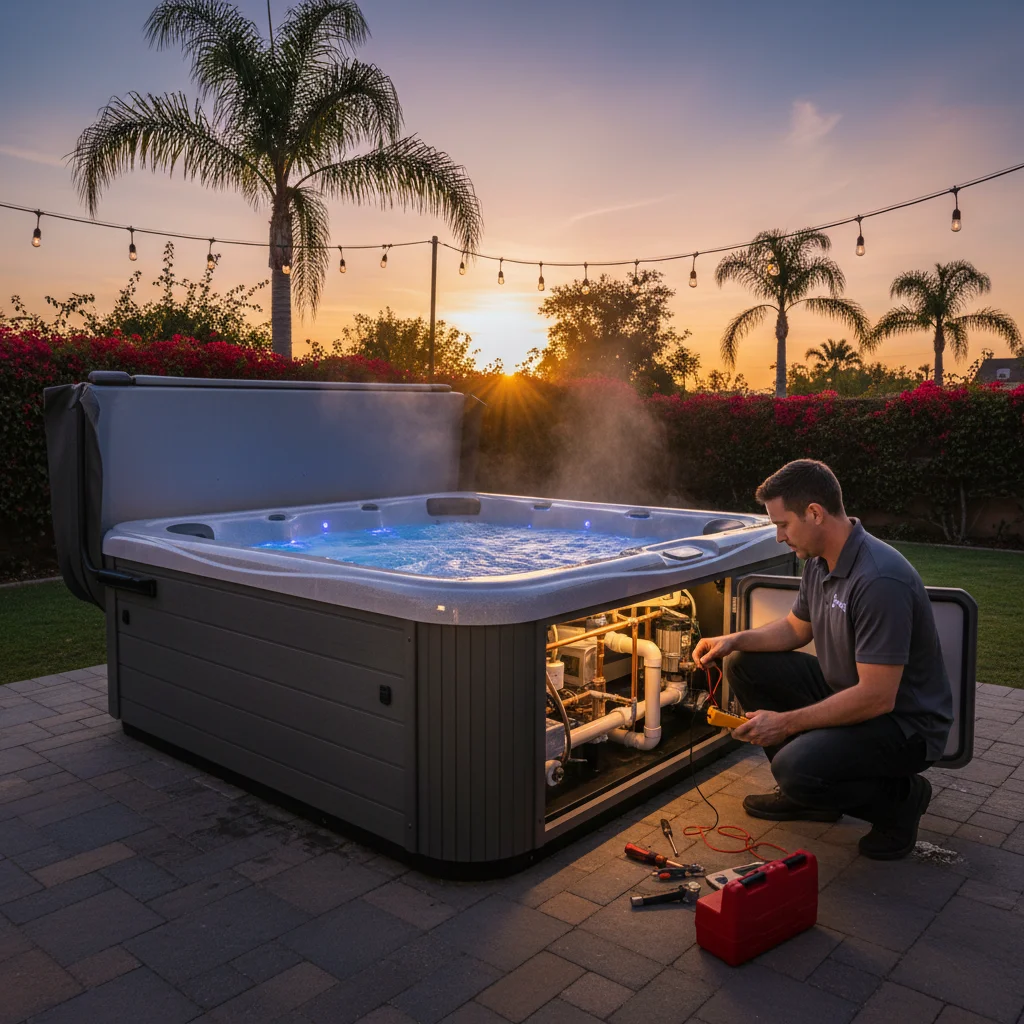
What Vista’s hard water does to spa heaters
This is the issue that sets North County Inland spa repair apart from coastal San Diego. At 12-14 gpg, Vista water deposits calcium carbonate on heating elements at a pace most homeowners don’t expect. The element doesn’t fail all at once. It scales slowly, loses efficiency, and eventually burns out.
Here’s the practical timeline: a spa heater in a softer-water market might last 5-7 years with decent maintenance. In Vista, 3-5 years is more realistic without active scale management. Homeowners who haven’t been keeping pH between 7.4 and 7.6 often see failures closer to the 3-year mark.
The fix is straightforward. A technician tests the element for continuity with a multimeter. No continuity means it’s open and dead. Element replacement runs $250-$450 in parts and labor. While the panel is open, the high-limit sensor and pressure switch get tested at the same time, since either one can shut down heating on older units without throwing a clear error code.
Scale buildup on the element is also why draining your spa every 3-4 months matters more in Vista than the label on your chemical kit suggests. A fresh refill resets the calcium load before the water chemistry becomes unmanageable.
The failure pattern on 80s and 90s spas in Shadowridge
Shadowridge and Rancho Buena Vista have a concentration of homes built in the 1980s and 90s, many with original spas. These shells are often in good shape, since fiberglass holds up well, but the equipment is another story.
The most common failure pattern on these older builds involves multiple components failing in the same season. That’s not bad luck. It’s age. Here’s what tends to go:
Pumps. Older single-speed spa pumps develop worn shaft seals from years of hard water and mineral abrasion. A weeping seal starts as a small drip. Left alone, moisture gets into the motor and the whole pump fails. Pump wet-end replacement runs $200-$400. A full pump swap is $400-$700.
Control packs (spa packs). The circuit board is the brain. It reads sensors, controls the heater relay, and manages error codes. Boards in older spas fail in a recognizable pattern: erratic behavior, error codes that don’t clear, or a dead display while the equipment still powers on. Board replacement runs $500-$900 depending on the brand and whether the part is still manufactured. Before replacing a board, a good tech rules out the sensors and transformer, because a bad sensor kills new boards too.
GFCI trips. Older equipment bays with moisture intrusion, aging wiring, or a deteriorating heater element trip GFCI breakers. This is worth diagnosing properly rather than just resetting. The fault is real and usually points to the heater or pump drawing abnormal current.
Leaks at unions and fittings. The plumbing unions in older spa equipment bays dry out and crack. Union leaks are the most common and easiest to fix, typically $100-$300 depending on accessibility. A buried plumbing leak behind foam insulation costs more, usually $250-$600.
Vista hot tub repair cost table
These ranges reflect what we see on North County Inland calls. They’re consistent with the broader San Diego cost ranges in our county-wide spa repair guide.
| Repair | Typical range |
|---|---|
| Heater element replacement | $250-$450 |
| High-limit sensor or pressure switch | $120-$220 |
| Pump wet-end replacement | $200-$400 |
| Full pump replacement | $400-$700 |
| Circuit board (spa pack) replacement | $500-$900 |
| Union or valve leak repair | $100-$300 |
| Buried plumbing leak | $250-$600 |
| Filter replacement (labor + filter) | $80-$150 |
| Jet replacement (per jet, parts + labor) | $40-$90 |
Diagnostic labor typically runs $85-$125 for the first hour, applied toward the repair if you proceed the same day.
When repair beats replacement in Vista
The shell-and-plumbing question is the deciding factor. If the acrylic or fiberglass shell is crack-free and the plumbing is intact, repair almost always makes financial sense, even on an older spa, unless the spa pack is discontinued or two or three major components have failed in the same season.
A heater element plus a pump replacement on a sound 1990s shell typically runs $650-$1,150 and extends useful life by 5-8 years. A new entry-level spa starts around $4,000-$6,000 installed. The math usually favors repair.
The calculus shifts when:
- The shell has an active leak below the waterline that requires professional relining
- The spa pack brand is discontinued and a compatible board can’t be sourced
- The foam insulation is saturated from a long-running slow leak (adds complexity and cost to any repair)
- More than three major components have failed in 12 months
If you’re unsure, a diagnostic visit gives you the information you need before committing to either path.
The simple maintenance habits that matter most in Vista
Hard water makes maintenance non-negotiable rather than optional. These three habits extend spa equipment life meaningfully in Vista’s conditions:
Drain and refill every 3-4 months. Total dissolved solids rise fast in the small volume of a spa. After 90 days of regular use, chemistry becomes hard to hold stable and scale accumulates faster. A fresh refill resets the calcium load before it causes real damage.
Test chemistry twice a week. Keep pH between 7.4 and 7.6. Low pH corrodes equipment seals. High pH accelerates calcium scaling on the heater element, and Vista water already pushes in that direction. Calcium hardness in the spa should stay between 150 and 250 ppm.
Rinse the filter every two weeks, replace annually. A clogged filter starves the pump and stresses the heater. It’s the most common root cause of pump and heater failures, and also the cheapest problem to prevent.
For a detailed monthly routine, our hot tub maintenance guide walks through the full schedule.
When to call us
If your Vista spa isn’t heating, is tripping the GFCI, or is leaking at the equipment bay, those issues don’t improve on their own. Sitting water with off-balance chemistry damages equipment fast, and a slow leak saturates foam insulation in ways that multiply repair costs.
A technician can usually diagnose the problem in one visit and have parts sourced the same day. Call (858) 400-6757 and we’ll connect you with a vetted local pool pro. You can also see the full range of hot tub repair in Vista available, or visit our Vista pool and spa service hub for everything we cover in your area.
Frequently asked questions
How much does hot tub repair cost in Vista, CA?
Most Vista hot tub repairs fall between $150 and $900. Heater element replacement typically runs $250-$450. A full pump swap lands closer to $400-$700. Circuit board work is the most expensive single job, usually $500-$900 depending on the brand and whether the board can be sourced locally.
Why does Vista's hard water damage spa heaters so fast?
Vista Irrigation District water runs 12-14 gpg, which is firmly in the hard range. That mineral load deposits calcium scale on the heater element over time, reducing heat transfer efficiency and eventually causing the element to burn out. Heaters in Vista commonly last 3-5 years instead of the 5-7 you'd see in softer-water markets.
How often should I drain and refill my hot tub in Vista?
Every 3-4 months is the standard recommendation, and in Vista that timeline matters more than most places. Hard water raises total dissolved solids fast in a small spa volume, making chemistry increasingly difficult to manage past the 90-day mark. A fresh fill resets the baseline.
Why does my hot tub keep tripping the GFCI breaker?
GFCI trips usually point to a moisture issue in the equipment bay, a failing heater element, or a pump motor drawing excessive current. All three are diagnosable in one visit. Don't keep resetting the breaker without finding the root cause. A fault that keeps tripping is a safety concern.
Should I repair or replace a hot tub from the 1980s or 90s?
If the shell and plumbing are sound, repair usually makes financial sense unless the spa pack (control board) is discontinued or multiple major components have failed in the same season. A heater plus a pump replacement on an otherwise good shell often extends useful life by 5-8 years for less than half the cost of a new spa.
What is a realistic diagnosis cost for spa repair in Vista?
Diagnostic labor runs $85-$125 for the first hour. Most reputable techs apply that toward the repair if you proceed the same day. Budget for the diagnostic before committing to a repair scope, because the symptom and the root cause are often not the same thing.
Need this done in San Diego County?
For repair and renovation work like this, we hand you to our trusted partner, Del Rancho Pools.