Before you read on: this sits outside what Splash Pro Pools does. We hand it to a vetted local spa and hot tub repair pro, reachable on (858) 400-6757.
This page is the diagnosis and cost guide. To book the repair, call Del Rancho Pools at (858) 400-6757. Common jobs land between $150 and $900. A heater that will not hold temperature, a pump that hums, or a circuit board error is usually one of those, not a full spa replacement.
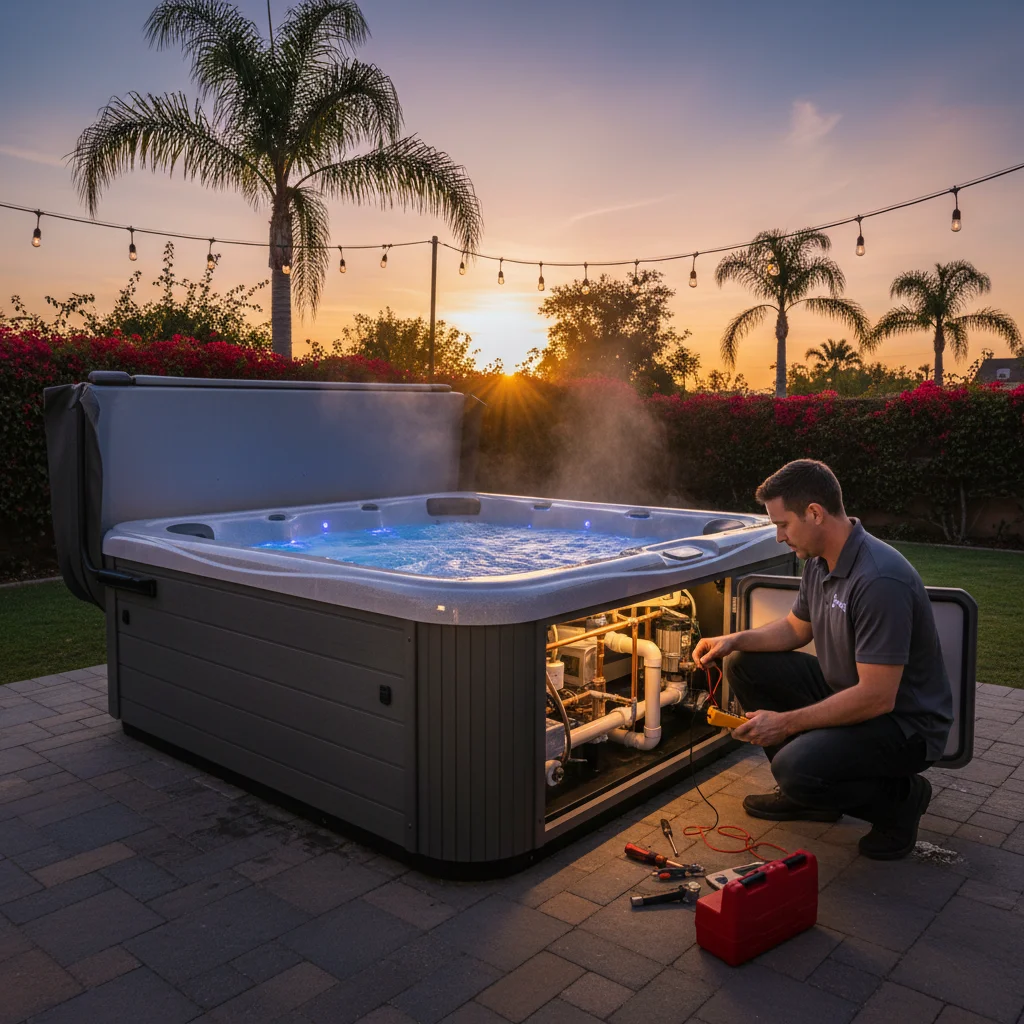
The parts that fail first on most San Diego spas
No component lasts forever, but some wear out on a predictable schedule. Knowing the order helps you budget, and keeps you from replacing an expensive part when a cheaper one was the real culprit.
Filters
Spa filters are the first thing to go, and the most often neglected. A clogged filter starves the pump, which stresses the heater, which trips the high-limit sensor. What looks like a heater problem is sometimes just a dirty filter. Rinse yours every two weeks. Replace it every 12-18 months depending on bather load and San Diego’s notoriously hard water, which deposits calcium scale faster than in softer markets.
Jets and jet internals
The internal nozzles, gaskets, and directional fittings inside spa jets break down from UV exposure and chemical wear. A jet that spins stiffly or doesn’t adjust is usually a $10-$30 parts fix. A jet that leaks at the wall fitting is a different story, that’s a potential shell or plumbing issue.
Heating elements
San Diego’s tap water runs high in calcium hardness, often 280-300 ppm, according to the San Diego County Water Authority. That mineral load coats heating elements over time, reducing efficiency and eventually causing them to burn out. Most elements last 3-7 years. You’ll know the element is failing when the spa takes much longer than usual to reach temperature, or stops heating entirely.
Cover hardware
Not an equipment failure, but covers that are waterlogged or have broken buckles force the heater to work harder to maintain temperature. A cover that’s saturated and heavy has lost its insulation value. In San Diego’s dry heat, foam cores degrade faster than the vinyl shell shows it. Replace a cover every 3-5 years.
Heater, pump, and circuit board, diagnosing the difference
These three components account for the majority of serious spa repair calls. The tricky part is that their symptoms overlap. Cold water can mean a bad heater or a pump that isn’t moving water past the sensor or a circuit board that’s sending the wrong signal. Here’s how to sort them out.
Heater problems
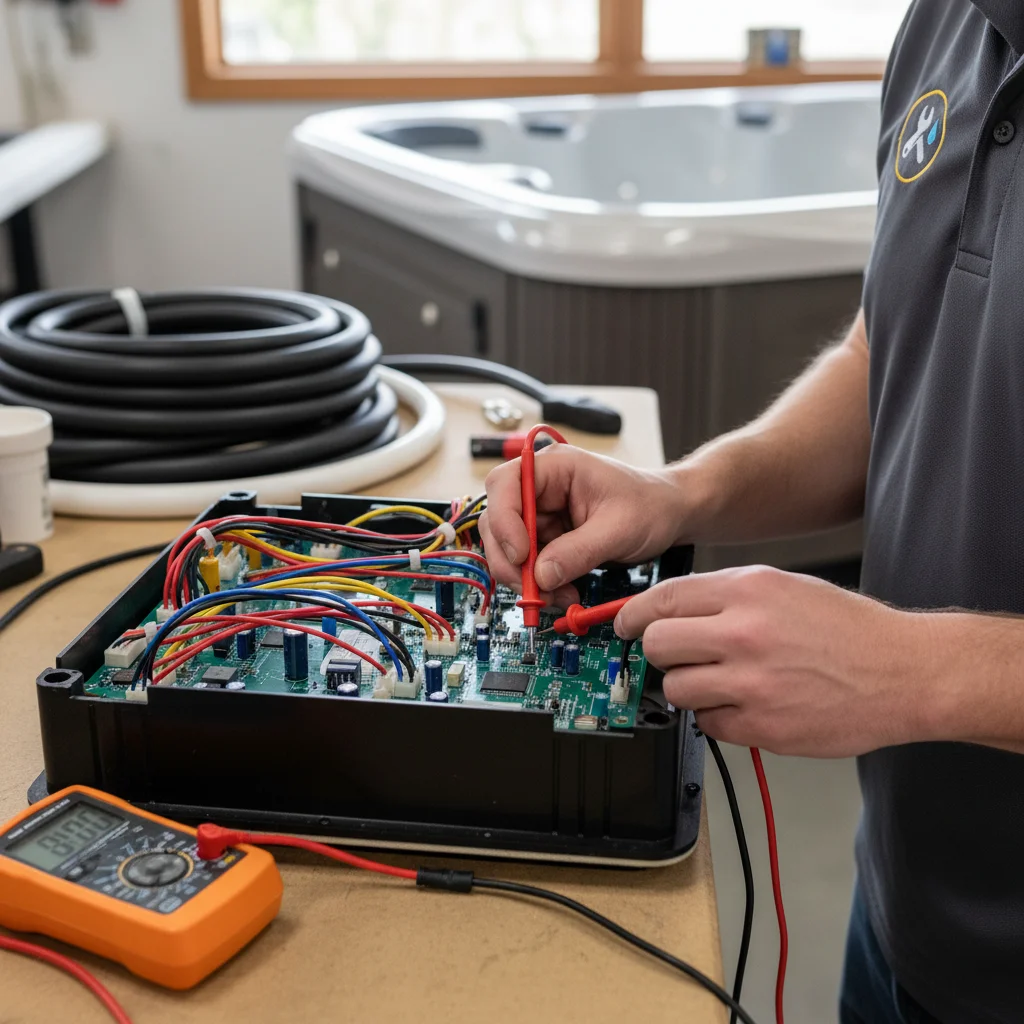
If the spa runs, jets work, but the water never gets warm, start with the heater. A technician will use a multimeter to test the element for continuity. No continuity means the element is open, it’s dead and needs replacement. While the panel is open, the high-limit sensor and pressure switch get tested too, since either one can shut down heating without any error code on older units.
Pump problems
A pump that hums but doesn’t move water usually has one of two issues: a seized impeller or an airlock. An airlock resolves quickly by bleeding the fitting at the pump. A seized impeller means the motor windings are still alive but the wet end has failed, that’s a wet-end replacement or a full pump swap depending on age.
A pump that runs loudly (cavitation noise, grinding) typically has a worn bearing. Bearings can be replaced on some pump models, but on older pumps the labor cost often makes a full replacement the smarter move. Pros doing spa and hot tub service calls carry common pump models on the truck, so most jobs finish in one visit.
Circuit board problems
The circuit board, or spa pack, is the brain. It reads sensors, controls the heater relay, manages jet speeds, and handles error codes. Board failures show up as erratic behavior: jets cycling on and off randomly, error codes that don’t clear, or a display that’s dead while everything else powers on.
Before replacing a board, a good tech will rule out the sensors and the transformer. Boards are expensive ($200-$600 for the part alone on most residential brands), and a bad sensor will keep killing a new board if it isn’t caught first.
When a spa leak is fixable and when it’s not
Spa leaks fall into two buckets: plumbing leaks and shell leaks. The repair approach, and cost, is very different between them.
Plumbing leaks
Most spa leaks originate at unions, valves, or barbed fittings in the equipment bay. These are accessible without demolition. A union that’s hand-tight can be snugged down in minutes. A cracked valve body or a fitting that’s pulled free from a flex line is a bit more involved but still a same-day fix in most cases. Expect $100-$300 for a straightforward plumbing leak repair.
Leaks inside the cabinet walls, where jets meet the shell from behind, are harder to access. The technician may need to remove sections of the spa’s foam insulation to reach the fitting. That adds time and cost, typically $250-$600 depending on how deep the leak is buried.
If you’re dealing with a similar issue on the pool side of your equipment pad, pool repair pros handle those the same way: diagnose first, replace only what needs replacing.
Shell leaks
Acrylic shell cracks are less common but more serious. Small surface cracks above the waterline are often cosmetic and can be patched with an acrylic repair kit. A crack that extends below the water line and is actively leaking needs professional attention, the spa has to be fully drained, dried, and professionally repaired or relined. In some cases, a cracked shell on a spa older than 15 years makes replacement the better financial decision.
If you suspect a leak but can’t find it, the same dye-testing and pressure-testing methods used in pool leak detection apply to spas. Don’t let a small leak run, it saturates the foam insulation, adds to your water bill, and accelerates corrosion in the equipment bay.
What these repairs typically cost
Prices vary by brand, part availability, and how accessible the equipment is. These ranges reflect what we see regularly on San Diego calls.
| Repair | Typical range |
|---|---|
| Filter replacement (labor + filter) | $80-$150 |
| Jet replacement (per jet, parts + labor) | $40-$90 |
| Heater element replacement | $250-$450 |
| High-limit sensor or pressure switch | $120-$220 |
| Pump wet-end replacement | $200-$400 |
| Full pump replacement | $400-$700 |
| Circuit board replacement | $500-$900 |
| Plumbing leak at union or valve | $100-$300 |
| Buried plumbing leak (behind foam) | $250-$600 |
Diagnostic labor, the time to figure out what’s actually wrong, typically runs $85-$125 for the first hour, applied toward the repair if you proceed the same day.
California contractors doing electrical and plumbing work on spas are required to hold a C-53 Swimming Pool Contractor license. Always verify before someone opens your equipment panel.
Maintenance habits that double spa lifespan
The spas that last 15-20 years in San Diego aren’t luck, they’re the ones with consistent, simple maintenance routines.
Water changes every 3 months. Total dissolved solids accumulate in spa water faster than in a pool because the volume is small. After 90 days of regular use, chemistry becomes harder to manage. Drain, refill, and rebalance on a quarterly schedule.
Filter rinse every 2 weeks, replacement annually. San Diego’s hard water scale and sunscreen residue from bathers clog filter media faster than in softer markets. A clogged filter is the single most common root cause of pump and heater failures.
Cover care. Condition the vinyl monthly. Prop the cover open for 30 minutes after each use to let moisture escape. A well-maintained cover pays for itself in heating costs alone.
Keep pH between 7.4 and 7.6. Low pH corrodes equipment seals and the heater element. High pH accelerates calcium scaling on that same element, and San Diego water is already pushing in that direction. Test twice a week if the spa gets heavy use.
Annual equipment inspection. Have a tech check the pump shaft seal, all unions, the heater element condition, and board connections once a year. Catching a slow shaft seal leak costs $80. Ignoring it until the motor floods costs $500+.
For a broader look at what maintenance neglect costs San Diego pool and spa owners, the numbers in our pool maintenance cost guide apply directly to spa budgeting too. North County Inland readers dealing with hard-water heater failures can go deeper with our hot tub repair guide for Vista.
When to call us
If your spa isn’t heating, is losing water, or is throwing error codes that won’t clear, those aren’t problems that wait well, sitting water with off-balance chemistry damages equipment fast. A trained technician can usually diagnose the issue in one visit. Call us at (858) 400-6757 and we’ll connect you with a vetted local pool pro.
Frequently asked questions
How much does hot tub repair cost in San Diego?
Most common repairs fall between $150 and $900. A heater element replacement typically runs $250-$450 in parts and labor. A full spa pump replacement lands closer to $400-$700. Circuit board repairs or replacements are the most expensive single-component job, often $500-$900 depending on the brand.
Why is my hot tub not heating?
The three most common causes are a failed heating element, a faulty high-limit sensor, or an airlock in the circulation pump. A technician can usually diagnose which one in under 30 minutes with a multimeter and a pressure check.
Can a hot tub leak be repaired without draining it?
Sometimes. Leaks at unions, valves, and fittings can often be tightened or resealed while the spa is still running. Shell cracks and delaminated plumbing lines almost always require a full drain.
How often should a hot tub be serviced in San Diego?
Every 3 months for a water change and filter inspection is the baseline. San Diego's hard water, averaging around 280-300 ppm calcium hardness, means calcium scale can build faster than in softer-water markets, so chemistry checks every 2 weeks are smart.
Is a hot tub repair tech in California required to be licensed?
For electrical and plumbing work above certain thresholds, yes. California law requires a C-53 Swimming Pool Contractor license for most spa repair work. You can verify any contractor's license at the CSLB website before they start work.
Need this done in San Diego County?
For repair and renovation work like this, we hand you to our trusted partner, Del Rancho Pools.