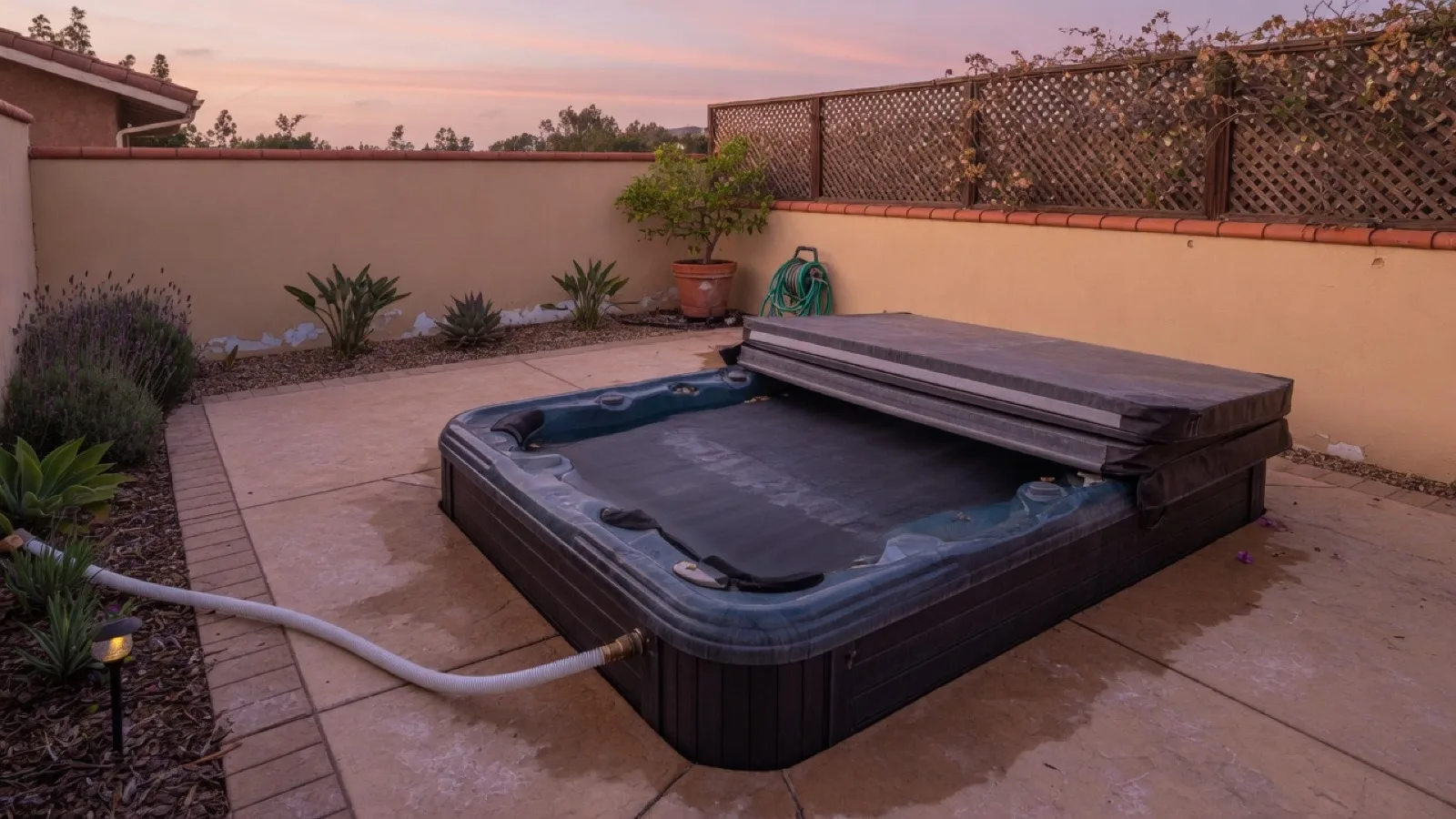
When to drain a hot tub in San Diego is a calendar and a chemistry question. HomeGuide’s November 5, 2024 guide says professionals recommend draining and refilling every 3 to 4 months. A matched local pool pro also watches the CDC’s spa chlorine rules, then puts the old water somewhere the City will accept.
HomeGuide’s 3 to 4 month cadence
HomeGuide (November 5, 2024) is the named source for the interval. DIY refill water and chemicals run $30 to $70. Hiring the drain out is $150 to $400. Professional monthly care is $50 to $200 ($600 to $2,400 a year). DIY monthly is $10 to $30. Chemicals $100 to $250 or more a year. Filters $20 to $120 every 1 to 2 years. Electricity $20 to $60 a month. All national market figures.
The cost page for the year is hot tub spa maintenance cost. This page is the drain date.
Sweat, lotion, and jets load a small volume of water faster than a 15,000-gallon plaster pool. Waiting until the water looks gray is late. The 3 to 4 month mark is a reset, not a punishment for missing a weekly test.
Why CDC chemistry is different in a spa
The CDC home-pool page (May 10, 2024) wants at least 3 ppm chlorine in hot tubs and recommends not using cyanuric acid or chlorine products that contain it. Pools: at least 1 ppm free chlorine, 2 ppm with stabilizer. pH still 7.0 to 7.8. Test chlorine and pH at least twice a day, more when the spa is busy. DPD kits beat strips.
Jets create droplets that consume chlorine. Heat speeds everything. A trichlor puck in a spa fights the CDC’s no-CYA instruction. If the kit cannot hold 3 ppm without a stabilizer crutch, the water is due to leave. The CDC pair above is the rule: 3 ppm in the spa, no cyanuric acid. The two-body version of that split is spa vs pool chemistry.
Where the water can go in San Diego
Inside City of San Diego limits, spa water is in the same storm-drain ban as pool water. San Diego Municipal Code §43.0304 and §43.035(e)(3), cited in the City’s Pools, Spas & Fountains fact sheet (February 2016), also set penalties that can reach $10,000 per day per incident. Legal paths the fact sheet names: sanitary sewer through an onsite sink or lateral cleanout with Public Utilities Department approval at (858) 654-4100, or slow landscape irrigation if the soil absorbs it without runoff or erosion. Water should be dechlorinated, pH 7 to 8, at ambient temperature, and free of algae and debris before any rare storm-drain exception even comes up. Saline water is stricter.
Oceanside, Vista, Encinitas, and the rest of the county write their own stormwater rules. Confirm locally. The inground-pool drain hazards (hydrostatic lift, empty shells) live on how to drain a pool. A portable spa does not float out of the ground the same way. The water still cannot go in the gutter.
What a pro does on a drain-and-refill visit
Power off per the spa’s manual. Drain to a legal path. Wipe the shell. Clean or swap the filter. Refill. Balance to the CDC spa numbers, without cyanuric acid. The monthly care posts on this site, including hot tub maintenance, cover the weeks between drains. If the spa needs a part, that is repair, and it routes with the other equipment topics.
Ask for a license when the work leaves a simple drain. California’s C-53 classification covers spas and hot tubs as swimming-pool contractor work. Confirm it on the CSLB lookup.
When to call us
Call when the water is past a 3 to 4 month fill, when chlorine will not hold the CDC’s 3 ppm in the spa, or when nobody can name a legal place for the drain water to go. A matched local pool pro will drain, refill, and set the chemistry for a hot tub, not for a pool.
Frequently asked questions
How often should you drain a hot tub?
HomeGuide's November 5, 2024 hot tub maintenance guide says professionals recommend draining and refilling every 3 to 4 months. DIY refill water and chemicals run $30 to $70; hiring it out is $150 to $400. Those are national market figures, never a Splash price.
Is hot tub chemistry the same as pool chemistry?
No. The CDC wants at least 3 ppm chlorine in hot tubs and recommends not using cyanuric acid or dichlor/trichlor in them. Pools can use stabilizer, with free chlorine at least 2 ppm when they do. A spa is hotter, smaller, and loaded with jets that consume chlorine.
Where can spa water go in San Diego?
Inside City of San Diego limits, San Diego Municipal Code §43.0304 and §43.035(e)(3) make it illegal to discharge spa water into the storm drain. The City's February 2016 fact sheet points at the sanitary sewer with Public Utilities approval, or slow landscape irrigation if the soil takes it. Other cities set their own rules.
How much does professional hot tub care cost?
HomeGuide (2024-11-05) puts professional care at $50 to $200 a month ($600 to $2,400 a year), DIY at $10 to $30 a month, chemicals at $100 to $250 or more a year, filters at $20 to $120 every 1 to 2 years, and electricity at $20 to $60 a month. National ranges, not our fees.
Do I drain a spa the same way I drain a pool?
The shell risk is different. An inground pool can float on groundwater when it is empty. A portable spa is a drained appliance on a pad. The water still has to go somewhere legal. The pool-drain walkthrough is a separate page.
Need this done in San Diego County?
For repair and renovation work like this, we hand you to our trusted partner, Del Rancho Pools.