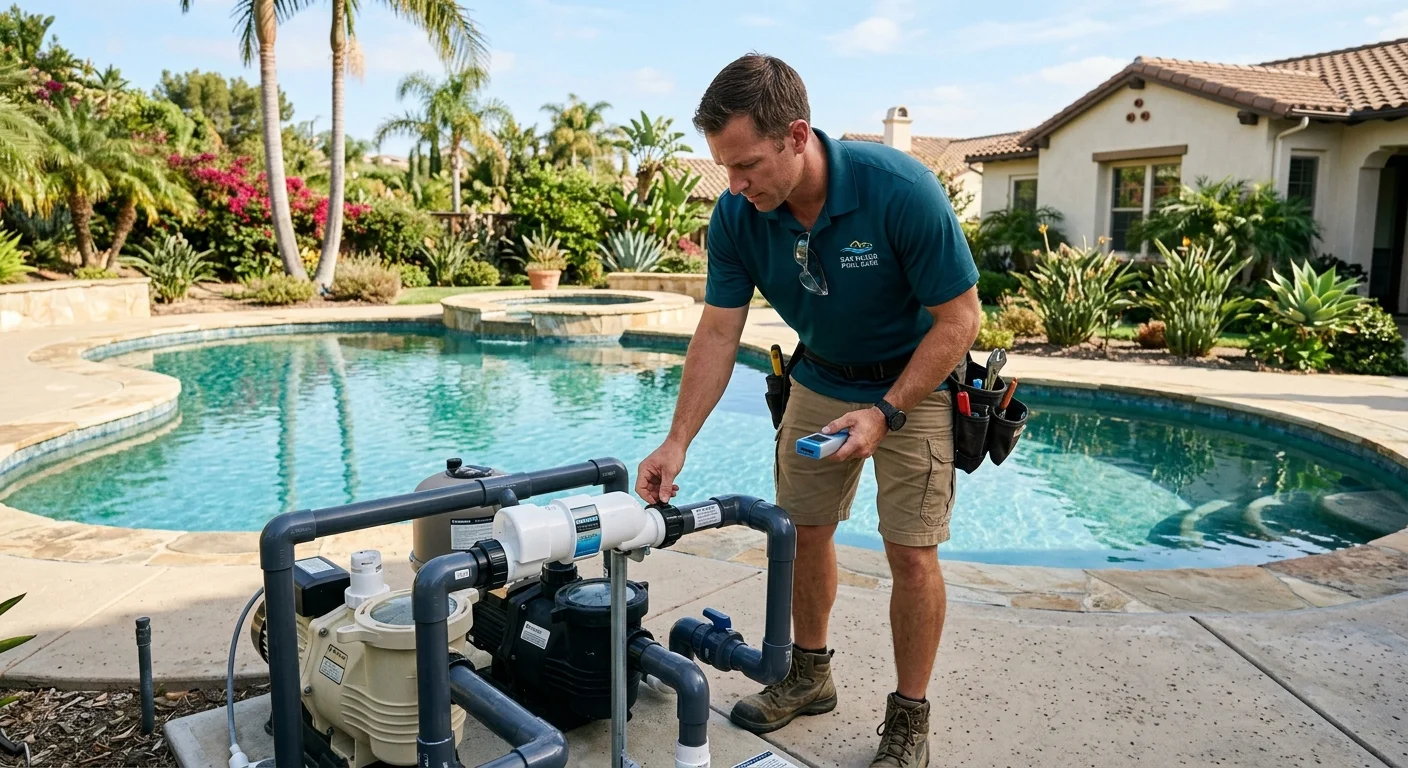
A salt cell not producing chlorine needs diagnosis before replacement. Low chlorine can come from poor flow, unsuitable water conditions, scale, a control fault, or a worn cell. Start by testing the water independently, confirming circulation, and reading the manufacturer’s diagnostics.
What a salt cell not producing chlorine usually means
A low chlorine test doesn’t prove the salt cell has failed. It only shows that the pool has less free chlorine than it needs at that moment.
A salt system passes dissolved saltwater across energized cell plates. That process produces chlorine while water moves through the cell. Production depends on circulation, the controller, the cell surface, and water conditions staying within the equipment maker’s operating range.
Chlorine also disappears as it works. The CDC’s swimming pool guidance notes that sunlight, sweat, dirt, swimmer waste, and droplet-making jets reduce chlorine levels. A working generator can fall behind that demand.
That difference shapes the diagnosis. A low test result may point to heavy chlorine demand, while a blank output reading may point toward flow, power, or controls. Warning lights and error codes must be read against the manual for that exact model. The same light can’t be interpreted across every brand.
The older guide to a salt cell that isn’t working covers basic owner checks. This repair-focused guide goes further by separating water problems from equipment faults.
| What you find | What it suggests | What comes next |
|---|---|---|
| Low chlorine with normal system status | Chlorine demand may exceed current production | Test the water and review recent pool conditions |
| A flow warning | Water may not be moving through the cell correctly | Inspect circulation before testing the cell |
| Mineral crust on the plates | Scale may be covering the working surface | Clean it by the manufacturer’s method, then retest |
| No power or a control fault | The cell may not be receiving the correct command | Test the power path, wiring, and controller |
| Normal flow and controls but no production | The cell surface or another component may be worn | Confirm electrical readings before replacing parts |
The order matters. Replacing a cell won’t clear a blocked filter or repair its controller.
How flow and water balance affect chlorine production
Steady water flow lets the generator operate and carry chlorine into the pool. When circulation drops, the system may reduce output or stop energizing the cell.
A full pump basket, dirty filter, closed valve, plumbing blockage, pump problem, or faulty flow sensor can trigger that condition. Air moving through the equipment can also make circulation unstable. The controller’s flow light is useful, but the whole equipment pad still needs inspection.
Start with the pump and filter. Water should move through the intended valves, through the cell, and back through the returns. Our guide to weekly pool cleaning and maintenance explains how routine equipment checks fit alongside water care.
Water chemistry creates a different problem. Each salt system has a manufacturer-specified salt range. A pool pro can compare an independent salt test with the controller reading instead of adding salt from the display alone. Temperature limits and other operating conditions also vary by model, so the equipment manual controls those decisions.
Pool pH affects how well chlorine works. The CDC recommends a pool pH of 7.0 to 7.8 and says chlorine kills germs more slowly above that range. Poor balance can also encourage deposits on the cell surface.
Local conditions change chlorine demand. An open Santee pool receives different sun exposure than a sheltered Point Loma courtyard under the marine layer. Swimmers, windblown debris, and water features add more demand. Those conditions can make a working cell appear weak.
Regular saltwater pool maintenance in San Diego helps catch changing chemistry and circulation before the water turns cloudy or green.
Why scale blocks the cell’s working surface
Scale blocks chlorine production by covering the cell plates with mineral deposits. The generator needs exposed plate surfaces and moving saltwater to complete its process.
The buildup often looks like a chalky or crusted layer between the plates. Heavy deposits can restrict the narrow water passages inside the cell. That creates two problems at once: less working surface and poorer flow through the housing.
San Diego pool water can leave visible mineral evidence elsewhere too. A pale ring along the tile line may appear near the same time as deposits inside the cell. The San Diego hard-water pool guide explains how dissolved minerals affect pool surfaces and equipment.
Cleaning helps only when deposits are causing the loss of output. The cell must be powered down and removed according to its manufacturer’s instructions. Cleaning products, concentrations, and procedures vary. A matched pool pro can identify the cell model and use the method specified for it.
A clean-looking cell can still be worn. Chlorine production occurs at a coated working surface, and cleaning can’t restore that surface after it has deteriorated. Cleaning also won’t repair a cracked housing, damaged cable, failed sensor, or controller fault.
That’s why visual inspection is one part of the diagnosis. The cell should be tested again after scale removal. If flow and water conditions are correct but output remains absent, the repair moves toward electrical and component testing.
When cleaning helps and when parts need repair
Cleaning is the right correction when scale covers an otherwise working cell. Parts testing makes more sense when the plates are clean, flow is steady, and the controller still reports no production.
The first pass should separate the cell from everything around it. A technician checks that the pump is running, valves are positioned correctly, and the filter isn’t restricting circulation. The flow sensor and its connection come next. Only then does testing move toward cell power and controller output.
Control problems can resemble cell failure. A timer may not be sending power when expected. A loose connection can interrupt communication. A sensor may report an unsuitable condition even when the water test says otherwise. The control board can also fail to energize a healthy cell.
Physical damage creates clearer repair territory. Cracks around the housing, damaged cable ends, burned connections, or leaking unions need component-level attention. The pro should identify the failed part rather than replacing the whole system by default.
A worn cell is different from a dirty one. Its working surface no longer produces adequate chlorine even after circulation, water conditions, and controls have been confirmed. Replacement becomes reasonable only after those other causes are ruled out.
This distinction also matters for pools considering a broader salt water conversion or system service. A failed component doesn’t always mean the whole installation is wrong. The plumbing layout, controller compatibility, electrical supply, and remaining equipment should guide the repair decision.
Ask the pro to explain which test isolated the fault. A clear diagnosis should connect the failed reading to the recommended part.
How a pool pro confirms the cell is producing
A pool pro confirms production by testing the water and equipment as separate systems. That prevents low pool chlorine from being mistaken for automatic proof of cell failure.
The process starts with an independent water test. The controller display isn’t a substitute for measuring pool conditions. The CDC recommends testing chlorine and pH at least twice daily, with more frequent testing during heavy use. It also says DPD test kits are more accurate than test strips.
Next comes circulation. The pro checks the pump, baskets, filter, valves, returns, and flow indication while the generator is supposed to run. Any restriction gets addressed before electrical readings are used to judge the cell.
The cell is then inspected for scale, damaged connections, leaks, or visible wear. After that, controller diagnostics can be compared with the specifications for the exact model. Voltage, current, error codes, salt readings, temperature status, and output commands only make sense against that manufacturer’s instructions.
This order avoids guesswork. It can show that the generator is operating but chlorine demand is high. It can also reveal a circulation fault, scaled cell, failed sensor, damaged controller, or depleted cell surface.
Equipment repair should be handled by a qualified pool professional. Ask for the contractor’s license number when equipment or construction work is involved, then confirm it through the California Contractors State License Board lookup.
After repair, ongoing weekly pool care can track chlorine, pH, circulation, and new scale. That follow-up shows whether the repair corrected the underlying problem.
When to call us
Call when flow looks normal but output remains absent, scale returns, controls show a fault, or electrical testing is needed. Splash Pro Pools connects homeowners with independent local pros who handle diagnosis, cleaning, and salt cell repair. Call us at (760) 642-1256 and we’ll connect you with a licensed local pool pro.
Frequently asked questions
Why is my salt cell running but chlorine stays low?
Sunlight, swimmer waste, dirt, poor circulation, scale, water balance, or worn equipment can leave chlorine low. Test the water and generator separately before replacing the cell.
How do I know if my salt cell is working?
An independent water test, controller diagnostics, flow inspection, and cell inspection help confirm production. A pool pro can also compare electrical readings with the manufacturer’s specifications.
Will cleaning fix a salt cell that stopped working?
Cleaning helps when mineral scale covers the cell plates. It will not repair a flow sensor, control board, power problem, or worn cell surface.
Should I replace the cell or the control board?
Check circulation, water conditions, scale, wiring, and controller diagnostics first. Testing should identify which component failed before either part is replaced.
Need professional help in San Diego County?
Splash Pro Pools connects San Diego homeowners with pool pros for the work in this post.