Pool water testing in San Diego starts with the two readings the CDC names first: free chlorine and pH, at least twice a day, on a DPD kit. A matched local pool pro then reads the rest of the sample so the dose matches this yard’s fill water, sun, and bather load, not a strip from the garage.
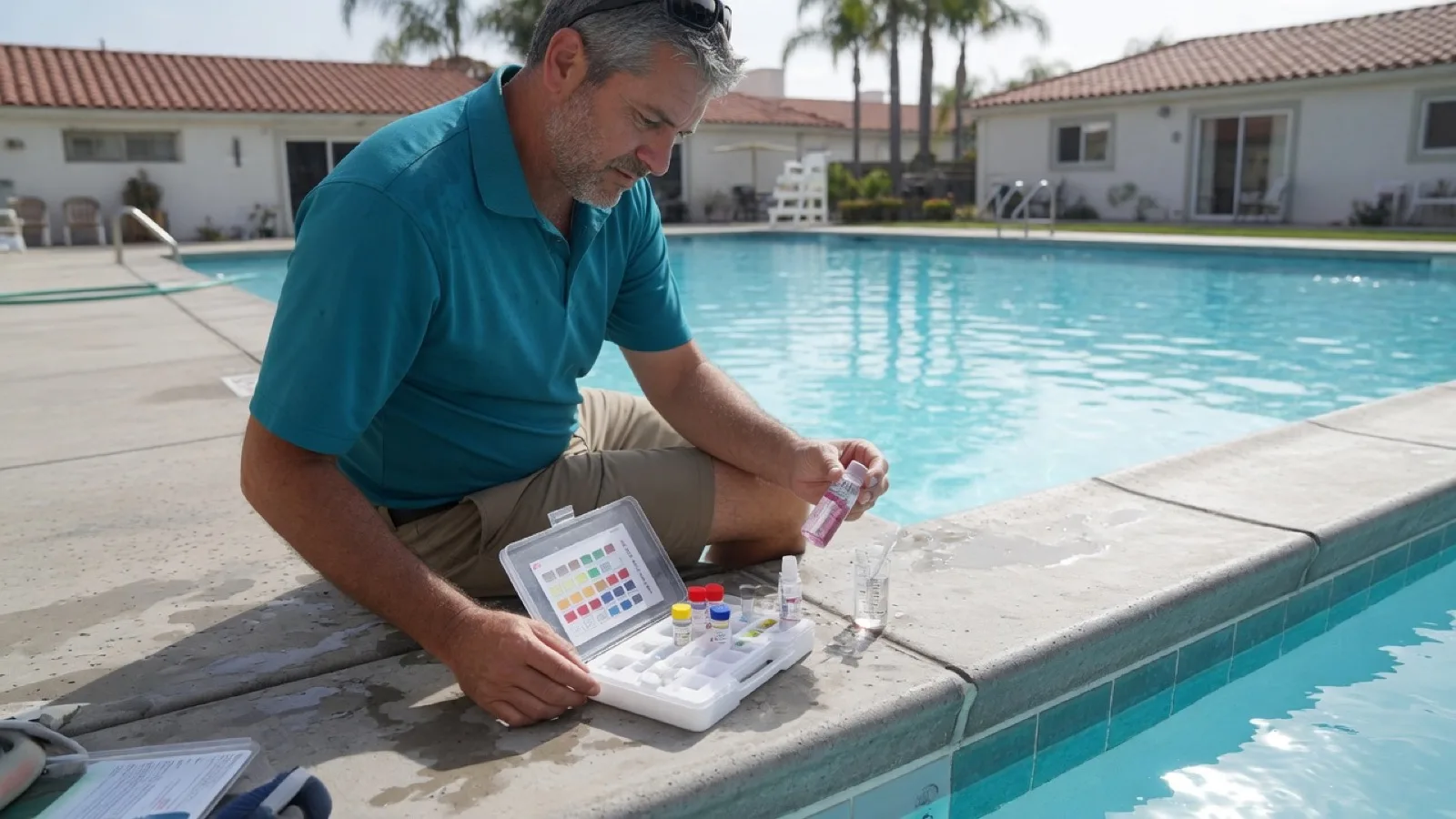
What the CDC wants tested, and how often
The CDC home-pool page (May 10, 2024) says chlorine and pH are the first defense against germs, and that owners must routinely test and adjust both. Test at least twice per day, more under heavy use.
CDC pool range for pH is 7.0 to 7.8. Free chlorine is at least 1 ppm in pools, and at least 2 ppm if cyanuric acid or dichlor/trichlor is in the water. Hot tubs: at least 3 ppm, and do not use cyanuric acid there. Below pH 7.0, water corrodes pipes and equipment. Above 7.8, chlorine kills germs more slowly.
Pee, poop, sweat, dirt, sunlight, and droplet-making jets all reduce chlorine. Inland August sun on an El Cajon plaster pool is a chlorine eater. A Point Loma spa spillover adds the jet effect the CDC names. Neither yard can skip the kit.
DPD kits versus strips
The CDC wants a DPD kit for the most accurate chlorine and pH results. Strips are allowed, and they are less accurate. If chlorine in the sample is more than 10 ppm, DPD can bleach out and read a false low or zero. Follow the kit manufacturer’s directions either way.
Taylor Technologies (May 15, 2025) adds a sampling rule: elbow-deep, away from return jets. Morning readings, before the sun has worked the chlorine, make day-to-day comparisons cleaner. Store reagents away from heat, cold, and direct sun, lids tight.
The split between free, combined, and total chlorine is its own page: free chlorine vs total chlorine. Testing is the habit. That page is the arithmetic.
What else the sample is for
Chlorine and pH decide whether the water can kill germs. Alkalinity tells the pro how hard pH will swing when they add a base or an acid. Hardness and stabilizer explain why a dose that worked in May fails in September. Those extra numbers do not replace the CDC pair. They keep the pair from lying.
San Diego fill is not one tap. The Water Authority’s 22 member agencies serve 3.3 million people. A Padre Dam top-off in Santee is not an Oceanside tap. Test what the hose is adding if the kit keeps drifting after every fill. Our how to raise pH and pool pH too high or too low pages are the corrections. This page is the measurement.
How San Diego weather changes the cadence
Twice a day is the CDC floor. A Saturday party, a Santa Ana blow, or a week of inland heat is the “more often” clause. Rain dilutes. Wind drops dust. Salt cells and sheers strip carbon dioxide and walk pH up. Trichlor in a feeder walks pH down. None of that is visible without the kit.
A weekly pool cleaning stop is how most owners get a DPD reading they did not have to run themselves. The pro on that route already knows whether the property is an inland evaporator or a coastal aerator.
When to call us
Call when the kit and the water disagree, when strips and a DPD vial tell two stories, or when chlorine vanishes between morning and dinner. A matched local pool pro will sample away from the jets and read the CDC pair for real.
Frequently asked questions
How often should I test pool water?
The CDC's home-pool page (May 10, 2024) asks owners to test chlorine concentration and pH at least twice per day, and more often when the pool or hot tub is busy. San Diego sun, weekend swim loads, and inland evaporation make that schedule practical.
Are test strips good enough?
The CDC rates a DPD test kit as more accurate than strips. Strips still have a use as a quick screen. Hard San Diego fill is where strips like to lie, which is why a matched pro carries DPD for the readings that decide a dose.
What chlorine number should a pool show?
The CDC recommends at least 1 ppm free chlorine in pools, and at least 2 ppm if you use cyanuric acid or stabilized chlorine such as dichlor or trichlor. Hot tubs need at least 3 ppm, and the CDC recommends not using cyanuric acid in hot tubs.
Where should I dip the sample?
Taylor Technologies (May 15, 2025) says collect the sample elbow-deep beneath the surface, away from return jets. A scoop off the surface next to a spa spillover is not the pool.
Why did my kit read zero chlorine when I just added some?
The CDC warns that if the sample is over 10 ppm chlorine, a DPD test can bleach out and show a false low or zero. High shock leftovers are a common way to get that fake zero.
Need professional help in San Diego County?
Splash Pro Pools connects San Diego homeowners with pool pros for the work in this post.