Pool water recycling San Diego homeowners search for is usually mobile reverse osmosis, which treats water while it remains in the pool. Recycling fits clear water burdened by calcium, salts, phosphates, or cyanuric acid. Draining and refilling fits only after a pool pro confirms recycling won’t solve the problem and identifies a legal discharge route.
What is pool water recycling?
Pool water recycling is an on-site treatment for dissolved buildup. A mobile system pulls water from the pool, passes it through reverse osmosis membranes, and returns treated water. The shell stays full throughout the process.
Portside Pool Purification, a San Diego and North County provider, says its process lowers calcium hardness, total dissolved solids, salts, phosphates, and cyanuric acid. Those materials remain in the water after ordinary filtration because a pool filter catches particles, not most dissolved substances.
Reverse osmosis works differently. Pressure moves water through membranes that separate much of the dissolved load from the water being returned. A smaller reject stream carries the separated material away through an approved wastewater route. Fill water replaces that rejected share.
This isn’t routine cleaning or algae treatment. Mobile reverse osmosis doesn’t remove algae or suspended solids, so the pool should be clear first. It also won’t repair a leak, replace damaged equipment, or renew worn plaster. Those are separate problems.
That distinction matters after years of stabilized chlorine use or repeated evaporation and refilling. Cyanuric acid and mineral concentrations can keep rising even when the water looks blue. Testing shows what has accumulated. A pool pro can then compare recycling with a controlled drain and refill based on the actual water, finish, and discharge options.
Recycle or drain and refill: which makes sense in San Diego?
Recycling usually makes sense when the pool is clear and dissolved buildup is the main problem. Draining becomes the stronger option when testing shows reverse osmosis can’t address the problem, or when the pool must already be emptied for other work.
| Decision factor | Mobile reverse osmosis | Drain and refill |
|---|---|---|
| Dissolved buildup | Membranes lower calcium, salts, phosphates, and cyanuric acid. | Old water leaves and fresh water replaces it. |
| Pool shell | The pool remains full during treatment. | The finish is exposed while the pool is empty. |
| Wastewater | Only the rejected portion needs a legal discharge route. | The full drained volume needs an approved destination. |
| Algae or suspended debris | The pool must be cleared before treatment. | Draining isn’t a substitute for diagnosing the underlying water problem. |
| Other planned work | Treatment can focus on water alone. | An empty pool may align with approved finish work. |
Discharge rules change across San Diego County. The San Diego County Water Authority has 22 retail member agencies, and each pool owner gets local rates and directions from the agency serving that property.
Inside City of San Diego limits, San Diego Municipal Code §§43.0304 and 43.035(e)(3) prohibit pool water and filter backwash from entering the storm drain system. The City’s guidance describes strict conditions for prepared nonsaline water. It must be dechlorinated, have a pH from 7 to 8, match ambient temperature, and contain no algae, algaecides, debris, or suspended solids. The flow path must be swept, and the owner must be able to document compliance.
Salt pool water can’t enter City gutters or storm drains except through the narrow direct route described for a naturally saline water body. Sanitary sewer discharge through an onsite sink or lateral cleanout requires Public Utilities Department approval. Gradual landscape irrigation is another option when soil absorbs the water without runoff or erosion.
Oceanside, Vista, Encinitas, La Mesa, and other cities set their own stormwater rules. Review those before following any guide to draining a pool in San Diego.
When does a San Diego pool actually need new water?
New water becomes part of the plan when testing finds dissolved material that treatment must remove or dilute. Pool color alone doesn’t settle that decision. Clear water can still carry accumulated calcium, salts, phosphates, or cyanuric acid.
Evaporation leaves dissolved minerals behind. Repeated additions of stabilized chlorine can also raise cyanuric acid over time. Ordinary filtration won’t remove those dissolved materials. Mobile reverse osmosis can lower them while preserving most of the existing water.
Green or cloudy water points to a different first step. Portside states that its mobile process doesn’t remove algae or suspended solids, so the water needs to be clear before membrane treatment. Draining without diagnosing the cause can leave the circulation, filtration, or care problem untouched.
A falling waterline also calls for diagnosis before treatment. Paying to recycle or replace water makes little sense while that water is escaping. A local pro can perform pool leak detection and repair before anyone commits to a water exchange.
The finish may also shape the plan. A pool already scheduled for approved surface work will be handled differently from a sound, occupied pool that only has a chemistry problem. Inside City of San Diego limits, overfilling pools and spas is prohibited under Municipal Code §67.3803(e). That makes controlled filling and active water-level monitoring part of the job.
How much does pool water recycling cost in San Diego?
Portside Pool Purification’s published San Diego price is $800 for pools up to 20,000 gallons. Its posted schedule adds $15 for each additional 1,000 gallons. These figures were reviewed in August 2026 and belong to that provider, not Splash Pro Pools.
Under that schedule, a 25,000-gallon pool would cost $875. The calculation is $800 plus five additional 1,000-gallon increments at $15 each. Pool volume matters because more water requires more membrane processing.
A drain and refill has a different cost structure. City of San Diego single-family water rates effective January 2026 are $8.51 per HCF for the first tier, $9.50 per HCF for the middle tier, and $11.89 per HCF above that. One HCF equals 748.05 gallons.
A 15,000-gallon refill uses about 20 HCF:
15,000 gallons ÷ 748.05 gallons per HCF = about 20 HCF
At those City rates, the water alone lands around $170 to $240, depending on where that usage falls across the account’s tiers. That calculation comes before sewer charges or any separate pool service.
The cheaper water bill isn’t always the cheaper overall decision. A full drain sends far more water to an approved destination and leaves the pool empty. Recycling preserves most of the existing water but carries a higher treatment price. Properties outside City limits need current rates from their own city or water district before comparing the totals.
How mobile reverse osmosis recycling works
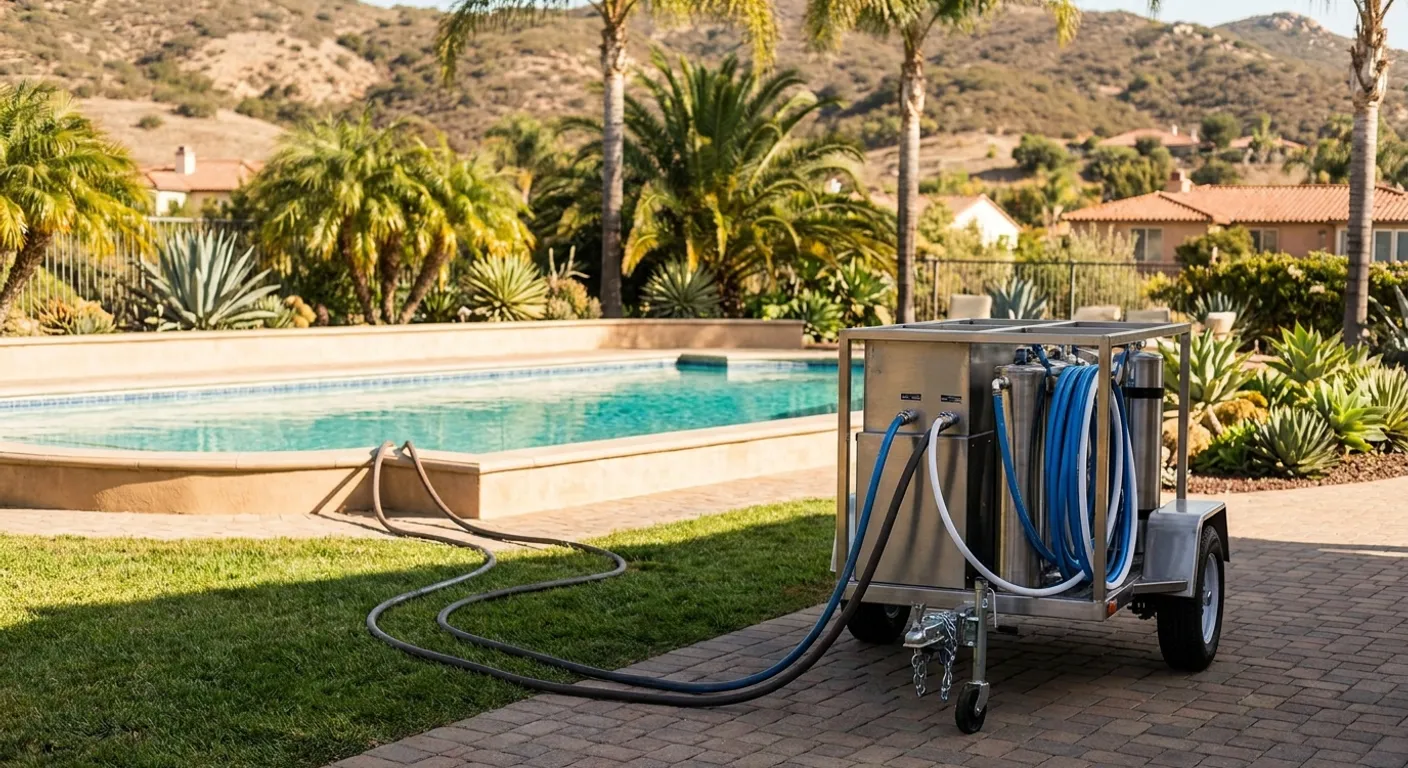
Mobile reverse osmosis creates a temporary treatment loop between the pool and a trailer-mounted system. One hose pulls pool water into the equipment. Membranes separate much of the dissolved buildup, and another hose returns treated water to the pool.
The membranes target substances that ordinary pool filters leave behind. Portside lists calcium hardness, total dissolved solids, salts, phosphates, and cyanuric acid among the materials reduced by its process. The pool remains full as water moves through the loop.
Portside says its trailer can process 30,000 gallons in 24 hours. Most residential pools take 12 to 16 hours under its published operating description. Those are treatment durations from that specific provider, not an arrival or completion promise from Splash Pro Pools.
Some water becomes the concentrated reject stream. Portside reports that roughly 15% to 25% of the pool water can’t be recycled. That portion goes through a sewer cleanout, and fresh fill water replaces it. The contractor still needs to follow the property’s local wastewater rules and obtain any required approval.
Clear water is a starting condition, not an optional detail. Algae and suspended solids need separate treatment before mobile reverse osmosis begins. Afterward, the water should be tested again so the servicing pro can adjust the pool’s operating chemistry based on current results.
Does recycled water hurt your pool or plaster?
Mobile reverse osmosis treats the water, not the plaster. The pool stays full, and the membranes operate outside the shell. The process doesn’t grind, wash, coat, or resurface the finish.
That makes water recycling different from an acid wash or replastering project. Reverse osmosis lowers dissolved material in circulating water. It doesn’t strip existing scale from tile, fill cracks, smooth rough areas, or restore a worn surface.
Water chemistry still matters after treatment. The CDC’s healthy swimming guidance recommends keeping pool pH between 7.0 and 7.8. It also recommends at least 1 ppm free chlorine in pools, or at least 2 ppm when cyanuric acid or stabilized chlorine is used.
The CDC explains that chlorine kills germs more slowly when pH rises above 7.8. Water below pH 7.0 can corrode pipes and equipment. Testing chlorine and pH before normal pool use gives the servicing pro current information rather than an assumption based on appearance.
Existing finish damage needs its own inspection. If the concern is peeling material, exposed areas, or a surface that no longer cleans normally, water purification won’t rebuild it. A licensed contractor can determine whether pool resurfacing and replastering belongs in the plan. Recycling and resurfacing solve different problems.
When to call us
Bring in a licensed pool pro when the decision involves wastewater routing, persistent chemistry problems, a leak, equipment, or the pool finish. You can confirm a contractor’s status through California’s CSLB license check. Call us at (760) 642-1256 and we’ll connect you with a licensed local pool pro.
Frequently asked questions
Is pool water recycling the same as draining?
No. Mobile reverse osmosis circulates water through external membranes and returns treated water while the pool stays full.
How much does pool water recycling cost in San Diego?
Portside Pool Purification's published San Diego pricing, reviewed in August 2026, is $800 for up to 20,000 gallons and $15 for each additional 1,000 gallons.
Can reverse osmosis remove algae from a pool?
No. Mobile reverse osmosis removes dissolved buildup, not algae or suspended solids. The water should be clear before treatment.
Can pool water enter a City of San Diego storm drain?
City rules generally prohibit pool water and backwash in storm drains. Prepared nonsaline water must satisfy every condition in the City's storm water guidance.
Need professional help in San Diego County?
Splash Pro Pools connects San Diego homeowners with pool pros for the work in this post.