If you’ve got a pool in Spring Valley, you already know the waterline tile scales up faster than it should. Pool tile cleaning cost in Spring Valley runs a bit higher than the San Diego County average, typically $5 to $7.50 per linear foot, or $450 to $900 for a full job on a standard residential pool. The reason comes straight out of the tap: Otay Water District serves this part of East County, and its water sits at 14 to 16 grains per gallon, some of the hardest water anywhere in San Diego County.
Why Spring Valley pools scale faster than the county average
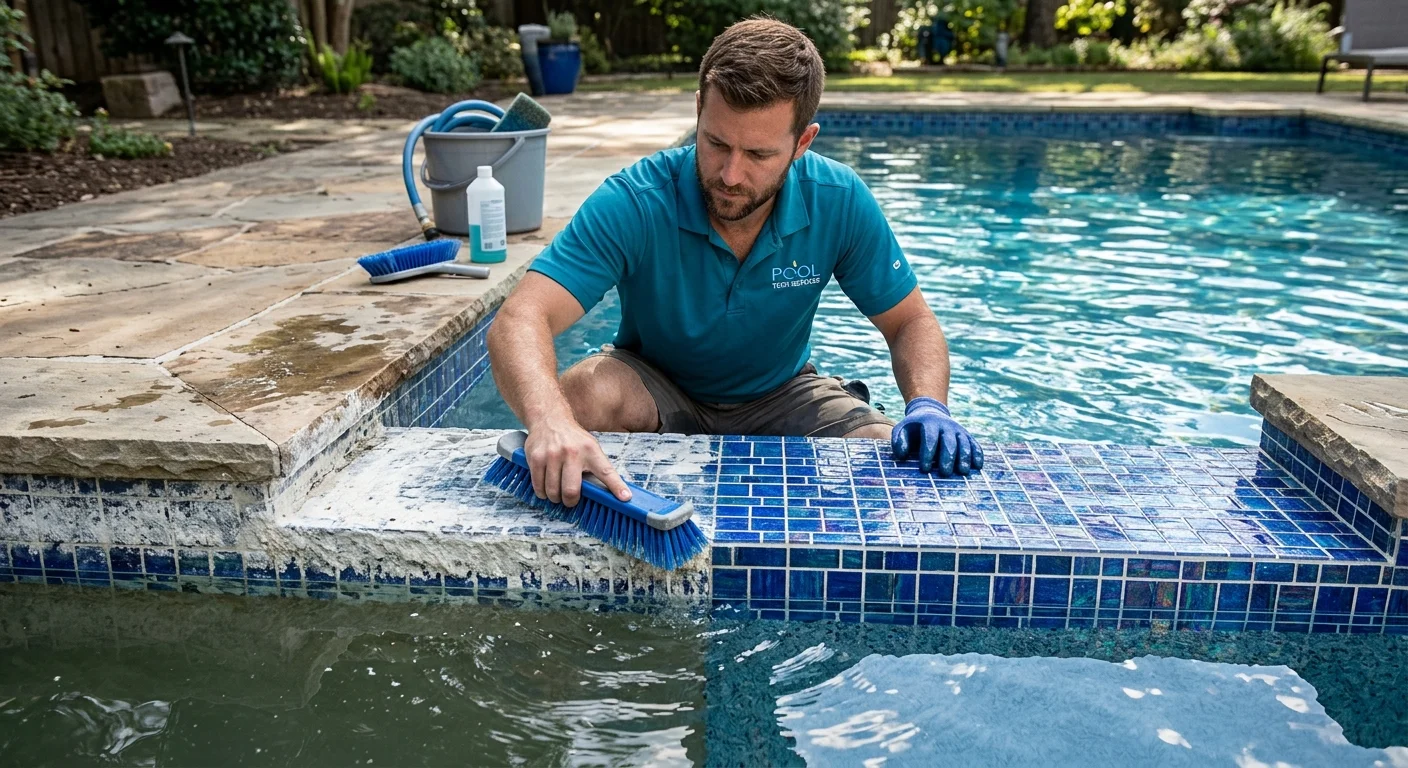
Every pool loses water to evaporation, and every gallon that evaporates leaves its dissolved minerals behind. In Spring Valley, that mineral load is heavier than what pools in coastal North County deal with. Calcium and magnesium ride the water in from Otay Water District’s supply, and as the sun does its work on an exposed backyard pool, those minerals concentrate right at the waterline. That’s the thick white or gray band you see creeping up the tile.
Spring Valley has another factor working against it: age. Roughly 53.7% of homes here were built before 1978, according to Census ACS figures, and pools built in that era carry the same vintage. Older grout is more porous. Older plaster has already absorbed decades of hard water. Put very hard water on top of an aging pool shell, and the calcium has more places to grab hold. That combination is why a Casa de Oro or La Presa pool that hasn’t been serviced in a couple of years often shows a heavier scale line than a comparable pool in Carlsbad or Encinitas, where the water runs softer.
None of this means the tile is ruined. It means the cleaning schedule needs to match the water, not a generic countywide rule of thumb. That’s the difference between managing calcium and fighting it every season. If you want the fuller picture of how this same hard water affects plaster and equipment, not just tile, our guide on calcium removal in Spring Valley covers the rest of it.
What pool tile cleaning costs in Spring Valley
Pricing for professional tile cleaning runs on linear feet, meaning the full perimeter of your pool where tile meets water. Here’s how that breaks down for a typical Spring Valley pool:
- Light to moderate buildup: around $5.00 to $6.00 per linear foot. This is a haze or thin line that hasn’t had years to set in.
- Heavy, long-neglected buildup: $6.00 to $7.50 or more per linear foot, since it takes more media, more passes, and more time to strip years of scale without damaging the glaze.
- Small pool (around 60 linear feet): roughly $300 to $450.
- Medium pool (around 90 linear feet): roughly $450 to $675.
- Large pool with an attached spa (around 120 to 140 linear feet): roughly $600 to $1,050.
Most companies, Splash Pro Pools included, set a minimum service charge in the $350 to $400 range to cover the trip and equipment setup on smaller jobs. If your pool has a raised spa, a tanning ledge, or an unusually long perimeter, expect the estimate to land toward the higher end of these ranges. A pro should always walk your tile line and give you a firm number before starting, not a phone quote based on square footage alone.
Compare that to the broader San Diego average of $4 to $7 per linear foot, and you can see Spring Valley sits consistently in the upper half of that band. It’s not a markup. It’s the water.
Bead blasting versus acid washing for Spring Valley tile
These two methods get confused constantly, and using the wrong one on the wrong surface causes real damage. Pool tile and calcium cleaning in Spring Valley is almost always a bead blasting job, not an acid wash.
Bead blasting projects a fine, food-grade abrasive media, often glass bead or a soda-based blend, at the tile under controlled pressure. It lifts calcium off the surface without etching the glaze underneath, and it works into the grout lines where scale likes to hide. This is the right tool for waterline tile, which is where nearly every Spring Valley calcium complaint shows up.
Acid washing is a different process entirely. It’s meant for plaster, pebble, or quartz pool surfaces, not tile, and it works by removing a thin layer of the surface itself along with the stains sitting on it. Used on tile or on grout that hard water has already softened over the years, acid washing can pit the glaze, eat into the grout, and shorten the life of both. If a company quotes an acid wash to fix your tile line, that’s a sign to ask more questions before booking.
How to stretch time between tile cleanings
You can’t out-chemistry Otay Water District’s mineral content, but you can slow how fast it shows up on your tile. A scale inhibitor added during regular weekly pool cleaning and maintenance binds to dissolved calcium before it has a chance to crystallize on a surface. Keeping pH and total alkalinity inside the normal range matters just as much, since high pH pushes calcium out of solution faster.
A quick weekly wipe of the waterline with a tile brush, before scale has a chance to harden, also buys real time. Once calcium sets past a light haze, brushing alone stops working and you’re back to professional bead blasting. Partial drain-and-refill every few years, done carefully and in line with water conservation guidance from the San Diego County Water Authority, dilutes the accumulated mineral load in the water itself rather than just treating what lands on the tile.
None of that eliminates the need for a periodic professional cleaning in a hard-water area like Spring Valley. It does stretch the interval and keep each visit shorter and cheaper.
What’s included in a professional visit
A tile cleaning appointment isn’t just someone showing up with a blaster and hosing off the waterline. A proper visit starts with the pro walking the full perimeter and noting where the buildup is thickest, since a pool with a raised spa or a shaded side often scales unevenly. From there, the technician sets up the blasting equipment, tests a small section first to confirm the media and pressure are right for your specific tile (glass, ceramic, and stone all respond a little differently), then works the full waterline in sections.
Grout gets particular attention in Spring Valley, since it’s usually the softest part of the surface and the first place hard water damage shows. A careful pro slows down around grout lines instead of blasting through them at the same pressure used on the tile face. Once the perimeter is clean, the water gets vacuumed of any loosened debris and the chemistry gets checked, since a fresh tile line paired with unbalanced water just starts the scaling clock over again. Expect the whole process to take two to four hours depending on pool size and how much scale has built up.
Ask whether scale inhibitor treatment is included or offered as an add-on. Given how fast Otay Water District’s water rebuilds a calcium line, starting a chemical prevention plan the same day as the cleaning is worth the extra cost for most Spring Valley pools. Calcium doesn’t stop at the tile line either. It settles in cartridges and sand beds too, so a pool filter cleaning on the same schedule keeps the whole system running the way it should.
Getting it done
Tile calcium is one piece of what a pool service in Spring Valley covers alongside weekly cleaning, equipment checks, and the occasional catch-up work that older East County pools tend to need. A pro looks at your actual tile line, tells you where it falls in the pricing range above, and handles the bead blasting with equipment sized for your pool’s perimeter. Call (858) 400-6757 to get a number for your pool.
If your tile issue is tied to a bigger chemistry problem, it’s worth reading through our guide on hard water in San Diego pools for the full picture of what Otay Water District’s supply does to a pool beyond the waterline.
Frequently asked questions
How much does pool tile cleaning cost in Spring Valley?
Most Spring Valley homeowners pay between $450 and $900 for a full tile cleaning, or roughly $5 to $7.50 per linear foot. That's the upper half of the countywide range, driven by Otay Water District's very hard water. A pro gives you an exact number after seeing the tile in person.
Why does Spring Valley pool tile scale faster than other parts of San Diego?
Otay Water District delivers water in the 14 to 16 gpg range, among the hardest in the county. Every bit of evaporation leaves calcium behind on the waterline, and older Spring Valley homes with decades-old plaster and grout give that calcium more surface to grip.
Is bead blasting or acid washing better for Spring Valley pool tile?
Bead blasting is the right call for waterline tile calcium, which is what most Spring Valley pools deal with. Acid washing targets plaster and pebble surfaces, not tile, and it's too aggressive for grout that's already been softened by years of hard water.
How often should Spring Valley pools get tile cleaning?
Plan on every 18 to 24 months rather than the 2 to 3 years common in softer-water parts of the county. If you can already feel a rough line at the waterline, don't wait for a full season to pass before calling.
Can I remove calcium from my own pool tile?
Light buildup will respond to a pumice stone or a calcium-specific cleaner used carefully. Anything beyond a thin haze risks scratching the glaze or pushing calcium deeper into the grout, which is when a professional bead blast becomes the cheaper option in the long run.
Need professional help in San Diego County?
Splash Pro Pools connects San Diego homeowners with pool pros for the work in this post.