Pool phosphates are a food source for algae, nothing more and nothing less. They get into your water through yard dust, lawn fertilizer runoff, and decaying leaves. Having phosphates in your pool doesn’t automatically turn it green. Chlorine still does the actual work of killing algae. But when phosphates build up, your sanitizer has to work a lot harder to keep the water clear, and a small dip in chlorine can lead to a fast bloom. Testing for phosphates a couple of times a year tells you whether treatment is worth the money. The pros we connect you with can run that test and tell you exactly where you stand.
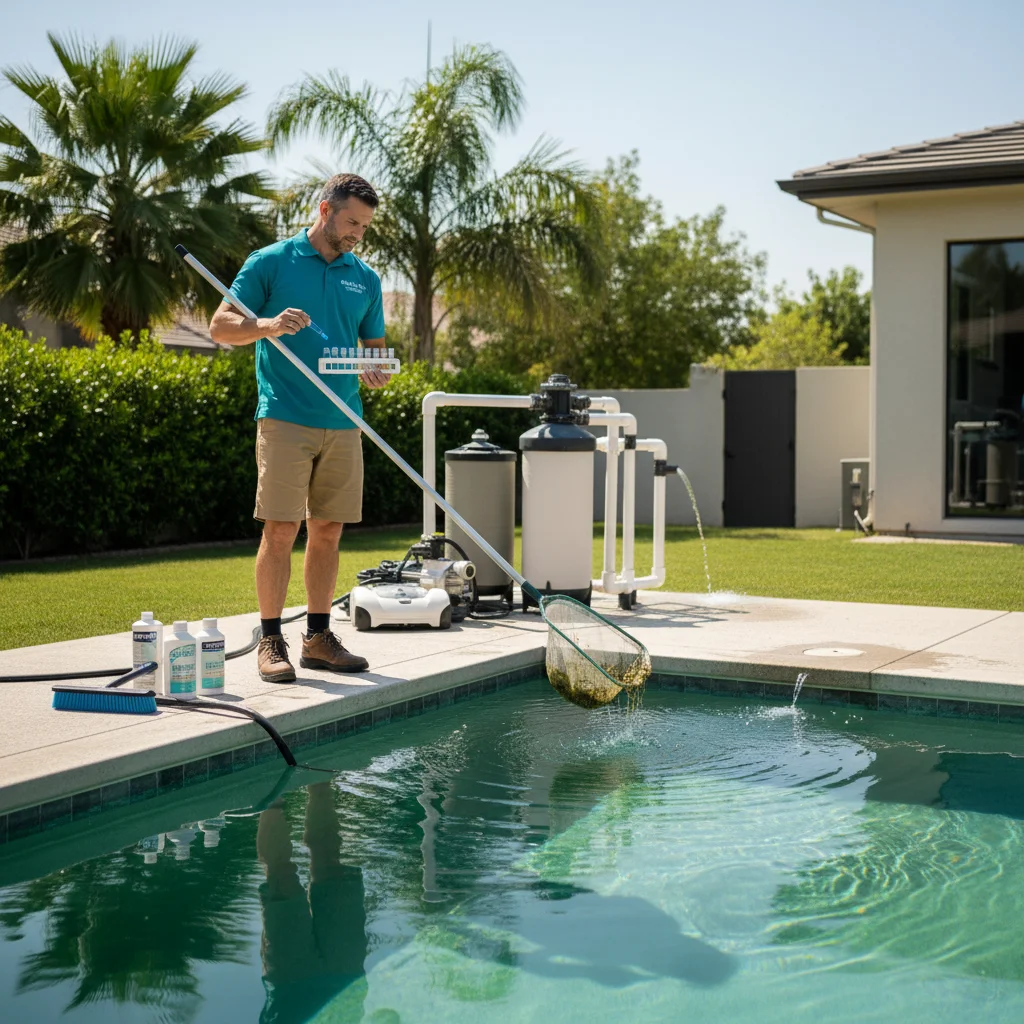
What pool phosphates actually are and where they come from
Phosphates are naturally occurring compounds made of phosphorus and oxygen. In a backyard, they act as plant food. Algae is a microscopic plant, and phosphates give it exactly what it needs to grow and spread.
These compounds reach your water through a handful of common routes. Lawn fertilizer carries a heavy concentration of phosphorus to keep grass green. When sprinklers run or rain falls, that fertilizer washes across the deck and straight into the pool.
Decaying organic matter is another steady source. Every leaf, twig, or piece of grass clipping that lands in the skimmer or sinks to the bottom releases phosphates as it breaks down in the water.
Your fill water adds a little too. Many municipal water systems treat pipes with orthophosphate compounds to prevent corrosion and keep drinking water safe to carry. Every time you top off your pool, you’re adding a small dose of the same plant food.
Wind carries the rest. Fine dust and dirt settling on the surface dissolve slowly, and the phosphates they carry stay suspended in the water.
Why San Diego pools tend to build up phosphates
Local climate makes phosphate management an ongoing chore here. Santa Ana winds push heavy dust out of the desert and straight into backyards across the county. Pools in El Cajon and other inland North County and East County communities catch the worst of it, and that fine dust settles into the water and dissolves over the following days.
San Diego’s landscaping culture doesn’t help. Mature palms, eucalyptus, and bougainvillea constantly drop material near the water, and a landscaper’s leaf blower can push yard debris straight toward the pool instead of away from it. Every bit of organic matter that ends up in the skimmer adds to the phosphate load as it decays.
San Diego pools also run year-round, which means more months of evaporation concentrating whatever is already in the water. Minerals and compounds that arrive with the fill water don’t leave when the water evaporates, they stay behind and build up over time. Our guide on why pools go green in San Diego covers how these local conditions stack together against a pool’s chemistry.
How phosphates interact with chlorine and your algae risk
A common myth says phosphates directly cause algae blooms. That’s not accurate. Phosphates alone don’t turn a pool green. Low sanitizer is the real trigger.
The CDC recommends keeping free chlorine at a minimum of 1 ppm in a typical pool, or at least 2 ppm if you’re using cyanuric acid or a stabilized chlorine product. As long as chlorine sits in that range and keeps working, it kills algae spores before they can take hold.
Phosphates work as an accelerant to that process. They give any surviving algae an endless food supply, so when chlorine dips even briefly, the bloom that follows can be much faster and more severe than it would be in a low-phosphate pool.
Chlorine gets consumed constantly by sweat, dirt, and sunlight, and once pH climbs above 7.8, it kills germs more slowly on top of that. That slower reaction time is exactly the window algae needs, and high phosphates mean there’s a much bigger food supply waiting when that window opens. This is part of why a pool can look fine one week and be visibly cloudy or green the next, a pattern our guide to cloudy pool water walks through in more depth.
Testing for phosphates and deciding what to do about a high reading
You can’t see or smell phosphates in the water. The only way to know your level is a specific test, run either with a home phosphate test kit or by a pool professional using a lab-grade reader. That test measures phosphates in parts per billion, a unit fine enough to catch the level long before it’s visible as algae growth.
Every pool tolerates a different phosphate load depending on sunlight exposure, bather load, and how consistently the chlorine and pH stay in range. Rather than chasing a number pulled from a random source online, ask whoever tests your water for your specific reading and what they’d recommend for a pool like yours. Above a certain point, algae’s food supply outpaces what routine chlorine levels can keep in check, and that’s the point where a phosphate remover starts to make sense.
Phosphate removers are a category of specialty chemical that bind to phosphate molecules in the water and clump them into larger particles. That process can temporarily cloud the water while the chemical reacts. Once the particles clump, your filter can actually catch them, something it can’t do with dissolved phosphates on their own. From there, cleaning or backwashing the filter removes the trapped material, and with it, the food source, from the pool for good.
| Approach | Best for | Why it works |
|---|---|---|
| Routine chlorine and pH management | Low phosphate readings, standard weekly care | Chlorine kills algae spores directly before they have a chance to feed and multiply |
| Phosphate remover treatment | High phosphate readings, recurring algae despite good chlorine | Clumps dissolved phosphates together so the filter can physically remove them |
| Full green pool recovery | Swampy water, chlorine at zero, heavy algae growth already established | Resets the pool’s baseline chemistry when the biological load has outgrown normal filtration |
What a neglected phosphate problem ends up costing
When phosphates go unmanaged long enough to produce a full algae bloom, the fix usually means heavier chemical dosing and extra filtration runtime, and in the worst cases, draining part of the pool to start over.
Draining water in San Diego isn’t cheap. The City of San Diego bills single-family water on a tiered rate, and refilling a typical 15,000-gallon pool works out to about 20 hundred cubic feet (15,000 gallons divided by 748.05 gallons per HCF). At the city’s 2026 single-family tiers, that refill water alone lands somewhere around $170 to $240 before sewer charges, depending on which tier the usage falls into.
Dumping that water isn’t as simple as opening a valve to the street, either. Discharging pool water into the City of San Diego’s storm drain system is illegal, and penalties for a violation can run up to $10,000 per day per incident. Legal disposal means dechlorinating the water and getting it to a pH of 7 to 8 first, then routing it to a sanitary sewer cleanout or absorbing landscape, never a gutter or storm drain.
Keeping phosphates and chlorine in check from the start avoids all of that. A phosphate test costs very little next to a full drain-and-refill, and a remover, when it’s actually needed, protects the water you’ve already paid to fill the pool with in the first place.
Simple habits that keep phosphate levels low
Prevention costs a lot less than treatment. A few backyard habits go a long way toward keeping phosphate levels manageable without ever needing a remover.
Empty your skimmer baskets often. Pulling leaves out before they break down keeps them from leaching phosphates into the water, and a quick pass with a net across the surface does the same job for anything that hasn’t sunk yet.
Check where your irrigation is actually pointed. Sprinkler heads aimed at the pool deck wash fertilizer straight into the water every time they run, so redirecting them away from the pool cuts off a steady source. Trimming back branches that hang over the water reduces the leaf and debris load the same way.
If a test comes back low, a remover is money you don’t need to spend. Keep chlorine steady, keep pH in range, and stay on top of brushing and skimming, that combination does more for water clarity than any chemical poured in after the fact. If staying on top of it isn’t realistic with your schedule, weekly pool cleaning puts a professional’s eyes on your chemistry every seven days instead of once a season.
And if the water has already gone past the point a test kit and a remover can fix, a full green pool recovery resets the baseline instead of fighting a losing battle one dose at a time. Call (858) 400-6757 to get matched with a local pro who can test your water and tell you exactly where it stands.
Frequently asked questions
Does high phosphate mean I have to drain my pool?
No. You can treat high phosphates with a chemical remover. The chemical binds to the phosphates and traps them in your filter. Draining is only necessary if your cyanuric acid or total dissolved solids are too high to manage chemically.
Will shocking the pool remove phosphates?
Shocking the pool doesn’t remove phosphates. Chlorine kills the algae that feeds on them. The phosphates stay in the water until you use a specific remover or physically drain the pool.
Can I swim in a pool with high phosphates?
Yes. Phosphates aren’t harmful to swimmers. They’re simply a food source for plants and algae. As long as your chlorine and pH stay balanced, the water is safe.
How often should I test for phosphates?
Testing once a month during swim season is usually enough. Test again after a major wind event or if the water starts to look cloudy, so you catch a spike before it turns into a full algae bloom.
Does a pool filter remove phosphates on its own?
No. A standard filter can’t catch dissolved phosphates because the particles are too small to trap. A phosphate remover clumps the particles together first, and then the filter can pull them out of the water.
Frequently asked questions
Does high phosphate mean I have to drain my pool?
No. You can treat high phosphates with a chemical remover. The chemical binds to the phosphates and traps them in your filter. Draining is only necessary if your cyanuric acid or total dissolved solids are too high to manage chemically.
Will shocking the pool remove phosphates?
Shocking the pool doesn't remove phosphates. Chlorine kills the algae that feeds on them. The phosphates stay in the water until you use a specific remover or physically drain the pool.
Can I swim in a pool with high phosphates?
Yes. Phosphates aren't harmful to swimmers. They're simply a food source for plants and algae. As long as your chlorine and pH stay balanced, the water is safe.
How often should I test for phosphates?
Testing once a month during swim season is usually enough. Test again after a major wind event or if the water starts to look cloudy, so you catch a spike before it turns into a full algae bloom.
Does a pool filter remove phosphates on its own?
No. A standard filter can't catch dissolved phosphates because the particles are too small to trap. A phosphate remover clumps the particles together first, and then the filter can pull them out of the water.
Need professional help in San Diego County?
Splash Pro Pools connects San Diego homeowners with pool pros for the work in this post.