The underwater light at a Point Loma or El Cajon house stays black after dusk. The wall switch still clicks. Lift the small lid on the deck and the pool junction box is a cup of water sitting on the splices. That wet meeting is why the lamp never comes back, and it is a different failure from a burned-out bulb.
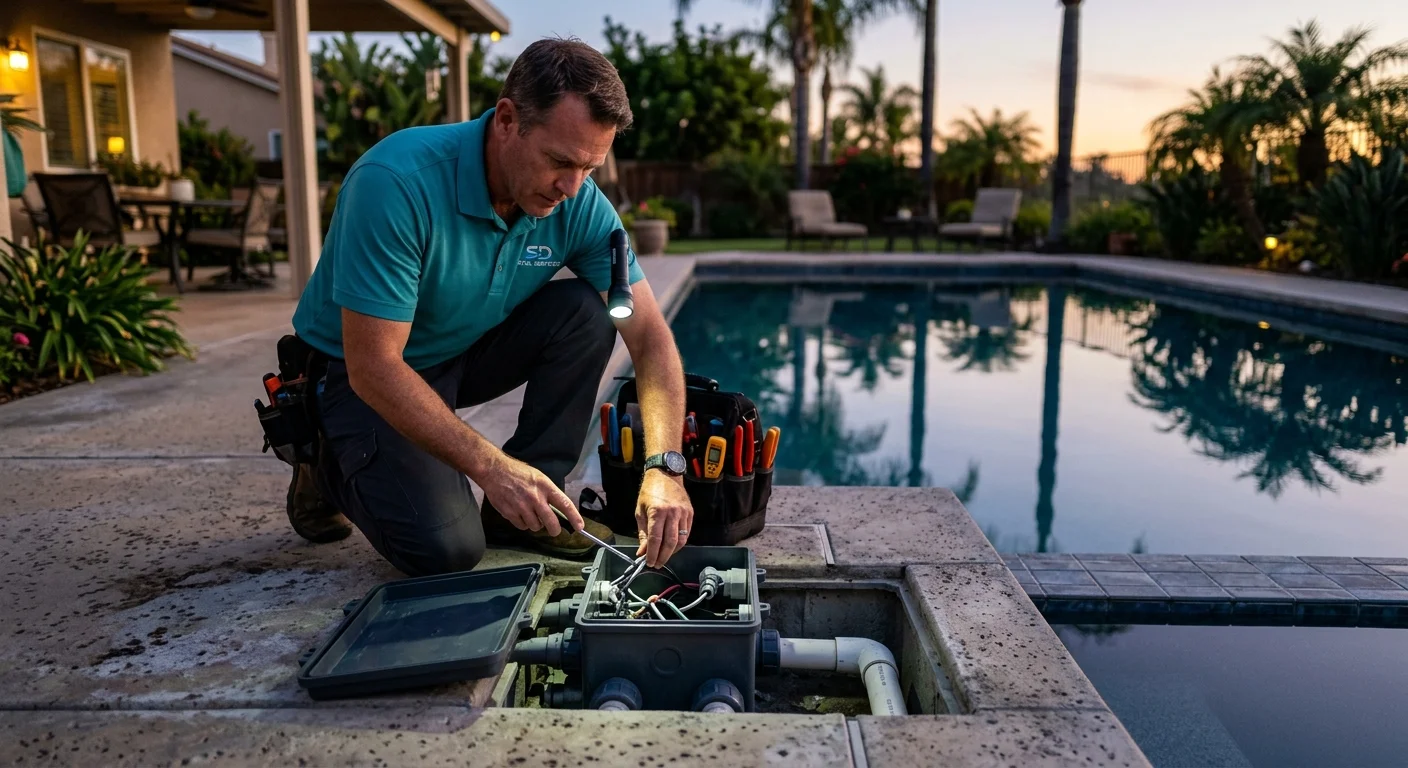
Why a wet pool junction box kills the light
A pool light does not get its power at the niche. The fixture lives in the wall, underwater. Its cord runs up a conduit and meets the house feed in a sealed enclosure on the deck, above the waterline. That enclosure is the pool light junction box. The splice inside is the whole circuit in one small room.
Water on those splices is a short. Current leaks off the copper. If the circuit has a GFCI, that device opens and the light goes black in a blink. Leave the water in place and the damage keeps going. Terminals pit. Wire nuts turn chalky. Copper goes green. Dry the box later and the light still fails because the metal is already eaten.
Coastal yards take this faster. Salt air at Coronado and Mission Beach rides in with every onshore breeze and every bit of splash. It attacks gaskets and lugs the way it attacks stainless rails. A box in Ramona or Valley Center sits in drier air. The same tired gasket still lets water in, but the terminals do not green over as quickly. The mechanism is the same. The clock runs at a different speed.
Homeowners treat a dark niche as a lamp problem. The lamp may be fine. The splice failed first. Pool light replacement in San Diego is the right job when the fixture itself is spent, the lens is cloudy, or the cord jacket is cut. A flooded box is one step upstream. Power never arrives clean, so a new bulb sits in the dark too.
How water gets into the box in the first place
The box is supposed to live above the waterline for a reason. Gravity and splash still find a way in. The lid gasket flattens, cracks, or picks up grit from the deck. A missing screw leaves a gap. Kids cannonball off the sun shelf in Mission Beach and a sheet of water lands on a low lid. Winter rain sits in the same recess for days on a Clairemont patio that does not drain.
Conduit is the quieter path. The wet niche is full of pool water by design. If the cord entry or the conduit glue joint is tired, that water wicks up the pipe toward the box. You can towel the lid dry on Saturday and find the same puddle on Monday because the feed is coming from below. Condensation does a smaller version of the same trick when a cool marine layer sits on a warm deck in Point Loma and moisture beads inside the enclosure.
Deck layout makes some yards easier targets. In Santee, nearly half the housing stock was built before 1978, so a lot of original boxes still sit in the walkway, close to the coping, taking every splash from the deep end. Older East County gunite pools in El Cajon and Lakeside often share that layout. Newer remodels sometimes move the enclosure back toward the pool equipment pad, where foot traffic and overspray are lighter. A low lid in a travel path still floods first.
Salt is a second leak, not a first one. On Coronado and along Mission Beach, salt spray eats the seal and the hardware that holds the lid down. Once the gasket is gone, splash has an open door. Inland Ramona does not get that salt load. Its boxes fail from heat-baked gaskets, UV-brittle lids, and the same conduit wick as everywhere else in the county.
What a licensed pool pro checks before opening it
Live pool electrical gear is not a homeowner lid. The licensed pool pro we connect you with, and the licensed electrician that pro brings in when the feeder, bonding, or panel is in play, treats the box as energized until the breaker is proven off. The wall switch is not that proof. The switch can fail closed. The breaker at the panel is the cut.
Before the lid comes off, the pro traces which circuit feeds the light, confirms the breaker is open, and looks at the box from the outside. A lid sitting in a puddle, a cracked cover, missing screws, or a box rim below standing water on the deck already tells the story. Salt crust on a Coronado cover is a clue. A dry lid over a wet interior points at conduit wick from the niche, not splash from above.
California treats this as contractor work when it is more than casual, minor service. A swimming pool contractor under 16 CCR §832.53 builds and works on pools, spas, and the trades those jobs need. Ask for a license number and check it on the CSLB site before anyone opens a live enclosure. Splash Pro Pools is a referral service. We match you with independent local pros. We do not open the box, and we do not hold a trade license.
Once the power is down, the pro looks at the splices, the potting or grease on the connections, the ground and bonding lugs, and the conduit entries. A dried-out potting compound that has pulled away from the walls is an open path for the next rain. Green copper and white salt scale mean the hardware itself is done. Pool repair at this stage is resealing, re-splicing, or replacing the enclosure, not guessing at a bulb.
When the niche, conduit, or bonding is the real fault
A dry-looking lid can still hide a wet circuit. The niche in the wall is a metal or plastic pocket that holds the fixture. Pool water belongs outside the lens. It does not belong in the conduit behind the cord. A cracked niche, a failed grommet, or a cut jacket lets the pool itself feed the pipe. The box then fills from below no matter how new the gasket is.
Conduit joints do the same thing when glue has let go or a fitting was never seated. On older decks in La Mesa and Spring Valley, that run may be short, shallow, and full of elbows. Each joint is a chance for water to enter. The repair is the path, not the lid. Swap the box and leave a wicking conduit and the new enclosure fills too.
Bonding is the quiet fault. Metal parts of the light circuit, the niche, and the box are meant to be tied together so stray current has a low-resistance path around the water instead of through it. A loose lug, a broken bonding wire, or a corroded terminal at the box breaks that tie. The light may still work on a good day. The hazard is the stray path, and that is electrician work, not a gasket swap.
These jobs stack. A wet box, a tired niche, and a green bonding lug can show up on the same visit, especially on a pre-1978 Santee or East County pool that has had the original deck electrical left alone through a plaster cycle or two. The licensed pool pro sorts which failure is feeding the others. Other pool repairs around San Diego follow the same order: find the path, then fix the part that opened it.
| What you see on the deck | Likely path | Why the light stays dark | | The lid is sitting in water and the terminals are green | Splash, a failed gasket, or salt-eaten hardware | The splice is shorted or already corroded | | The lid looks dry, the box is wet again by morning | Conduit wick from the niche | Water is climbing the pipe from below | | The box is dry, the niche light is still dead | Fixture, cord, or niche itself | Power is fine at the splice and the lamp circuit failed downstream | | Hardware is sound, the bonding lug is loose or broken | Bonding path, not the lamp | Stray current and a safety fault, with or without a dark light |
How this job ties to a dead light, not a bad bulb
A burned-out lamp is a local failure at the fixture. A wet pool junction box is a failure at the splice. They look the same from the patio after dark. One dark niche. One switch that does nothing. The bulb-swap habit wastes a lamp and leaves the short in place. If water is in the box, the new bulb never had a chance.
The tell is at the enclosure, not in the water. A homeowner can look at the lid, see standing water, and stop. That is the whole DIY step. Opening a live box, probing splices, or fishing a cord with the breaker on is how a dark light becomes a shock hazard. The licensed pool pro we connect you with handles the live gear. When the feeder or bonding is involved, that pro coordinates with a licensed electrician.
Fixture replacement still has a place. Cloudy lenses, a cord too short to reach the deck, a niche that will not hold a seal, those are lamp-side jobs. They sit next to this one, they do not replace it. If the box is flooded, dry and seal that meeting first. Then decide whether the fixture earned its own replacement. Mixing the two into one “new light” guess is how the same dark niche comes back after the next heat wave in El Cajon or the next set of southwest swell splash in Mission Beach.
Pool junction box repair on a San Diego deck is a small enclosure with a large job: keep the underwater light’s splice dry, bonded, and reachable. Water in that box is the cause. The bulb is the symptom.
When to call us
A dark pool light with water under the deck lid is live electrical work, not a lamp run to the warehouse. Call us and we’ll connect you with a licensed local pool pro. That pro, and the licensed electrician they bring in when the conduit, bonding, or panel is the real fault, is who opens the box.
Frequently asked questions
What is a pool junction box?
It is the sealed deck enclosure where the underwater light cord splices to the power feed. The box sits above the waterline so that meeting stays dry. Water on those splices is what kills the light, even when the lamp itself is still good.
Where is the pool light junction box?
On most San Diego yards it is a small lid in the deck above the waterline, often near the light niche and sometimes closer to the equipment pad after a remodel. Older East County and Santee pools often still have it in the walkway by the coping. If you cannot find it, leave the lids alone and let a licensed pool pro trace the conduit from the niche.
What is the purpose of a junction box?
It gives the wet-niche cord a dry, reachable place to meet house wiring, and it is where bonding lugs and ground wires land so metal parts of the light circuit stay tied together. It is not a storage box and it is not the light. Its only job is to keep that splice dry and serviceable.
How close can a junction box be to a pool?
The box belongs above the waterline and set back from the water's edge so splash, overflow, and foot traffic do not sit on a live enclosure. Exact placement follows current electrical rules for that light's voltage, and those rules are confirmed on site by the licensed electrician the pool pro coordinates with. A low lid in the walkway is a common older layout, not a layout to copy.
Does a dead pool light mean I need a new bulb?
Often it does not. A wet pool junction box shorts the splice upstream of the lamp, so the fixture never sees clean power. If the lid on the deck is sitting in water, replacing the bulb will not fix the circuit. That is a junction box and conduit job, and it is a different repair from swapping the fixture.
Need professional help in San Diego County?
Splash Pro Pools connects San Diego homeowners with pool pros for the work in this post.