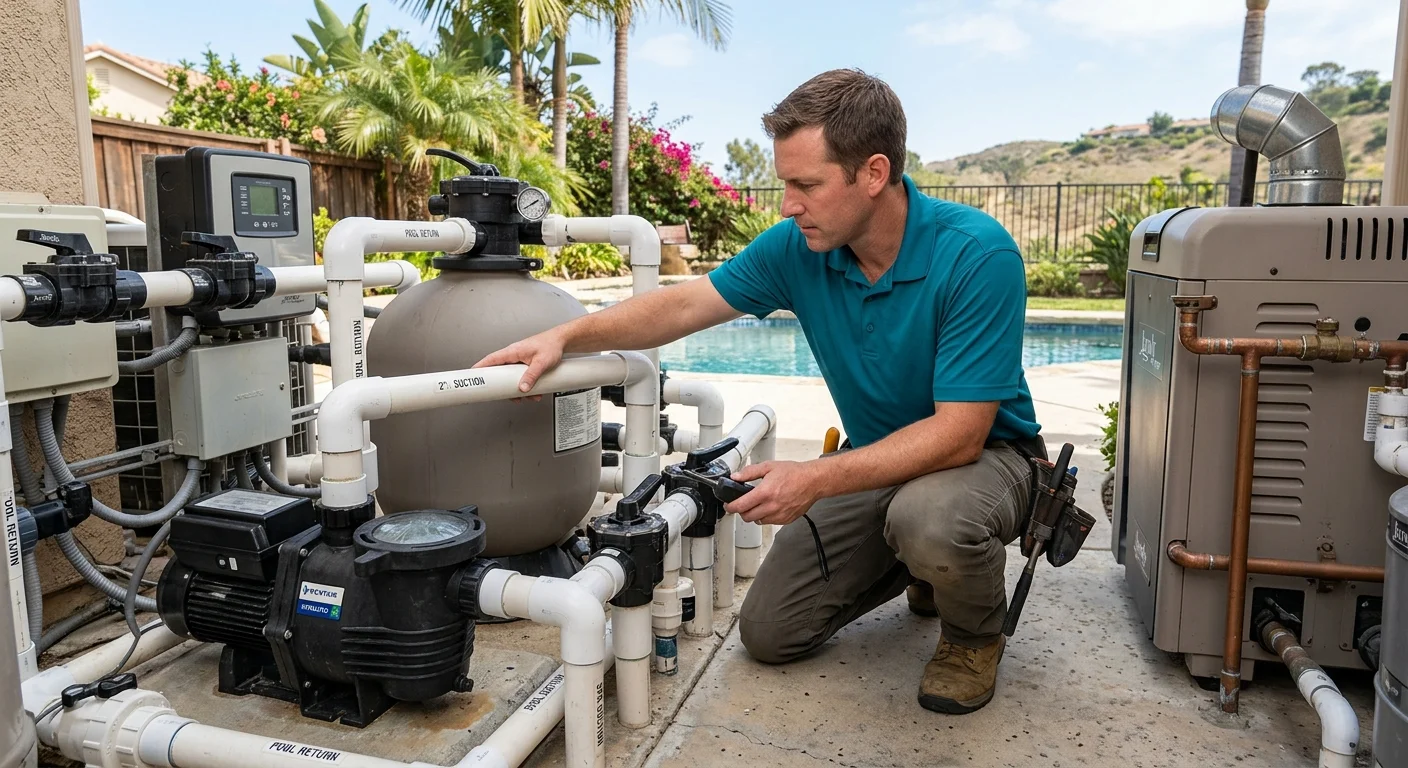
The returns are weak, the heater never kicks on, and a wet ring is spreading under the pump. A pool equipment repair service near me in San Diego is a licensed local pool pro standing at your pad, tracing which piece failed, not a brand that owns the trucks. Splash Pro Pools matches you with that independent pro. You contract with them directly. They treat the pad as one system: pump, filter, heater, valves, timer, and salt cell.
img src=“/images/blog/pool-equipment-repair-san-diego-hero.webp” alt=“Pool equipment repair near me in San Diego” />
What a pool equipment repair service near me covers on the pad
Equipment repair on the pad is work on the machines that move, clean, heat, and sanitize the water. It isn’t plaster, tile, coping, or deck. The pad is the slab cluster beside the house: pump, filter tank, heater, salt cell, valves, and the time clock or automation box.
A failed pump seal, a stuck multiport handle, a heater that won’t ignite, a salt cell that stopped making chlorine, and a timer that never closes the circuit are pad jobs. A cracked skimmer, a hollow-sounding deck, or a waterline that drops overnight with a dry slab is structure. That work sits with pool repair, not a parts swap on the pad.
San Diego pads run almost the whole year. Coastal houses in Oceanside, Encinitas, and Pacific Beach keep that gear in salt air. Inland yards in El Cajon, Santee, and Escondido bake the same brands in dry heat. The parts catalog looks identical. The way those parts die doesn’t.
What the pro is actually fixing is a chain. The timer tells the pump to run. The pump pulls from the skimmer and main drain and pushes through the filter. The heater’s flow switch needs that moving water before gas or electric heat can fire. A salt cell needs the same flow, plus power from its control board. Break any one link and the pool looks dead. Homeowners often replace the loudest part. The quiet part next to it was the real failure.
Pool equipment installation and upgrades cover a new unit when the old one is finished. Repair starts with diagnosis: which housing, which board, which union, which valve. Pool equipment repair companies near me that skip that map sell you a motor and leave the clogged filter in place.
How a dead pump differs from a heater or valve failure
A dead pump is a circulation failure. The motor hums and the impeller never turns, the shaft seal throws a fan of water across the slab, or the basket sits dry because the pump lost prime. Weak returns and a motor too hot to hold your hand on all point at the pump side. For seals, capacitors, and impellers, use the pool pump repair guide. This page stays at pad level. If water isn’t moving, start at the pump, then prove the filter and valves aren’t starving it.
A heater failure is a heat failure with circulation still present. Returns feel like pool water. The gas heater never clicks, clicks and won’t stay lit, or runs while the temperature never climbs. Scale inside a heat exchanger, a failed igniter, a dirty flame sensor, a closed gas cock, or a flow switch that never sees flow can all look like the heater is dead. Inland water lays mineral on hot metal. El Cajon and Santee heaters scale faster than Point Loma units sitting in cooler marine air. The San Diego pool heater repair post covers the appliance. The pad question is simpler: is water actually reaching the heater.
A valve failure is a routing failure. The pump is loud and happy. One body of water is dead. The spa spillway is dry while the pool returns blast, or the solar array never takes flow because a diverter froze after a summer of UV on the handle. Check valves that stick open let water drain back into the pump overnight, and the next start looks like a priming problem. A leaking valve stem weeps onto the slab and looks like a pump leak until someone dries the concrete and watches the bead form at the stem, not the motor.
Timer and automation failures impersonate all three. If the time-clock door is warped from Oceanside salt air and the mechanism never makes contact, the pump never starts. The wet end is fine. The switch isn’t. Filter clogs impersonate dying pumps too. A cartridge packed with inland dust or a DE grid that dumped will drop flow, trip a heater on low flow, and starve a salt cell. The pro reads pressure, opens the lid, and refuses to sell a motor until the filter is honest.
When pool equipment is not working, the symptom is almost never the whole story. Cold water with strong returns isn’t a pump. Strong pump noise with a dead spa isn’t a heater.
Why San Diego pads fail from heat, scale, and salt air
San Diego pads fail because the same outdoor gear lives in salt air on the coast and in hard, hot water inland, with almost no off-season. A pad in Pacific Beach takes night moisture and salt. A pad in Ramona takes heat, dust, and mineral-heavy fill. Both run for most of the year, so small corrosion and scale never get a winter off.
Salt air condenses on cool metal after sunset. Heater jackets, timer enclosures, bonding lugs, and salt-cell terminals pit. Stainless looks fine until a fitting weeps. Coastal south bay pads in Imperial Beach and Coronado see the same marine layer that keeps Point Loma pools cooler, and that moisture sits on electronics all night.
Inland, the attack is scale. The CDC’s home pool guidance puts pool pH at 7.0-7.8. As pH rises above 7.8, chlorine kills germs more slowly. Below 7.0, water corrodes pipes and equipment. High pH, high alkalinity, and hard fill water also lay down the white chalky calcium Pentair describes as scaling on tile and equipment. That crust coats salt-cell plates, heater tubes, and pump seals. Flow drops. Heat exchangers overheat. Cells work harder, then quit.
Santee water is very hard. East County summers cook a heater that already has scale in the tubes. Escondido, Lakeside, and El Cajon pads sit in the same inland pattern. Coastal north county fights salt. Inland north county around Vista and San Marcos fights minerals plus heat. A diagnosis that ignores which side of I-15 the house sits on will misread the failure.
Your rates and drain rules come from your own water agency, not one county utility. The San Diego County Water Authority lists 22 retail member agencies serving 3.3 million people. Fallbrook and Bonsall do not appear on that 2026 member list. Confirm fill-water chemistry with your agency and recent pool tests.
| Climate band | What fails first | Why it happens |
|---|---|---|
| Coastal pads in La Jolla, Pacific Beach, Coronado, Imperial Beach, Oceanside | Heater cabinets, timer doors, salt-cell terminals, metal fittings | Salt air condenses on cool metal overnight and eats housings, boards, and terminals |
| Inland pads in El Cajon, Santee, Escondido, Ramona, Lakeside | Heater exchangers, pump seals, filter laterals, salt-cell plates | Hard fill water plus summer heat bake minerals onto wet, hot surfaces and starve flow |
Repair the part or replace the unit
Repair the wearable part when the shell of the machine is still sound. Replace the unit when the housing, heat exchanger, or motor is already spent, or when one more repair on a worn machine just delays the next failure.
A pump with a fresh motor and a cracked volute is still a leak. A heater with a new igniter and a scaled, leaking heat exchanger is still done. A salt cell with plates coated until they won’t pass a test is usually a cell swap, not another rinse. INYO Pools notes that an SCG cell can be expected to last 5 or more years if the pool and equipment are maintained properly. That is a retailer estimate, never a promise.
HomeGuide’s July 22, 2025 pool repair guide puts repair labor at $45-$70 per hour. Angi, updated May 3, 2026, puts generator cell replacement at $700-$1,100 and the control board at $500-$900. HomeGuide’s September 22, 2025 saltwater notes put cells at $200-$1,400 and a mild acid wash every 3-4 months unless the cell is self-cleaning. Those are market ranges from named guides, never a Splash Pro Pools price. The matched pro quotes the machines on your slab.
A whole-pad rip-and-replace is priced piece by piece. HomeGuide’s September 22, 2025 maintenance guide puts annual ownership, including repairs, electricity, and water, at $3,000-$6,000. That is a national cost-of-ownership band, not a San Diego package and not a single invoice for every pump, filter, and heater on the pad.
California treats construction-level pool work as licensed trade. Under 16 CCR §832.53, a C-53 swimming pool contractor constructs swimming pools, spas, or hot tubs, including solar heating equipment. Remodels and structural repairs run well past the small-job exemption in Business and Professions Code §7048, so California requires a licensed contractor. Ask any pro who touches equipment or structure for a license number, then check it on the CSLB site.
A screaming single-speed that needs a new motor is also the moment to talk about a variable-speed replacement. That conversation is equipment installation once the diagnosis is honest.
What a matched pool pro should inspect on arrival
A matched pro should leave the pad with a named failed part, not a guess. They treat the slab as one system. They prove flow before they sell heat, and they prove power before they sell a motor.
They confirm the time clock or automation actually closes the circuit. They prove the pump turns, primes, and holds a lid seal. They read filter pressure and look inside before they condemn the wet end. They feel the returns and the heater inlet so a flow-switch failure doesn’t get sold as a new heater. They inspect salt-cell plates and board lights rather than dumping chlorine and walking away. They dry the slab and watch for the leak to reappear at a union, a pump lid, a valve stem, or a heater drain.
HomeGuide’s July 22, 2025 guide puts professional leak detection at $100-$1,000 and leak repair at $500-$1,500. Equipment-pad leaks often sit on the visible end of that work. A disappearing waterline with a dry pad is plumbing or shell, and that is a different visit.
- The pro records make, model, and approximate age of the pump, filter, heater, and cell so repair versus replace is based on the actual machine.
- The pro tests water enough to see whether scale or corrosion is still being fed by pH and hardness, because a new part in the old water fails the same way.
- The pro shows you the failed part on the pad before anyone orders a replacement.
That last pass is how you tell a diagnosis from a parts run. You should be able to point at the housing, the board, or the union and say what died.
When to call us
Pool equipment that isn’t working is a licensed-pro job once you are past a clogged basket or a timer that was switched off. Splash Pro Pools matches you with a licensed independent local pool pro who diagnoses the pad and prices the repair or the replacement with you directly. Call us and we’ll connect you with a licensed local pool pro.
Frequently asked questions
What is the average lifespan of pool equipment?
A salt chlorinator cell can last 5 or more years if the pool and equipment stay maintained, according to INYO Pools. That is a retailer estimate, not a warranty. Pumps, heaters, filters, and valves age at different rates because coastal salt air, inland scale, and year-round heat attack each part differently. A matched pro judges remaining life from the machines on your slab.
How much does it cost to replace all pool equipment?
A whole-pad swap is priced piece by piece from the units that actually failed. HomeGuide's July 22, 2025 pool repair guide puts repair labor at $45-$70 per hour. Angi, updated May 3, 2026, puts generator cell replacement at $700-$1,100. HomeGuide's September 22, 2025 maintenance guide puts annual ownership, including repairs, electricity, and water, at $3,000-$6,000. Those are named market ranges, never a Splash Pro Pools price.
What do you call someone who fixes pool equipment?
For construction-level pool work, California's C-53 swimming pool contractor classification covers building pools, spas, or hot tubs, including solar heating equipment. Remodels and structural repairs run well past the small-job exemption in Business and Professions Code §7048, so California requires a licensed contractor. Ask any pro who touches equipment or structure for a license number and check it on the CSLB site.
How do you find a leak in pool equipment?
A pro starts on the dry slab: a weeping pump lid, a union that beads after the pump starts, a valve stem that wets the concrete, or a heater draining from the heat exchanger. HomeGuide's July 22, 2025 guide puts professional leak detection at $100-$1,000 and leak repair at $500-$1,500. A dropping waterline with a dry pad is plumbing or shell, not a pad fitting.
Should I repair a pool part or replace the whole unit?
Repair the wearable piece when the housing is still sound. Replace the unit when the volute, heat exchanger, or motor is already spent. A new igniter on a leaking heater, or a new motor on a cracked wet end, just moves the next failure. The matched pro should show you the failed part on the pad before anyone orders a replacement.
Need professional help in San Diego County?
Splash Pro Pools connects San Diego homeowners with pool pros for the work in this post.