A note on scope: this is equipment installation and upgrades work, which sits outside what Splash Pro Pools does. Call (858) 400-6757 and we’ll match you with a vetted local pro who covers it.
TL;DR
- Pool heater installation in San Diego runs $2,800 to $7,500 installed for most residential pools, with the unit price being only part of the total.
- Gas heater: $2,800-$5,500 installed. Cheaper upfront, heats fast, costs more per hour to run.
- Electric heat pump: $4,000-$7,500 installed. Costs more upfront and needs a 240-volt circuit, but far cheaper to run in San Diego’s mild climate.
- Solar is a separate path (roughly $4,500-$8,500 installed) with the lowest running cost and the slowest heat.
- Sizing matters: most pools here take a 250,000-400,000 BTU gas heater or a 110,000-140,000 BTU heat pump.
- Gas line work, electrical circuits, and permits are the biggest swing factors on the final bill.
If your pool heater finally died, or you’re adding heat to a pool that never had it, the first quote you get can be a surprise. The heater itself is often the smaller half of the number. What drives the total in San Diego is the work around it: the gas line for a gas heater, the dedicated 240-volt circuit for a heat pump, the plumbing tie-in, and the permit.
This guide breaks down what pool heater installation actually costs in San Diego in 2026, how gas and heat pump compare for our climate, and how to size the unit so you’re not overpaying for BTUs you don’t need. If your existing heater is only a few years old and acting up, start with our pool heater repair guide first, a repair may be all you need.
How much does pool heater installation cost in San Diego?
Pool heater installation in San Diego runs $2,800 to $7,500 installed for a typical residential pool. The spread comes down to the type of heater and how much gas or electrical work the install requires. Here’s how the three main paths compare.
| Heater type | Installed cost | Best for |
|---|---|---|
| Gas heater | $2,800 - $5,500 | Fast, on-demand heat; pools used occasionally; attached spas |
| Electric heat pump | $4,000 - $7,500 | Frequent swimmers who want low running cost year-round |
| Solar system | $4,500 - $8,500 | Lowest running cost, no fuel bill, slower to heat |
Those numbers include the unit, mounting, plumbing tie-in, and standard labor. What they don’t always include is a new gas line run, a panel or circuit upgrade, or extra permit and inspection fees, which is where a “starting at” quote can climb. For the full solar breakdown, see our dedicated solar pool heater guide, since solar prices and payback work differently from gas and heat pump.
Gas heater installation cost
A new gas pool heater in San Diego runs about $2,800 to $5,500 installed. The unit itself, a Raypak, Pentair MasterTemp, or Hayward Universal H-Series in the 250,000 to 400,000 BTU range, usually lands between $2,000 and $3,500. Labor, plumbing, and gas connection make up the rest.
The big variable is the gas line. If you’re replacing an old gas heater and the existing line is the right size and in good shape, installation is straightforward and lands at the lower end. If the line is undersized for a modern high-BTU heater, or you’re adding gas heat to a pool that never had it, running or upsizing the line adds real cost and often a permit.
Gas heaters make the most sense for pools that get used on demand rather than every day, or pools with an attached spa you want hot in under an hour. They heat fast, which a heat pump can’t match. The tradeoff is the running cost, gas burns through SDG&E fuel quickly, so a gas heater you run daily gets expensive.
Installing a pool heat pump: what it costs
An electric heat pump runs about $4,000 to $7,500 installed in San Diego. The unit, a Pentair UltraTemp, Hayward HeatPro, or AquaCal in the 110,000 to 140,000 BTU range, typically costs $3,000 to $5,500. The install cost climbs because heat pumps need a dedicated 240-volt circuit, and if your panel doesn’t have the capacity, a panel upgrade is a separate line item.
Here’s why heat pumps are worth a hard look in San Diego specifically: they pull heat from the surrounding air, so they run most efficiently when the air is warm. A heat pump needs ambient temperatures above roughly 50°F to work well, and San Diego rarely drops below that. That means a heat pump runs efficiently here nearly year-round, where the same unit would struggle in a colder climate.
The result is a much lower running cost than gas. The catch is speed, a heat pump raises water temperature slowly, a few degrees over several hours, so it’s built for holding a pool at temperature rather than heating it fast for a weekend. For a household that swims regularly, that lower operating cost usually wins over the life of the unit.
Gas vs. heat pump: which should you install?
For most San Diego homeowners who swim often, a heat pump is the better long-term value because of how cheaply it runs in our climate. For pools used occasionally, or where fast on-demand heat matters, gas is the more practical choice. Here’s the honest breakdown.
Install a gas heater when: you swim occasionally rather than daily, you want the water hot fast, you’re heating an attached spa on demand, or your upfront budget is tight and the existing gas line is already in place.
Install a heat pump when: you swim regularly and want to extend the season, running cost matters more than upfront cost, and your electrical panel can handle a dedicated 240-volt circuit (or you’re willing to budget the upgrade).
Look at solar when: you want the lowest possible running cost, have suitable south-facing roof space, and can accept slower heating. Our solar pool heater guide walks through whether it pays off for your setup.
Many pools end up with a heat pump for everyday heating plus a small gas heater for the spa, since gas heats a spa far faster. That combination costs more upfront but covers both needs.
What size pool heater do you need?
Sizing is where a lot of San Diego installs go wrong in one of two directions: an undersized heater that never quite reaches temperature, or an oversized one you paid too much for. Most residential pools here take a 250,000 to 400,000 BTU gas heater or a 110,000 to 140,000 BTU heat pump.
The right number depends on your pool’s volume, how fast you want to heat, the temperature you’re targeting, and whether wind exposure or an attached spa is in the picture. Larger pools, colder target temperatures, and spas you want hot quickly all push toward the higher BTU end. A good installer sizes the unit off your actual gallons and equipment setup, not a chart, so ask how they arrived at the number.
If you’re not sure how many gallons your pool holds, our pool gallon calculator guide shows you how to figure it out before you get quotes.
What’s involved in the installation
A pool heater install is more than dropping a unit on the pad. Knowing the steps helps you read a quote and spot what’s driving the price.
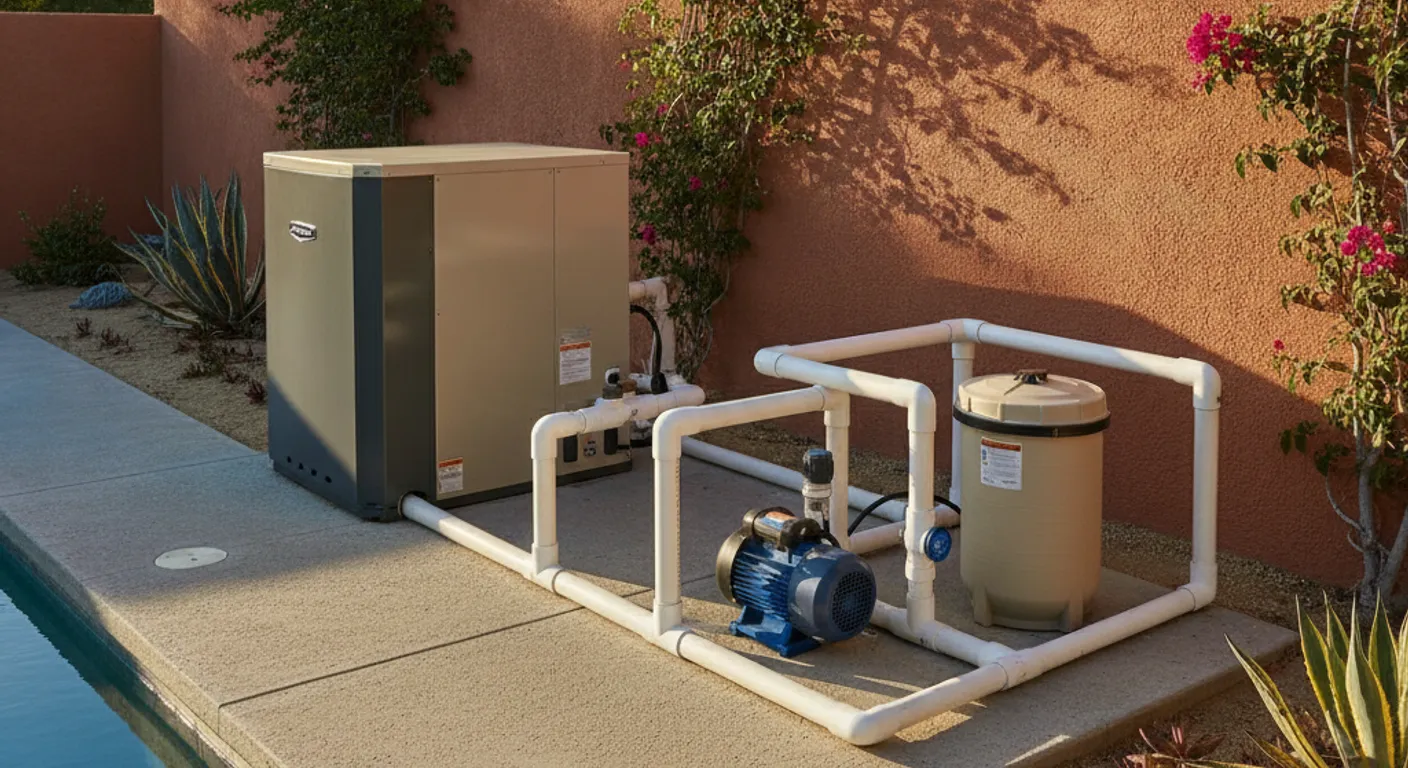
The pad and mounting. The heater sits on a level, non-combustible pad near the rest of the equipment, with clearance for airflow (heat pump) or flue venting (gas).
Plumbing tie-in. The heater plumbs into the existing circulation loop, usually after the filter and before the return to the pool. Older plumbing sometimes needs adapters or repair at this stage.
Fuel or power. A gas heater needs a correctly sized gas line and a shutoff. A heat pump needs a dedicated 240-volt circuit run from the panel. This is the single biggest cost variable and the most common reason a quote comes in higher than the sticker price of the unit.
Startup and testing. Once connected, the installer fires the unit, checks flow and pressure, sets the thermostat, and confirms it holds temperature. A gas heater’s combustion and a heat pump’s refrigerant charge both get verified here.
A pump upgrade often pairs well with a new heater, since a variable-speed pump moves water more efficiently through the heater and cuts your overall energy bill. Doing both at once saves on labor.
Permits and San Diego considerations
Requirements vary by city, so check with your local building department before committing to a timeline. In general, a straight unit swap that reuses the existing gas line or circuit may not need a permit, but new gas line work and new electrical circuits commonly do. A licensed installer usually pulls the permit as part of the job.
A few San Diego-specific things worth planning for. Coastal salt air is hard on gas heater heat exchangers, so if you’re near the coast, ask about corrosion-resistant models and factor a shorter replacement horizon into the decision. Inland, the county’s hard water scales up heat exchangers and heat pump coils faster than in softer-water regions, which makes routine equipment service more important, our hard water guide explains why. And if your panel is older, budget time for a potential electrical upgrade before a heat pump install rather than being surprised on install day.
Where we connect homeowners with installers
Splash Pro Pools connects homeowners across San Diego County with pool heater and equipment pros who handle gas, heat pump, and solar installs. We serve homeowners in Poway, Santee, El Cajon, La Mesa, San Marcos, Escondido, Chula Vista, Carlsbad, Encinitas, Vista, and Oceanside, along with the rest of the county. For the broader equipment picture, see our pool equipment installation guide and equipment service page.
Frequently asked questions
How much does pool heater installation cost in San Diego?
Pool heater installation in San Diego runs $2,800 to $7,500 installed for most residential pools. A gas heater lands around $2,800 to $5,500 installed depending on gas line work. An electric heat pump runs $4,000 to $7,500 installed because it needs a dedicated 240-volt circuit. Solar is a separate path at roughly $4,500 to $8,500 installed. The unit itself is only part of the number, gas line sizing, electrical work, plumbing tie-in, and permits all move the total.
Gas heater or heat pump: which is better for a San Diego pool?
For San Diego’s mild climate, a heat pump is usually the better long-term value if you swim often, because it runs efficiently almost year-round here and costs far less per hour to operate than gas. A gas heater costs less upfront and heats fast, which suits pools used occasionally or on demand. The tradeoff is operating cost: gas heats quickly but burns through SDG&E gas, while a heat pump is cheap to run but slow to bring the water up and costs more to install.
What size pool heater do I need in San Diego?
Size depends on pool volume, how fast you want to heat, and whether you’re using gas or a heat pump. Most residential San Diego pools take a 250,000 to 400,000 BTU gas heater or a 110,000 to 140,000 BTU heat pump. Bigger pools, attached spas you want to heat quickly, and colder target temperatures all push you toward the larger end. An installer sizes it off your actual gallons and setup rather than a rule of thumb.
Do I need a permit to install a pool heater in San Diego?
Often, yes. The heater unit swap itself may not require one, but the gas line work for a gas heater and the dedicated 240-volt circuit for a heat pump commonly do, and requirements vary by city and by HOA. Check with your local building department before work starts. A licensed installer will usually pull the permit as part of the job.
How long does pool heater installation take?
A straight replacement that reuses the existing gas line or electrical circuit is often a one-day job. A new install that needs a gas line run, a panel upgrade, or a new 240-volt circuit can take two to three days once permitting and inspection are factored in. Heat pumps more often need electrical work than gas heaters need gas work, so they tend to run longer on a first-time install.
Should I repair my old pool heater or replace it?
If the heat exchanger is corroded or the repair quote is climbing past $800 on a heater that’s already 10-plus years old, replacement is usually the smarter money. Igniters, pressure switches, and control boards are worth repairing on a newer unit. Our pool heater repair guide breaks down the common failures and what each one costs so you can weigh it against a new install.
Ready to add heat to your pool? Call (858) 400-6757 and we’ll connect you with pool heater installers in the San Diego network who can size the right unit and get you a quote. If your current heater is only a few years old and struggling, start with our pool heater repair guide first.
Frequently asked questions
How much does pool heater installation cost in San Diego?
Pool heater installation in San Diego runs $2,800 to $7,500 installed for most residential pools. A gas heater lands around $2,800 to $5,500 installed depending on gas line work. An electric heat pump runs $4,000 to $7,500 installed because it needs a dedicated 240-volt circuit. Solar is a separate path at roughly $4,500 to $8,500 installed. The unit itself is only part of the number, gas line sizing, electrical work, plumbing tie-in, and permits all move the total.
Gas heater or heat pump: which is better for a San Diego pool?
For San Diego's mild climate, a heat pump is usually the better long-term value if you swim often, because it runs efficiently almost year-round here and costs far less per hour to operate than gas. A gas heater costs less upfront and heats fast, which suits pools used occasionally or on demand. The tradeoff is operating cost: gas heats quickly but burns through SDG&E gas, while a heat pump is cheap to run but slow to bring the water up and costs more to install.
What size pool heater do I need in San Diego?
Size depends on pool volume, how fast you want to heat, and whether you're using gas or a heat pump. Most residential San Diego pools take a 250,000 to 400,000 BTU gas heater or a 110,000 to 140,000 BTU heat pump. Bigger pools, attached spas you want to heat quickly, and colder target temperatures all push you toward the larger end. An installer sizes it off your actual gallons and setup rather than a rule of thumb.
Do I need a permit to install a pool heater in San Diego?
Often, yes. The heater unit swap itself may not require one, but the gas line work for a gas heater and the dedicated 240-volt circuit for a heat pump commonly do, and requirements vary by city and by HOA. Check with your local building department before work starts. A licensed installer will usually pull the permit as part of the job.
How long does pool heater installation take?
A straight replacement that reuses the existing gas line or electrical circuit is often a one-day job. A new install that needs a gas line run, a panel upgrade, or a new 240-volt circuit can take two to three days once permitting and inspection are factored in. Heat pumps more often need electrical work than gas heaters need gas work, so they tend to run longer on a first-time install.
Should I repair my old pool heater or replace it?
If the heat exchanger is corroded or the repair quote is climbing past $800 on a heater that's already 10-plus years old, replacement is usually the smarter money. Igniters, pressure switches, and control boards are worth repairing on a newer unit. Our pool heater repair guide breaks down the common failures and what each one costs so you can weigh it against a new install.
Need this done in San Diego County?
For repair and renovation work like this, we hand you to our trusted partner, Del Rancho Pools.