Cloudy returns, a wet pad, or DE dust on the plaster usually means swimming pool filter repair, not another rinse. A dirty cartridge or a tired sand bed is maintenance. A cracked tank, torn grid, failed multiport, or broken laterals is a repair, and the licensed pool pro who opens the tank decides whether those parts get rebuilt or the whole filter gets swapped. Inland yards in El Cajon and Santee load filters with dust and hard-water scale that Point Loma’s marine layer rarely throws at a tank.
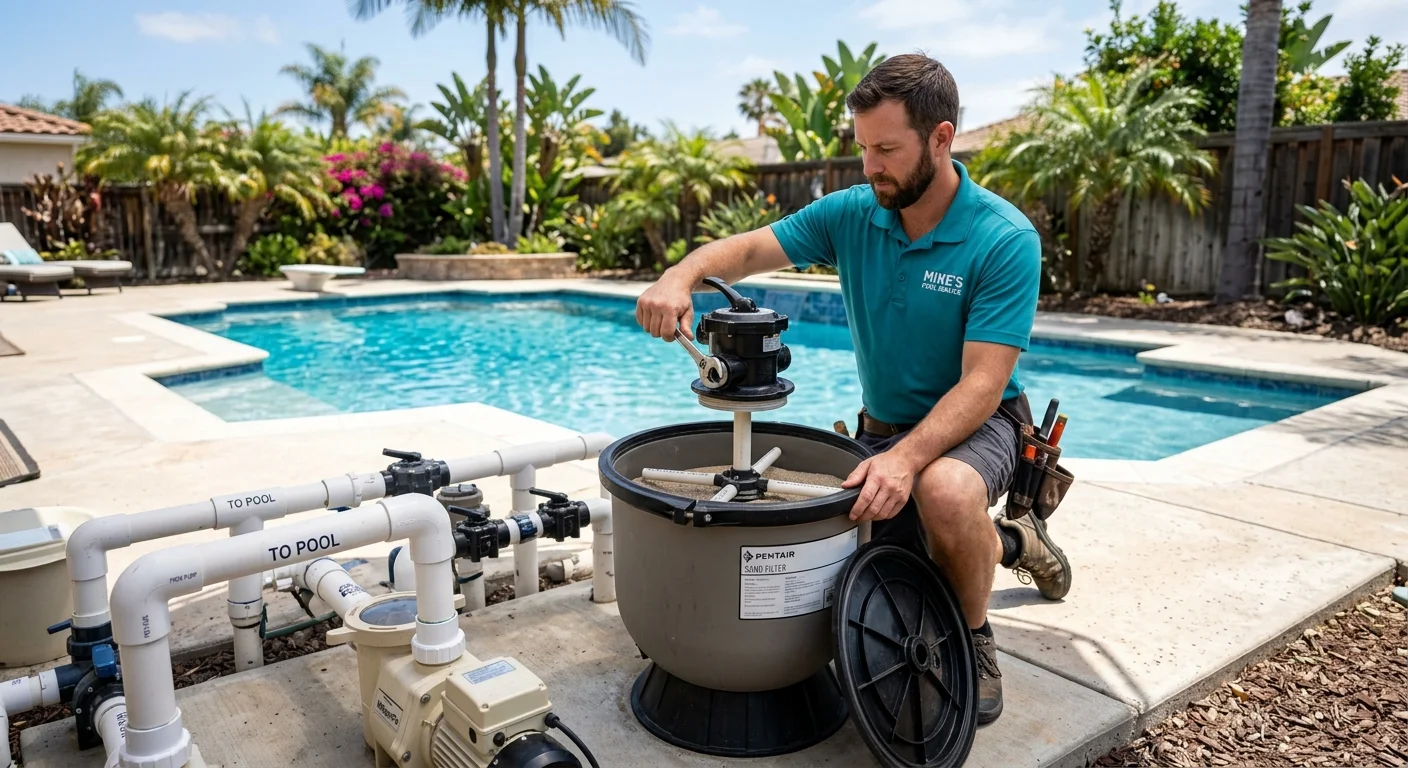
What swimming pool filter repair actually covers
Repair starts after someone proves the media is not just dirty. A high gauge after a party weekend in Mission Valley is often a loaded cartridge. The same gauge after a proper filter cleaning points at a part that is bypassing, leaking, or broken.
The tank is a pressure vessel. Water leaves the pump, enters the tank, and has to pass through sand, pleated fabric, or DE-coated grids. If that path is clogged, pressure climbs and the returns go soft. If the path is torn, debris and media come back out the returns. If a seal fails, the pad gets wet and the pump starts sucking air. Those are three different jobs, and they do not share a parts list.
A real repair visit is a teardown with a diagnosis, not a hose-down. The pro relieves pressure, opens the clamp or lid, and looks at the tank lip, the O-ring groove, the manifold, the laterals or grids, the air relief, and the valve. A pool filter not working after you already rinsed the cartridge is often a spider gasket, a scored piston, or a cracked bulkhead hiding behind the tank. Sand filter repair is frequently laterals and a standpipe, not a new tank. DE work is often a grid pack and a manifold, plus a recharge with fresh powder once the housing holds.
Small parts still count as repair. Pressure gauges stick and lie. Air bleeder assemblies clog with scale. Clamp bands corrode on sun-baked pads in Lakeside and Spring Valley. None of that is a new filter. It is also not a DIY clamp-tightening contest. Over-cranking a band on a plastic tank can crack the lip you were trying to seal.
Splash Pro Pools does not open tanks or stock parts. We match you with a licensed, independent local pool pro who does. If the work includes a new tank, cut plumbing, or a full swap, you are in contractor territory. California’s pool classification is C-53 (16 CCR §832.53). Ask for the license number and check it on the CSLB site before anyone cuts a union.
Chemistry still matters while the tank is down. The CDC’s home-pool guidance puts pH at 7.0–7.8. Above 7.8, chlorine slows down. A bypassing filter and a high pH stack on each other, which is why a Clairemont pool can look milky even after a shock.
When a cracked tank or grid means replacement
A hairline in the tank wall is the end of the repair conversation. Plastic tanks craze from sun, vibration, and clamp stress. Once the shell is cracked, glue does not make it a pressure vessel again. The honest call is a filter replacement, sized to the pump and the plumbing that already sit on the pad.
Torn DE grids sit in a gray zone until you count them. One small hole dumps powder into the pool and onto the plaster. A single grid can be swapped if the rest of the pack and the manifold are sound. Repeated tears, a cracked top manifold, or DE that keeps puffing from the returns after a careful recharge mean the internal assembly is done. At that point you are buying a grid set at minimum, and a new tank if the shell is stained, warped, or obsolete.
Cartridge end caps tell the same story. Pleats that splay, fabric that pulls off the plastic, or a center pipe that has split will not seal no matter how long you soak them. New elements are a repair. A warped lid or a tank that no longer takes a clamp is a replacement.
Access changes the decision. A filter tucked behind a heater on a tight La Jolla hillside pad costs more labor to open than the same model on an open Mira Mesa slab. If the unions are melted to the pipe, the pro has to cut and re-plumb. That labor often tips a tired tank toward a new unit instead of another round of used parts.
Parts availability matters too. Older tanks linger on East County pads from the 1970s and 1980s housing stock, including a large share of Santee homes built before 1978. If the clamp, lid, or laterals are no longer made, the pro is not repairing. They are hunting leftovers. A current tank that matches the pump is the cleaner path.
Do not confuse a leak at the pad with a pool leak in the shell. Water under the filter is usually a tank O-ring, a valve body, or a bulkhead. Water dropping in the pool with a dry pad is a different search.
How sand, cartridge, and DE failures differ
Sand, cartridge, and DE filters fail in different places because they trap dirt in different ways. The media you have on the pad decides what the pro is looking for when the lid comes off.
Sand pushes water down through a bed and out laterals at the bottom. Sharp grains catch dirt. Over seasons those grains round off, the bed channels, and water sneaks through without cleaning. East County dust and Santa Ana grit pack that bed faster than a Point Loma yard sitting under marine layer. Hard water adds scale that cements sand into clumps. The failure you can see from the deck is sand on the floor, usually from a broken lateral, not from “old” sand alone. Multiport valves on sand tanks wear spider gaskets and leak out the waste port or send water around the bed.
Cartridge filters are pleated fabric. Oils from sunscreen, body lotion, and a busy July in Carlsbad coat those pleats. Fine dirt packs the folds. That is a cleaning problem until the fabric tears, the end cap cracks, or the manifold lets water skip the pleats. Cartridges do not backwash, so a coastal owner who never soaks them will chase cloudy water all summer. A torn cartridge looks like debris returning to the pool, not like sand on the steps.
DE coats grids with a fine powder and catches the smallest particles of the three. The classic failure is a tear. White dust on the bottom or a puff from the returns is DE leaving the tank. The other DE failure is the valve. Push-pull pistons wear O-rings. Bottom-rotor valves are harder to service and more expensive to get wrong. After any DE repair, the grids need a fresh charge. An empty grid pack will not clear a cloudy pool.
Backwash handling is local, not optional. Inside City of San Diego limits, including neighborhoods such as Rancho Bernardo and Rancho Peñasquitos, filter backwash may not go to the storm drain. The City’s Pools, Spas & Fountains storm-water fact sheet (February 2016), citing San Diego Municipal Code §43.0304 and §43.035(e)(3), also sets penalties that can reach $10,000 per day per incident. Backwash belongs on absorbing landscape or through a legal sanitary-sewer connection after the fluid is in the pH 7–8 range the City describes. Oceanside, Vista, Encinitas, and the rest of the county run their own stormwater programs, so the rule you follow is the one your city publishes.
Repair versus replacement, side by side
Fix the part when the tank still holds pressure and the internals are still made. Replace the tank when the shell is cracked, the valve body is gone, or the internals keep failing in the same way. The matched pro should show you the broken piece, not a catalog page.
Labor is the quiet line on the quote. HomeGuide’s July 22, 2025 pool-repair guide puts typical repair labor at $45–$70 per hour. That is a national range, named and dated, and it is not a Splash Pro Pools price. Tank size, media type, pad access, and cut plumbing are what move your number up or down. A gauge and an O-ring on an open Encinitas pad is a short visit. A DE tank that has to come off the pad in Alpine, with unions cut and a new valve plumbed in, is a different afternoon.
| What failed | Repair usually fits | Replacement is the better call |
|---|---|---|
| O-ring, gauge, or air relief | New seals and a working gauge if the tank lip is smooth | The lip is chipped, or the clamp will not seat |
| Multiport or slide valve | Spider gasket, piston, or handle if the body is sound | The valve body is cracked or the ports are worn through |
| Sand laterals or standpipe | New laterals and a fresh sand bed in a sound tank | The tank is cracked or the bulkheads are shot |
| Cartridge elements | New cartridges and a manifold if the housing is round and true | The lid is warped, the tank is crazed, or the model is obsolete |
| DE grids | A full grid set and manifold if the shell holds pressure | Grids keep tearing, DE keeps blowing back, or the tank is cracked |
A second failure in the same season is a signal. New grids that tear again, sand that reappears after laterals were just replaced, or a clamp that weeps after a fresh O-ring usually mean the tank or the valve body is the real patient. Keep repairing around a cracked shell and you are paying labor twice.
Filter work also sits next to the rest of the equipment. A starved pump, a jammed skimmer, or a closed return valve can mimic a dead filter. The pro should prove flow at the pump basket before they condemn the tank. If the pump is the weak piece, start with pool pump repair instead of a new filter.
What a San Diego filter visit should include
A useful visit on a San Diego pad is a diagnosis you can see, not a mystery invoice. The licensed pro should leave you knowing whether the media was dirty, a part failed, or the tank is done.
Expect the pump off, the pressure relieved, and the tank opened. The pro checks the clamp band, tank lip, and O-ring groove for chips and scale. They inspect laterals, cartridges, or grids in good light, not through a backwash sight glass. They look at the valve body, the waste line, and the pressure gauge, then they run the system and watch the returns. On a sand tank they look for media in the pool. On a DE tank they look for powder. On a cartridge tank they look at the pleats and the manifold.
Local water should be part of that conversation. Hard water in inland North County and East County leaves scale on laterals, grids, and tank threads. Santee, for example, is served by Padre Dam Municipal Water District, and the water there runs very hard. Coastal pads in La Jolla and Coronado throw more salt air at plastic lids and clamps. The San Diego County Water Authority has 22 retail member agencies, so your rates and drain rules come from your own agency, not one county-wide utility.
The visit should also cover waste. In the City of San Diego, backwash and acid-cleaning waste stay out of the gutter. Elsewhere, the pro should follow that city’s stormwater rules. Nobody should be blowing a DE tank into a storm inlet behind a Normal Heights bungalow.
Ask for the C-53 license if the job is a tank swap, a valve replacement with cut pipe, or any other equipment work that is not a casual rinse. California Business and Professions Code §7048 sets a narrow exemption under $1,000 for minor work that needs no permit and is not advertised as contracting. Filter tanks and re-plumbs do not live in that pocket. The pro you get through pool filter cleaning and replacement should be able to show the license and explain the parts on the ground.
Bring a photo of the data plate and a note of what you already tried. A clean cartridge that still will not drop pressure saves the first twenty minutes of guesswork.
When to call us
Call when the tank is wet, the returns are pushing sand or DE, or a cleaning did not bring the pressure back. That is equipment work for a licensed pool pro, not another DIY rinse. We’ll connect you with a licensed local pool pro.
Frequently asked questions
How much is it to fix a pool filter in San Diego?
The quote moves with tank size, media type (sand, cartridge, or DE), how tight the equipment pad is, and whether plumbing has to be cut. HomeGuide's July 22, 2025 pool-repair guide puts typical repair labor at $45-$70 per hour. That is a national labor range, not a filter-part price and not a Splash Pro Pools fee. The matched pro prices the parts after the tank is open.
What are the common problems with pool filters?
Most calls start as a dirty cartridge, a loaded sand bed, or a DE grid that needs a teardown. True failures look different: a cracked tank, a leaking clamp or O-ring, a worn multiport, torn DE grids, collapsed cartridge pleats, or broken sand laterals that dump media back into the pool.
What is the average lifespan of a pool filter?
There is no single calendar number that fits every San Diego pad. Sand rounds off and channels. Cartridge fabric tears or pulls off the end caps. DE grids wear at the cloth and the manifold. Inland dust and hard water in East County load a filter harder than a marine-layer yard in Point Loma, so the same tank can age on a very different clock.
How do I know if my pool filter needs new sand?
Sand in the shallow end usually means a broken lateral or standpipe, not tired media. Water that stays hazy after a real backwash, mud balls in the bed, or channels you can see when the tank is open all point to sand that is no longer trapping dirt. A licensed pool pro confirms that on the pad before anyone orders a new charge.
Why is my pool filter not working after I cleaned it?
If pressure and flow bounce right back, the media was not the only problem. A bypassing valve, a torn grid, a cracked manifold, or laterals that no longer seat will send dirty water around the media and right back to the returns. That is a repair diagnosis, not another rinse.
Need professional help in San Diego County?
Splash Pro Pools connects San Diego homeowners with pool pros for the work in this post.