A matched local pool pro lowers calcium hardness by taking mineral-heavy water out of the pool, not by pouring a reducer into it. That is how to lower calcium hardness in pool water on San Diego fill: a legal partial drain and refill, or a mobile reverse-osmosis trailer that keeps the shell full. The hose you refill with will try to put the hardness back.
Why hardness only falls when water leaves
Calcium hardness is dissolved mineral. A clarifier, a shock, or a pH change does not subtract it. Dilution does. Reverse osmosis does. Those are the two tools a licensed pool pro actually uses.
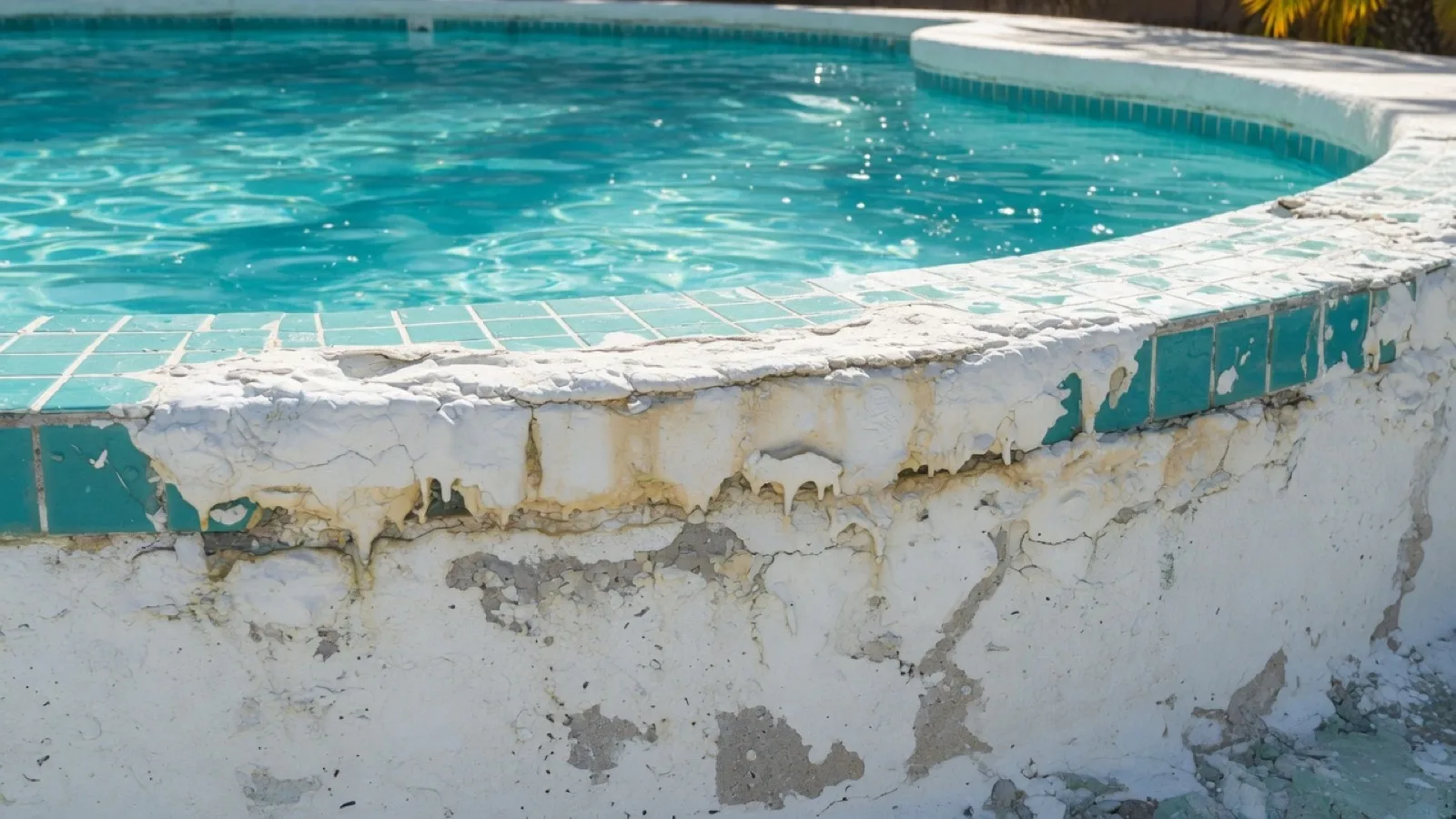
Pentair’s pool-water guide describes white chalky calcium buildup around tile and equipment as scaling, and it explains that high pH, high alkalinity, and hard water can contribute. That is a general explanation, not a diagnosis of every white mark on a Santee waterline. The companion for the local mineral fight is our hard water pool guide. This page is the removal step.
A matched pro tests, looks at scale and equipment, and then chooses dilution or RO. There is no single hardness number that, by itself, decides a drain.
Drain and dilute versus mobile reverse osmosis
A partial drain sends a slice of the old water to a legal discharge path, then the auto-fill or a hose puts fresh water in. Angi (updated May 3, 2026) puts a 10 by 20 ft inground pool at about 10,000 to 15,000 gallons, and a 20 by 40 ft shell at twice that or more. The pro still measures the actual pool. HomeGuide’s September 22, 2025 maintenance guide lists a pool drain around $175 as a national market figure, never our price.
Mobile reverse osmosis is the stay-full option. Portside Pool Purification, a San Diego and North County vendor, describes pulling water from the pool, running it through RO membranes, and returning it so the shell never sits empty. Portside’s published San Diego pricing is $800 up to 20,000 gallons, plus $15 per 1,000 gallons after that. The trailer processes 30,000 gallons in 24 hours; most residential pools take 12 to 16 hours. Roughly 15 to 25 percent of the water cannot be recycled and leaves through a sewer clean-out, replaced with fill. RO removes dissolved buildup, not algae or suspended solids, so the pool should be clear first. More on that method sits on our pool water recycling page.
An empty shell near the coast is a hydrostatic risk. That is why many yards pick RO, or a modest dilution, instead of a full dump. The full-drain hazards live on how to drain a pool.
San Diego fill water puts mineral back
The San Diego County Water Authority has 22 retail member agencies serving 3.3 million people. Your rates and your hose chemistry come from your own agency. Santee is served by Padre Dam Municipal Water District, and that supply is very hard. Nearly half of Santee’s housing stock, 47.8 percent, was built before 1978, so a lot of those shells are older plaster sitting in mineral-heavy top-off. El Cajon in a dry August loses volume all day. The auto-fill replaces it with more of the same.
Coastal pads under the marine layer evaporate less, so they import less hardness each week. They still scale when pH and alkalinity climb on a salt cell and a running sheer. Fallbrook and Bonsall sit outside the Water Authority’s 2026 member list. Treat the hose as a chemical. Test what it is adding.
Inside City of San Diego limits, San Diego Municipal Code §43.0304 and §43.035(e)(3) ban pool water from the storm drain. The City’s February 2016 fact sheet allows a sanitary-sewer drain through an onsite sink or lateral cleanout with Public Utilities Department approval at (858) 654-4100, or slow landscape irrigation if the soil takes it without runoff. Saline water is stricter. Other cities write their own rules.
What a pro checks before anyone opens a valve
They test hardness with the rest of the kit, because pH and alkalinity decide whether leftover calcium will plate out as scale. They look at the salt cell, the heater, and the tile line. They confirm the discharge path for that address, not a county-wide assumption. If the work is a drain, a sewer connection, or equipment, ask for the C-53 license number. The CSLB lookup is the check.
A weekly pool cleaning route is how most of these yards catch a climbing waterline before the heater sees the crust.
When to call us
Call when the tile line keeps crusting after every top-off, when a salt cell or heater is scaling, or when a drain is the only plan on the table and nobody has named a legal place for the water to go. A matched local pool pro will test, then pick dilution or reverse osmosis.
Frequently asked questions
Is there a chemical that lowers calcium hardness?
There is no bottle that subtracts dissolved calcium the way soda ash raises pH. Hardness comes down when some of that water leaves, through a partial drain and refill or through mobile reverse osmosis that pulls water, strips dissolved minerals, and returns it.
What does mobile reverse osmosis cost in San Diego?
Portside Pool Purification, a San Diego and North County vendor, publishes $800 up to 20,000 gallons, plus $15 per 1,000 gallons after that. The trailer processes 30,000 gallons in 24 hours, and most residential pools take 12 to 16 hours. Roughly 15 to 25 percent of the water cannot be recycled and is discharged through a sewer clean-out.
Will lowering hardness stop tile scale?
Pentair's pool-water guide describes white chalky buildup around tile and equipment as scaling, and it names high pH, high alkalinity, and hard water as contributors. Dropping hardness helps the water hold less mineral, but pH and alkalinity still have to sit in a useful range or the crust comes back.
Can I dump hard pool water in the gutter?
Inside City of San Diego limits, San Diego Municipal Code §43.0304 and §43.035(e)(3) make it illegal to discharge pool water into the storm drain. The City's February 2016 fact sheet also bans saline water from gutters unless a rare direct path to a naturally saline body exists. Other cities set their own rules.
Does San Diego fill water put the hardness right back?
Every top-off is a chemistry reset. The San Diego County Water Authority's 22 retail member agencies serve 3.3 million people, and your hose water comes from your own agency. Inland yards that evaporate hard take more of that mineral back in. Lowering hardness is a reset, not a one-time cure.
Need professional help in San Diego County?
Splash Pro Pools connects San Diego homeowners with pool pros for the work in this post.