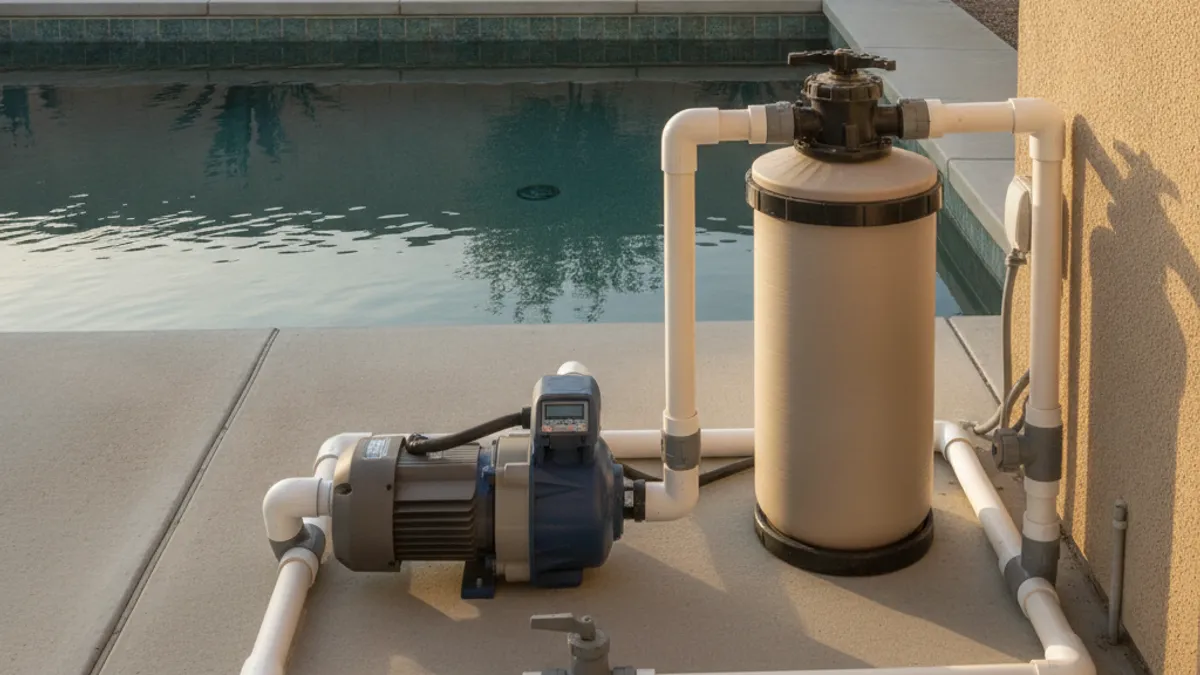
Run a single-speed pool pump about 8 hours a day, and a variable-speed pump 10 to 12 hours a day at low RPM. The real target is one full turnover, meaning every gallon of water passes through the filter once every 24 hours. In San Diego’s summer heat, aim for one to one-and-a-half turnovers. In winter you can drop to 4 to 6 hours. The exact number depends on your pool size and pump, but one daily turnover is the rule that keeps water clear and chlorine working.
Most people either run the pump too little to save money and end up with a green pool, or run it around the clock and hand SDG&E a huge bill. Neither is necessary. Here’s how to find the right run time for your pool and when to run it so you pay the least for it.
How long should you run a pool pump each day?
One full turnover per day is the standard, and for a typical San Diego backyard pool that lands around 8 hours on a single-speed pump. Turnover means the pump has cycled the entire volume of the pool through the filter once. That’s enough to distribute chlorine evenly, pull debris to the filter, and keep the water from going stagnant.
You don’t have to run those hours all at once. Splitting the run into two blocks, one in the early morning and one at night, keeps circulation steady across the day and lets you dodge the expensive late-afternoon rate window. What matters is the total hours add up to at least one turnover.
Variable-speed pumps change the math, and we’ll cover why below, but the principle holds for every pool: hit one turnover a day, more in a heat wave, and you’re in good shape.
How do you calculate your pool’s turnover time?
Turnover time is your pool volume divided by your pump’s flow rate. Two quick numbers and you have your minimum daily run time.
First, find your volume in gallons: length x width x average depth x 7.5. A 15-by-30-foot pool averaging 5 feet deep holds about 16,875 gallons.
Then divide by your pump’s flow rate in gallons per hour. A pump moving 3,000 gallons per hour turns that pool over in about 5.6 hours. Round up and run it 6 to 8 hours to give yourself margin. If you don’t know your flow rate, it’s on the pump’s spec sheet or the manufacturer’s flow curve for your model and speed.
| Pool size | Approx. gallons | Turnover at 3,000 GPH |
|---|---|---|
| 12 x 24, 4.5 ft avg | ~9,700 | ~3.5 hours |
| 15 x 30, 5 ft avg | ~16,875 | ~5.6 hours |
| 18 x 36, 5.5 ft avg | ~26,730 | ~8.9 hours |
Set your daily run time to at least the turnover number, then add a couple hours in summer. The bigger the pool, the more hours it needs, which is exactly where a variable-speed pump earns its keep.
Single-speed vs variable-speed: why the hours differ
A single-speed pump runs at one fixed 3,450 RPM whether the pool needs it or not. It moves a lot of water fast, so it hits turnover in fewer hours, but it draws roughly 2.3 kW the whole time. Eight hours a day of that is where the summer electric bill comes from.
A variable-speed pump runs at a much lower 1,200 to 1,800 RPM, so it moves water slowly and needs 10 to 12 hours to reach the same turnover. The trade is worth it: at low speed it draws around 0.3 kW, a fraction of the single-speed load. Longer hours, far less power, lower bill. Slow filtration also traps finer particles, so the water often looks clearer.
That’s why California’s Title 20 made variable-speed pumps the standard on replacements. If you’re still on a single-speed pump, our variable-speed pool pump guide breaks down the real San Diego savings, and there are SDG&E rebates that cut the upgrade cost.
When should you run the pump? San Diego time-of-use rates
In San Diego, when you run the pump matters almost as much as how long. SDG&E bills on time-of-use, so the same hour of pumping costs very different amounts depending on the clock.
On-peak is 4 to 9 p.m., the most expensive window of the day, sometimes above $0.55 per kWh in summer. That’s the worst time to run a pump. Super off-peak, roughly midnight to 6 a.m., is the cheapest. Early morning and late evening fall in between.
Set your pump’s built-in timer to run through the super off-peak window and the early morning, and keep it off from 4 to 9 p.m. You lose nothing in water quality by shifting the hours, and you can cut the pump’s share of the bill by half or more. Every variable-speed pump has a scheduler for exactly this. If yours is a single-speed pump on a mechanical or digital timer, the same off-peak scheduling still applies.
How many hours in summer vs winter in San Diego?
San Diego pools run year-round, but the water doesn’t need the same care in January that it does in August. Adjust the hours with the season.
In summer, heat speeds up chlorine loss and algae growth, and more swimmers mean more to filter. Run a full turnover, and in a heat wave or during heavy use, push to one-and-a-half. That might mean 10 hours on a single-speed pump or a full 12 on a variable-speed one.
In winter, cooler water holds chlorine longer and the pool sees less use. You can safely drop to 4 to 6 hours a day, or one turnover, whichever is longer. Don’t cut below that, since even a lightly used pool needs its water moving to stay balanced. Our pool maintenance schedule lays out the rest of the seasonal adjustments alongside run time.
What happens if you don’t run the pump long enough?
Under-running is the most common and most expensive pump mistake in San Diego. When the water doesn’t fully turn over, chlorine never reaches every gallon, dead spots form, and warm still water is exactly what algae wants. Within a few days you can go from clear to cloudy to green.
A short run time feels like savings until you’re buying shock, running the filter around the clock, and possibly calling for a green-pool cleanup. Our guide on cloudy pool water shows how fast poor circulation shows up in the water. The electricity you saved by cutting hours is almost always less than the cost of getting the pool back.
The fix isn’t more hours at full speed, it’s smarter hours. Shift your run time to off-peak, and if the summer bill still stings, a variable-speed upgrade lets you run longer for less. At Splash Pro Pools, the San Diego pool techs in our network can dial in your pump schedule, check your real turnover, and handle the pump or equipment upgrade if that’s the better long-term move. Call (858) 400-6757 for help getting your run time and your bill where they should be.
If you’d rather hand the whole thing off, steady weekly pool service keeps the pump schedule, chemistry, and circulation handled so you never have to think about turnover again.
Frequently asked questions
How many hours a day should I run my pool pump?
Run a single-speed pump about 8 hours a day and a variable-speed pump 10 to 12 hours a day at low RPM. The real goal is one full turnover, meaning every gallon in the pool passes through the filter once in 24 hours. In San Diego summer heat, push toward one to one-and-a-half turnovers to keep chlorine and circulation ahead of algae.
Is it cheaper to run a pool pump at night in San Diego?
Yes. SDG&E charges the most from 4 to 9 p.m. on-peak and the least during the super off-peak window, roughly midnight to 6 a.m. Running your pump overnight and in the early morning instead of the late afternoon can cut the pump's share of your bill by half or more without changing the total hours.
Can I run my pool pump only a few hours a day to save money?
You can, but under-running is the most expensive mistake there is. If the water doesn't fully turn over, chlorine can't reach every gallon, and San Diego heat lets algae take hold within days. A green pool costs far more to fix than the electricity you saved. Cut cost by shifting hours to off-peak or upgrading to a variable-speed pump, not by starving the pool of circulation.
Do I need to run my pool pump 24 hours a day?
No. A single full turnover a day is enough for a residential pool with balanced water. Running 24 hours a day wastes electricity for little added benefit. The exceptions are a heavy heat wave, an algae bloom you're clearing, or right after adding chemicals, when you want continuous circulation for a day or two.
How long should I run a variable-speed pump versus a single-speed pump?
Variable-speed pumps run longer on the clock, usually 10 to 12 hours, but at a low 1,200 to 1,800 RPM that draws a fraction of the power. That low-and-slow flow filters more thoroughly and still costs far less than a single-speed pump running 8 hours at full 3,450 RPM. Longer hours at low speed is the cheapest way to a clean pool.
How do I know my pool's turnover time?
Find your pool volume in gallons (length x width x average depth x 7.5), then divide by your pump's flow rate in gallons per hour. The result is how many hours it takes to move all the water once. Set your daily run time to at least that number. A local pro can measure your real flow rate if you don't have the pump's spec sheet.
Need professional help in San Diego County?
Splash Pro Pools connects San Diego homeowners with pool pros for the work in this post.