A typical Escondido pool remodel keeps the gunite shell that’s already in the hillside and replaces what inland summers have worn out: plaster, waterline tile, coping, and often the equipment. On older lots near Lake Hodges, Grand Avenue, and Kit Carson Park, the hole was dug decades ago. The finish is what failed. Splash Pro Pools matches homeowners with licensed, independent C-53 pool contractors. You contract with that pro directly.
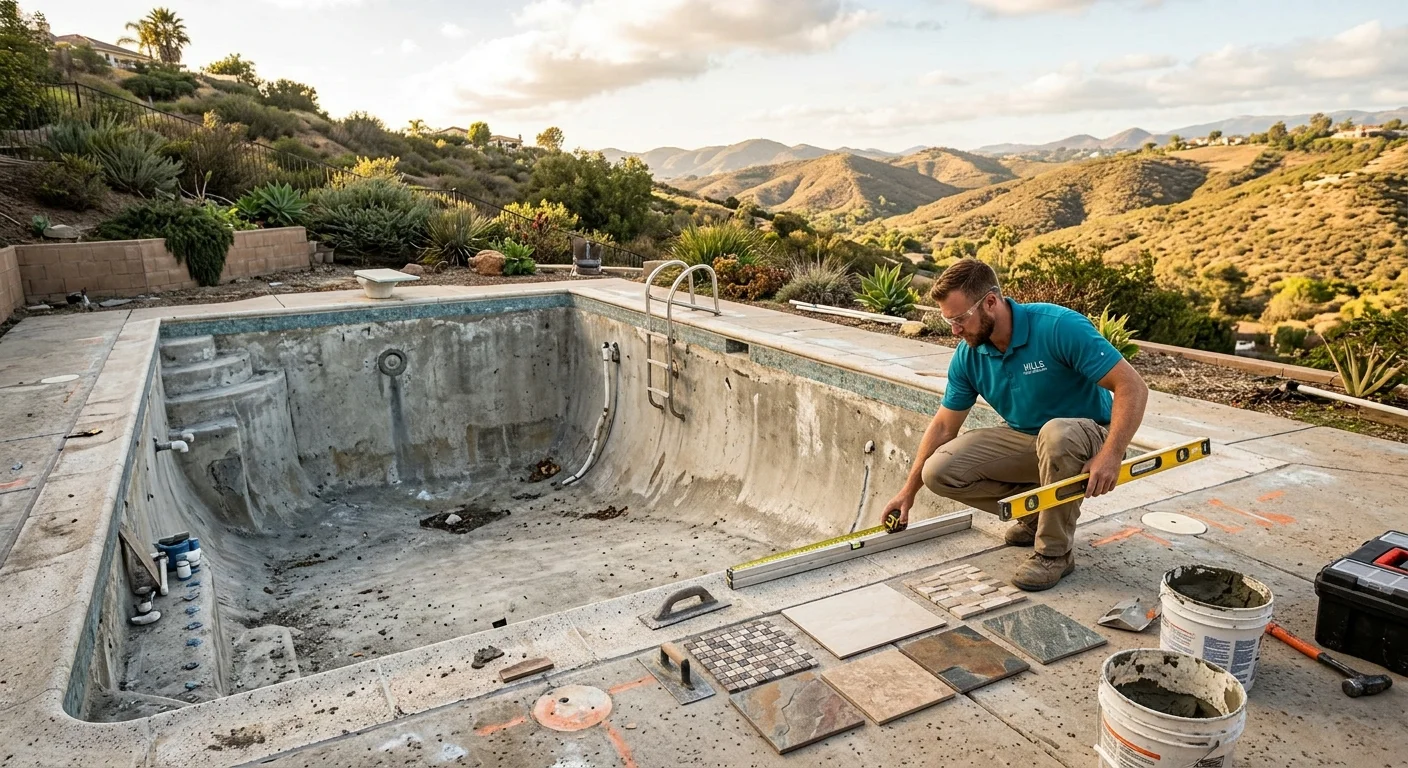
What an Escondido remodel usually includes
An Escondido remodel usually keeps the gunite shell and replaces the interior, the waterline, and the tired gear on the pad. The licensed contractor chips or grinds the old plaster, repairs hollow spots, then trowels a new plaster, quartz, or pebble finish. Waterline tile often comes out in the same pass, because inland fill water leaves a chalky crust there that a brush never fully clears. Pentair’s pool water guide describes that white film as scaling, the kind that shows up when pH, alkalinity, and hardness run high.
Coping and deck joints get pulled when they’re cracked or the mastic has shrunk away from the bond beam. Many pads east of I-15 still run a single-speed pump and an old heater. Opening that pad during a remodel is the clean time to swap them, not a second visit later. Lights, a Baja shelf, or a spillover spa can go in if the steel and plumbing can take the change. None of that starts until someone reads the shell. Structural cracks, hollow delamination, and wet spots in the yard belong in pool repair first.
Hillside pools toward Hidden Meadows, Harmony Grove, and Dixon Lake often sit on lots that already paid for excavation, retaining, and a long gunite pour. What aged out is the surface you stand on, the tile band at the water, and equipment that predates current pumps and heaters. HomeGuide’s June 10, 2024 “Pool Remodel Cost” guide puts a national remodel in a $5,000-$30,000 band, with a $17,500 average, and inground work spanning $6,000-$50,000. Resurfacing in that same guide runs $2,000-$15,000 nationally, and a heater addition $1,600-$5,200. Those are named market ranges, not an Escondido average and not a Splash Pro Pools price. For how those line items stack across the county, read the pool remodel cost in San Diego guide.
If the shell is sound and you only need a new interior, the job is closer to pool resurfacing than a full renovation. We published a dedicated walkthrough of resurfacing an Escondido pool for that narrower scope. The City of Escondido sets building permits. Your water district sets refill rates and drain rules. Confirm both locally before anyone opens a valve.
Why inland sun ages plaster faster than the coast
Inland sun and dry air concentrate minerals in the water, so plaster etches faster here than it does on the coast. Escondido sits in a valley well inland of the marine layer. A west-facing shallow end above Lake Hodges takes afternoon heat that a Point Loma pool, still in fog at noon, never sees.
Heat raises water temperature. Dry air pulls water off the surface. What’s left behind is more of everything the fill water brought in: calcium, sanitizer, and dissolved solids. That mix etches plaster from the inside. It also leaves scale at the tile line, the band you stare at from the patio. UV does the other half. The plaster that sits in air all summer dries and chalks. The plaster underwater lives in a tighter chemistry. Neither is kind to a plain white coat.
The CDC’s home-pool guidance still wants pH in the 7.0-7.8 range. Chlorine slows down as pH climbs past 7.8. Water below 7.0 corrodes metal and chews finishes. Inland evaporation makes that window harder to hold through July and August, when the pool is used every afternoon and the auto-fill keeps adding mineral-heavy makeup water. A coastal pool gets more humidity and milder peaks. Inland North County gets the long swim season that makes a backyard pool worth owning, and the same season that cooks the interior.
Fill chemistry is local. The San Diego County Water Authority lists the City of Escondido among its 22 retail member agencies. Your hardness, your refill price, and your drain rules come from the agency on your meter, not from a county-wide number and not from City of San Diego stormwater sheets. Ask the contractor to test the pool and the fill, then pick a finish that can live with both. Quartz and pebble take staining and inland UV better than bare plaster. That is why so many Escondido interiors get upgraded at remodel time instead of recoated in the same white mix that failed.
Resurface-only versus a fuller remodel
A resurface is a new interior. A remodel is that interior plus the parts around it that have aged out. The fork is the shell and the stuff attached to it, not a vibe.
| Surface refresh | Fuller remodel | |
|---|---|---|
| Interior | New plaster, quartz, or pebble on a sound shell | Same new interior, often after a deeper chip-out |
| Tile and coping | Keep what is still tight and clean | Replace the waterline, coping, and failing joints |
| Equipment | Leave the pad if it still runs well | Replace the pump, filter, heater, or salt system while the pad is open |
| Layout | Same shape and depth | Spa, tanning ledge, or lighting if the steel can take it |
| City and water rules | Still a permit and discharge conversation with Escondido | Same rules, more trades on the same path |
A refresh fits when your feet are the complaint. The floor feels like sandpaper. The plaster has gone from white to a mottled gray map. Stains at the waterline stop responding to brushing. The tile is still bonded, the coping is true, and the equipment still primes. That job is a drain, a prep, a new finish, and a startup. Painting sits even lower on HomeGuide’s 2024 remodel list, at $1,400-$2,500 nationally, and it does not last like a true interior.
A fuller pool renovation in Escondido CA shows up when several systems fail together. Tile popping at the waterline. Coping that rocks. A heater that costs more to keep than to replace. A deck that dumps dirt into the gutter every time the Santa Anas blow. Doing the interior alone then paying to tear the tile later is how people buy the same scaffold twice. Layout changes belong here too: a tanning ledge for 100-degree inland afternoons, a raised spa for nights that cool off hard after a hot day. Those are steel and plumbing decisions, not catalog stickers.
Late spring and fall often give the dry cure a new finish wants, without the midsummer bake on fresh plaster. The matched contractor times the pour to the weather and the product. There is no single Escondido month that fits every shell.
Licensed remodel work versus a punch-list repair
A pool remodel, a resurface, and structural repair all need a licensed C-53 contractor in California. Title 16 of the California Code of Regulations, section 832.53, defines that classification: a swimming pool contractor constructs swimming pools, spas, or hot tubs, including solar heating, using the trades those jobs require. Resurfacing and remodel work sit inside that trade.
California Business and Professions Code section 7048 exempts some work under an aggregate contract price of less than $1,000, and only when the job is casual, needs no building permit, is not a sliced-up larger project, the person does not advertise as a contractor, and no one is hired to help. HomeGuide’s remodel and resurfacing ranges sit far above that line. So the honest split is this: repairs and remodels require a licensed contractor. Ask anyone who touches the structure or the equipment for a license number, then check it on the CSLB site before you sign.
A punch-list repair is a different animal. A cracked skimmer lid. A light niche that weeps. A few loose waterline tiles. A pump that hums and will not prime. Those jobs can still need a license once they leave the casual-and-under-$1,000 box, and they still need a pro who knows gunite. They do not need a full chip-out. Mixing the two on one vague proposal is how a homeowner pays remodel money for a patch, or repair money for a job that leaves the plaster sandpaper.
Splash Pro Pools is a referral service. It holds no contractor license, owns no trucks, and does none of the work. The independent local pro you are matched with holds the C-53, pulls the City of Escondido permit when one is required, and warrants their own labor under whatever terms they put in writing. Read those terms. They are not ours.
How to read an Escondido remodel proposal
A usable Escondido proposal names the finish, the chip-out, the equipment, who pulls the permit, and how the water leaves the yard. If those five things are fuzzy, the number at the bottom is theater.
Chip-out and prep decide whether the new interior bonds. A light grind over failing plaster is how inland jobs delaminate after a couple of hot summers. The proposal should say whether the old finish is coming off, how hollow spots get repaired, and what bond coat goes down. Finish type should be a product family, not a color word. Plaster, quartz, and pebble wear differently under Escondido UV and mineral fill. Tile, coping, and mastic should be line items, not “as needed.” Equipment should list the pump, filter, and heater by function, not “upgrade package.”
Permits and water are local. The City of Escondido sets building permits for this work. Your water district sets refill rates. Stormwater and drain rules are the city’s, not a copy of San Diego’s municipal code. The proposal should say who applies, who confirms discharge, and whether landscape irrigation, a sewer cleanout, or another legal path is the plan. Confirm those rules with the city and the district before the pool is emptied. A bigger pool means more machine hours on the chip-out and more fill water on the way back in. That is what moves the number.
Exclusions matter as much as inclusions. Structural crack repair, deck replacement, and electrical upgrades often sit outside a finish-only price. A round figure someone heard, including a $20,000 backyard story, is a scope conversation, not a product. Walk the drained shell with the contractor. Mark what stays and what goes. If you no longer want the pool at all, fill-and-remove is a separate job, not a remodel allowance.
When to call us
Call when the plaster is rough, the waterline is scaled past cleaning, or the pad and coping are failing with the interior. That is licensed C-53 remodel and resurfacing work, not a weekend patch. Call us at (760) 642-1256 and we’ll connect you with a licensed local pool pro.
Frequently asked questions
What time of year is best to resurface an Escondido pool?
A licensed C-53 contractor times a new plaster or pebble finish for a stretch of dry weather so the material can cure. Inland Escondido runs hottest in midsummer, so many interiors go on in late spring or fall, when the shell can dry without a heat spike on fresh plaster. The matched pro sets that window from the forecast and the finish they specified.
How is a resurface different from a full Escondido pool renovation?
A resurface replaces the interior finish on a sound gunite shell. A fuller remodel still does that work, then adds the waterline tile, coping, deck joints, and equipment that inland sun and hard fill water have aged out. Layout changes such as a spa or tanning ledge sit in the remodel column, not the resurface column.
Does an Escondido pool remodel need a licensed contractor?
Yes. California treats remodel, resurfacing, and structural pool work as contractor work. The swimming-pool classification is C-53 under 16 CCR §832.53. Business and Professions Code §7048 only exempts some jobs under $1,000, and a remodel runs well past that line. Ask the pro for a license number and check it on the CSLB site before you sign.
What is the most affordable way to refresh an Escondido pool?
If the shell, tile, and deck can stay, a plaster resurface is the narrower job. HomeGuide's June 10, 2024 remodel guide lists national resurfacing at $2,000-$15,000 and painting at $1,400-$2,500. Painting is the cheaper market line and it does not last like a true interior. Quartz and pebble cost more up front and take inland sun better than plain plaster. Those figures are national ranges, not an Escondido quote.
What if I no longer want the inground pool?
A remodel assumes you are keeping the shell. If the pool no longer fits the yard, fill-and-remove is a different project with its own permits from the City of Escondido. Do not treat demolition as a line item on a remodel proposal. Ask the matched contractor which path the shell actually supports.
Need professional help in San Diego County?
Splash Pro Pools connects San Diego homeowners with pool pros for the work in this post.