Comparing pool service vs DIY San Diego options comes down to cash versus consistency. DIY removes the recurring service bill, but it puts testing, dosing, brushing, and early problem spotting on your calendar. HomeGuide’s September 2025 guide places weekly or biweekly service at $80–$150 per month, while DIY still carries chemicals, tools, and recovery costs.
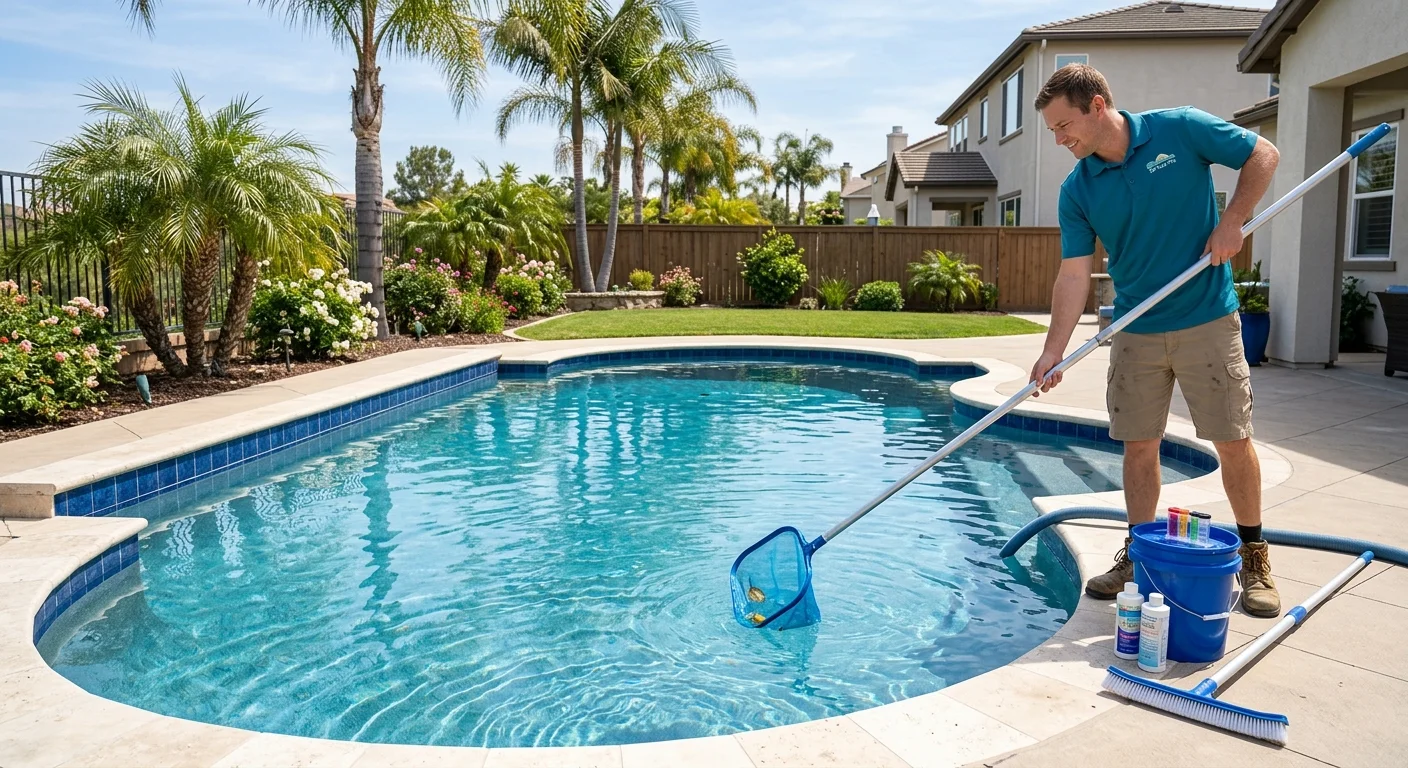
Pool service vs DIY in San Diego: the dollar comparison
The cheaper path depends on the value of your time and consistency. HomeGuide’s September 2025 guide lists annual professional maintenance at $960–$1,800. Its annual chemical estimates run about $175 for fiberglass, $400 for vinyl, and $750 for concrete pools.
Those figures don’t create a clean subtraction problem. Service plans differ. Some quotes include routine chemicals, while others separate materials from labor. A lower monthly figure may also cover fewer cleaning tasks. Our weekly pool service cost guide explains why the written scope matters as much as the quoted amount.
| Cost factor | DIY care | Professional service |
|---|---|---|
| Direct spending | You purchase chemicals, testing supplies, and cleaning gear directly. | You pay for the tasks and materials listed in the service agreement. |
| Routine labor | You handle testing, dosing, brushing, debris, and baskets. | The pool pro handles the maintenance tasks included in the plan. |
| Chemistry decisions | You interpret test results and calculate each treatment. | The pool pro manages the agreed chemistry work and records results. |
| Problem response | You identify changes and decide which specialist to contact. | The service provider can flag concerns and discuss the next step. |
| Schedule | Pool care competes with work, travel, and household plans. | The agreed maintenance routine becomes someone else’s responsibility. |
DIY wins on service fees when the work gets done correctly. Professional care wins when delegation prevents skipped testing or delayed cleaning. Compare the complete scope, not one monthly number.
What DIY actually requires
DIY care requires frequent testing, accurate dosing, physical cleaning, and written tracking. The chemistry work is the part most homeowners underestimate.
The CDC’s healthy swimming guidance recommends testing chlorine and pH at least twice per day. Testing should happen more often during heavy use. The CDC also says DPD test kits are more accurate than test strips.
For pools, free chlorine should stay at least 1 ppm. The minimum rises to 2 ppm when cyanuric acid or stabilized chlorine is used. The recommended pH range is 7.0–7.8. Above 7.8, chlorine kills germs more slowly. Below 7.0, water can corrode pipes and equipment.
Those readings move for ordinary reasons. Sunlight consumes chlorine. Swimmers add sweat, dirt, and other material that also reduces it. A clear pool can still need a chemistry correction, so appearance alone isn’t a test.
Cleaning adds another layer. The homeowner must remove debris, brush surfaces, empty baskets, and keep water moving through the filtration system. A robotic pool cleaner can take over some debris collection. It still can’t read sanitizer levels, measure pH, or choose a chemical dose.
DIY works when these jobs become a real routine. A test kit buried in the garage doesn’t save money.
What professional service actually buys you
Professional service buys delegation, repeat measurements, and another set of eyes on the pool. The exact package still controls what gets done.
An agreed service scope may cover water testing, chemical adjustments, brushing, debris removal, basket care, and visual equipment checks. Filter cleaning, specialty chemicals, repairs, and major recovery work may sit outside that scope. The quote should separate those items before service begins.
The practical value is continuity. A pool pro can compare this visit’s results with earlier readings. That pattern can show whether sanitizer is being consumed, pH keeps moving, or a mechanical concern needs closer attention. It doesn’t guarantee perfect water or failure-free equipment. It makes routine observation someone’s assigned job.
Our weekly pool cleaning and maintenance service connects homeowners with licensed, independent local pool professionals. The homeowner contracts with and pays the matched professional directly.
Routine cleaning isn’t construction, and California treats repair work differently. Under California Business and Professions Code §7048, the small-job licensing exemption is conditional. Repairs and remodels require a licensed contractor, and the pool contractor classification is C-53 under 16 CCR §832.53. Ask any professional touching pool equipment or structure for a license number, then confirm it through the California Contractors State License Board.
The honest tradeoff
DIY is a strong choice for homeowners who enjoy the work and follow a schedule. The savings are real when testing happens, results get recorded, and treatments match those results.
The tradeoff is ownership. Rain, travel, family plans, and busy workweeks don’t remove the need to test water. A missed task rolls into the next one. Skipped testing can leave the homeowner guessing about the correct dose, while skipped brushing gives debris more time on the surfaces.
Professional service fits households that would rather delegate that repetition. It can also make sense when several people use the pool but nobody clearly owns its care. The fee isn’t just payment for chemicals. It pays someone to carry out the agreed routine and notice changes over time.
Neither option removes every homeowner responsibility. With professional service, you still need to report leaks, unusual sounds, damaged parts, or sudden water changes. With DIY care, you need to recognize when the job has moved beyond routine maintenance.
The deciding factor is repeatability. If you’ll test, clean, record, and respond every week, DIY can work well. If the routine disappears whenever the calendar fills, service may cost less than repeated recovery work and wasted chemicals.
Where the hidden costs show up
Hidden costs appear when routine care turns into cleanup, repair, or water replacement. HomeGuide’s September 2025 guide lists first-time cleaning at $150–$350 and professional cleaning labor at $60–$90 per hour. Its July 2025 repair guide places pool repair labor at $45–$70 per hour.
A refill shows how San Diego location changes the math. Inside the City of San Diego, 1 HCF equals 748.05 gallons. A 15,000-gallon refill uses about 20 HCF because 15,000 divided by 748.05 is roughly 20. At the city’s January 2026 single-family tiers, the water alone lands around $170–$240, depending on the tier where that usage falls. That’s before sewer charges.
That example doesn’t apply countywide. The San Diego County Water Authority has 22 retail member agencies serving 3.3 million people. Each pool owner’s rate and local drain rules come from the agency or city serving that property.
Drainage can create another expensive mistake. Inside City of San Diego limits, Municipal Code §43.0304 and §43.035(e)(3) prohibit pool water and filter backwash from entering the storm drain system. The city’s narrow conditions for prepared pool water include dechlorination, pH from 7–8, ambient temperature, no algae or suspended debris, and no salinity. Backwash may never enter the storm drain.
Those city rules apply in neighborhoods such as Rancho Bernardo and Rancho Peñasquitos. Elsewhere in the county, confirm the current requirements with your city or water district before draining.
A middle option: chemical-only service
A chemical-only arrangement can fit homeowners who enjoy cleaning but don’t want full chemistry responsibility. The homeowner handles debris, brushing, baskets, and the cleaner. The pool pro handles the testing and dosing stated in the agreement.
HomeGuide’s September 2025 guide places basic pool care at $30–$95 per month. Treat that as a national market reference, not a local quote or a fixed chemical-only package. The label “basic care” can cover different tasks. Have the written scope identify who supplies chemicals, which tests are recorded, and whether filter care is included.
This split keeps some DIY savings while assigning chemistry decisions to a professional. It doesn’t make monitoring disappear. The CDC still recommends checking chlorine and pH at least twice daily, especially when sunlight and heavy swimming consume sanitizer.
The arrangement works best when the division is unmistakable. If the homeowner owns brushing, that task needs a place on the calendar. If the pro owns chemical dosing, the service agreement should say which materials are included. Equipment repairs should remain separately defined.
Chemical-only care isn’t the automatic winner between full service and DIY. It’s useful when both sides understand exactly where one person’s work ends and the other’s begins.
When to call us
Bring in a licensed pool pro when chemistry won’t hold, algae returns, or equipment and structural work enter the job. Call us at (760) 642-1256 and we’ll connect you with a licensed local pool pro.
Frequently asked questions
Is pool service cheaper than DIY in San Diego?
DIY removes the recurring service bill, but you still pay for chemicals, testing supplies, cleaning tools, and recovery work. The cheaper choice depends on your consistency and pool.
How often should a homeowner test pool water?
The CDC recommends testing chlorine and pH at least twice per day, with more frequent testing when the pool gets heavy use.
What does weekly pool service include?
The exact scope varies by provider. A written quote should state who handles testing, chemicals, brushing, debris, baskets, filter care, and equipment concerns.
Can a robotic cleaner replace pool service?
A robotic cleaner can collect some debris, but it doesn't test water, balance chemicals, inspect every system, or arrange equipment repairs.
Need professional help in San Diego County?
Splash Pro Pools connects San Diego homeowners with pool pros for the work in this post.