A note on scope: this is pool repair work, which sits outside what Splash Pro Pools does. Call (858) 400-6757 and we’ll match you with a vetted local pro who covers it.
That white, chalky line on your pool tile is more than just an eyesore. It’s a preview of what our hard Vista water is doing inside your pool pump. We get our water from the Vista Irrigation District, and while it’s great for our avocado trees, its 12 to 14 grains per gallon of hardness is absolutely brutal on pool equipment.
Vista Irrigation District water at 12 to 14 grains per gallon scales the inside of the pump the same way it scales the tile. Shadowridge and Gopher Canyon pads hear that as a grind. Splash matches the repair. Call (858) 400-6757. Cleaning is (760) 642-1256.
Why Vista Pool Pumps Have It Rough
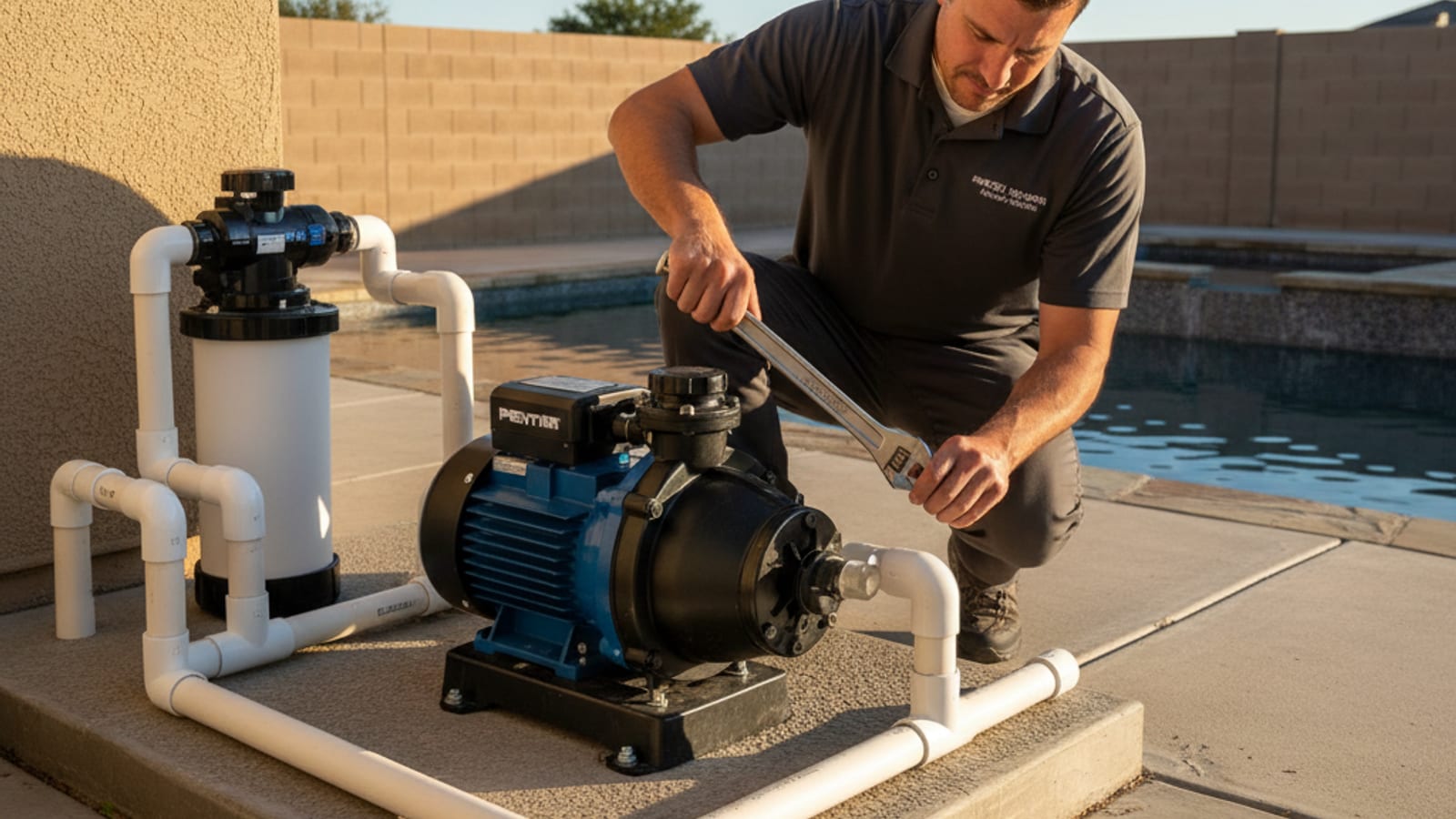
Your pool pump is the heart of your pool’s circulation system. It pulls water through the skimmer, pushes it through the filter and heater, and sends it back to the pool clean and clear. When that heart is under constant stress, the whole system suffers. In Vista, our pumps face two main enemies: our water and our history.
The Hard Water Problem
Hard water is just water with a high concentration of dissolved minerals, mostly calcium and magnesium. When the pH, alkalinity, or temperature of your pool water fluctuates, these minerals come out of the solution and form calcium carbonate scale. It’s the same stuff that clogs your shower head, but on a much more destructive scale inside your pump.
Here’s how it causes damage:
- Clogged Impellers: The impeller is a spinning disk with vanes that flings water out, creating the pressure that moves it. Scale builds up on these delicate vanes, throwing the impeller off balance. An unbalanced impeller vibrates, which wears out the bearings and seals. Eventually, it can get so clogged that it dramatically reduces water flow, making your filter and heater work poorly.
- Destroyed Shaft Seals: Every pump has a mechanical seal assembly that keeps water inside the wet end of the pump and away from the electric motor. It’s a precise, two-part seal. Calcium scale is abrasive, like liquid sandpaper. It gets into the seal and grinds it down, causing leaks. A small drip might not seem like a big deal, but it’s a sign of failure. That drip will only get worse, and if water gets into the motor bearings, you’re looking at a total motor failure.
- Motor Overheating: When scale clogs the impeller or other parts of the plumbing, the pump has to work much harder to move the same amount of water. This extra strain makes the motor run hotter. Heat is the number one killer of electric motors. It breaks down the winding insulation and fries the bearings, leading to a loud, seized motor that needs to be replaced.
The 80s and 90s Pool Boom
Walk through any neighborhood in Shadowridge or the surrounding areas and you’ll see them: beautiful, mature landscapes and pools that were put in 30 or 40 years ago. These pools were built to last, but the equipment they came with is from a different era.
Many of these pools still have old single-speed pumps like the Pentair WhisperFlo or Hayward Super Pump. These were workhorses in their day, but they are incredibly inefficient. They run at one high speed, all the time, burning through electricity. More importantly, after decades of fighting our hard water, their components are worn out. The plastic housings can become brittle, the copper windings in the motor are fatigued, and finding exact replacement parts can be a challenge. Trying to patch up a 25-year-old pump is often a losing battle.
Telltale Signs Your Pump Needs Help (Not Just a Whine)
Most people call for a pool pump repair in Vista when their pump is making a terrible noise or just won’t turn on. But there are earlier warning signs. Catching them early can sometimes mean the difference between a simple repair and a full replacement.
1. A High-Pitched Squeal
This isn’t the normal hum of the motor. A loud, high-pitched squeal is almost always the sound of bad motor bearings. The bearings are small metal rings that allow the motor shaft to spin smoothly and quietly. When the seals fail and water gets in, or when they just wear out from age, they lose their lubrication and start to grind. A squealing pump is a pump on its last legs. You need to shut it down and get it looked at right away before the motor seizes completely.
2. The Pump Won’t Prime (or Loses Prime)
“Priming” just means the pump is full of water and able to create suction. If you look through the clear lid and see a ton of air sloshing around, or if the pump runs but your skimmers aren’t pulling in any water, you have a priming problem. This could be a simple fix, like a bad lid o-ring. But it can also point to a bigger issue. An air leak on the suction side of the pump, a shrunken thread sealant, or a cracked pump housing can all cause this. Running a pump dry without water will overheat and destroy the shaft seal in minutes.
3. Leaks and Drips
Any water coming from the pump body is a bad sign. Most leaks happen from the seal plate, which is the part that bolts the motor to the plastic pump housing. As mentioned before, this points to a failed shaft seal. Don’t ignore it. That drip is landing right on the motor, and water and electricity don’t mix. It will cause corrosion and eventually short out the motor.
4. It Keeps Tripping the Breaker
If your pump runs for a few minutes and then shuts off, and you have to go reset the breaker, that’s a serious red flag. It means the motor is drawing too much electricity. This is usually because it’s overheating due to failing bearings, a bad capacitor, or an internal short in the windings. This is a safety issue and a fire hazard. Don’t keep resetting it; call a professional.
The Repair vs. Replace Question in Vista
So your pump is shot. The big question is, do you fix it or replace it? Ten years ago, the answer was almost always to repair. A new motor was a few hundred bucks, and you could be back up and running. Today, the math has completely changed.
Here’s the deal: California’s energy efficiency standards (Title 20) mean you can’t legally install a new single-speed pump over a certain horsepower. The only real option for a replacement is a variable speed pump (VSP).
A VSP is a game-changer. Instead of running at one frantic speed (usually 3,450 RPM), you can program it to run at very low speeds for most of the day. Moving water slowly is dramatically more efficient. Think of it like driving your car: you get much better gas mileage at 55 mph on the freeway than you do flooring it from stoplight to stoplight.
Let’s break down the costs. A motor replacement for an old pump might cost you $500 to $800, parts and labor. You’re putting a new motor on a 20-year-old plastic housing with old seals and an old impeller. It’s a patch, not a long-term solution.
A new, high-quality VSP like a Pentair IntelliFlo3 or a Hayward TriStar VSP will cost somewhere between $1,800 and $2,800 installed. Yes, that’s a big number. But here’s the part most people miss: with SDG&E rates being what they are in San Diego County, a VSP can save you $70 to $120 per month on your electricity bill compared to an old single-speed pump.
Over two to three years, the pump literally pays for itself in energy savings. Plus, you get a brand new, warrantied piece of equipment that is whisper-quiet and will last for years. Pouring $700 into a pump that costs you an extra $100 a month to run just doesn’t make sense anymore.
A Quick Story from the Vista Hills
One of the pool pros in our network was at a customer’s house last spring, up off Buena Creek Road. The homeowner had a classic 1990s pool with a big, loud, energy-guzzling WhisperFlo pump. It was finally making that awful bearing squeal. He was retired and on a fixed income, and he was really hesitant about the cost of a new VSP.
He told the tech, “I just want to replace the motor. Get me another five years out of it.”
The pro understood where he was coming from, but sat down with him and his SDG&E bill. Together they figured out his old 1.5 HP pump was costing him about $115 a month to run for 8 hours a day. The numbers showed that a new VSP, running 24 hours a day at a low speed to keep the water turning over, would cost about $25 a month.
The savings were around $90 a month. The new pump would pay for itself in just over two years. After that, it was pure savings in his pocket. He also had neighbors close by, and the fact that the new pump would be so quiet you could stand next to it and have a normal conversation was a huge selling point. He decided to go for the new pump. A few months later, he ran into the tech at the grocery store and couldn’t stop talking about how much his electric bill had dropped. He said he wished he’d done it years ago.
What to Expect from a Professional Pump Service
When you call us for a pump issue, the pro who comes out doesn’t just show up and try to sell you the most expensive option. The approach is to diagnose the whole system, because a pump problem can sometimes be a symptom of something else, like a clogged filter or a suction-side air leak.
Here’s what the process looks like:
- Full System Inspection: The tech tests the pump, checks the electrical connections, inspects the plumbing, and listens to the motor. Filter pressure gets checked too, along with any leaks in the system.
- Clear Explanation of Options: You’ll get told exactly what was found. If it’s a simple repair, like replacing a capacitor or a seal, you’ll hear that straight. If the motor is shot, you’ll get a clear, side-by-side comparison of repairing the old unit versus upgrading to a new VSP, including the long-term energy savings.
- Proper Installation: If you choose a new pump, it gets done right. That means using new plumbing unions, ensuring the electrical connections are safe and up to code, and mounting the pump securely.
- VSP Programming: This is critical. Installing a VSP is only half of it. Programming it for your pool’s needs, your size, your features (like a spa or water feature), and your cleaning schedule is the rest, set up to give you the perfect balance of cleaning power and energy efficiency.
Your pool is a big investment. Keeping its heart, the pump, running smoothly is the best way to protect it. Whether you need a simple fix or a major upgrade, getting honest advice from someone who understands our unique Vista conditions is the first step. If you need help with your pool, check out our Vista pool service options. We’re here to help.
Frequently asked questions
How much does a typical pool pump repair cost in Vista?
A simple repair like a seal kit or capacitor can run from $250 to $450. A full motor replacement usually costs between $500 and $800. A complete replacement with a new, energy-efficient variable speed pump is a larger investment, typically starting around $1,800 installed.
My Shadowridge HOA is strict about noise. Are new variable speed pumps loud?
This is a great question for communities like Shadowridge. New variable speed pumps (VSPs) are incredibly quiet. When running on their normal, low-speed filtration cycles, you can often stand right next to them and barely hear them running, which is a huge benefit for you and your neighbors.
Can I prevent hard water damage to my new pump?
Yes, absolutely. The best defense is maintaining proper water chemistry. Keeping your pH between 7.4-7.6 and your total alkalinity in the right range helps keep calcium dissolved in the water. Occasionally using a scale-inhibiting chemical can also provide an extra layer of protection for your pump and other equipment.
How long should a new pool pump last in Vista's hard water?
With our challenging water, a quality variable speed pump should last between 8 and 12 years. The key to reaching and even exceeding that lifespan is consistent professional maintenance and diligent water chemistry management. Ignoring water balance can significantly shorten the life of any pump.
Need this done in San Diego County?
For repair and renovation work like this, we hand you to our trusted partner, Del Rancho Pools.