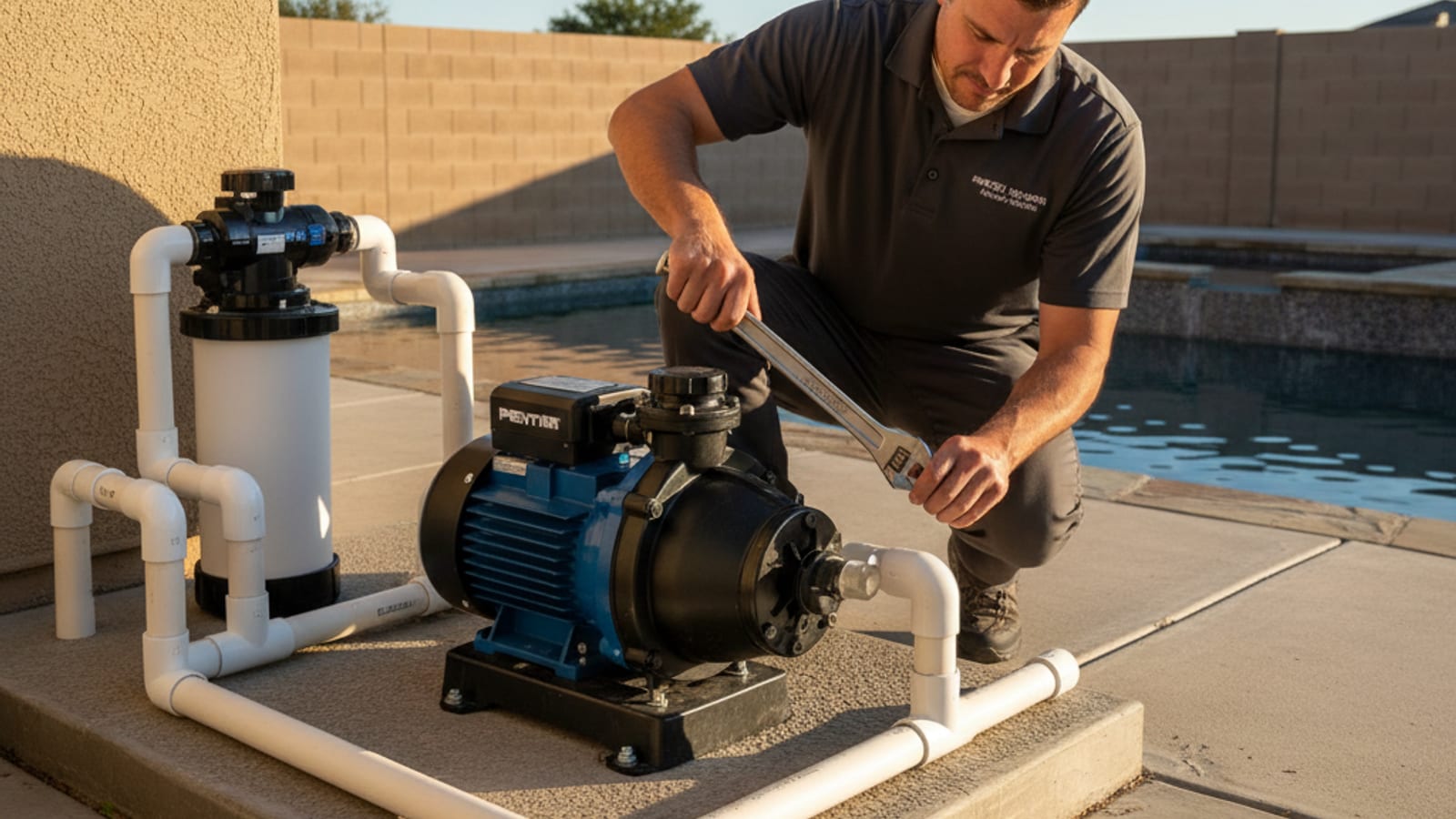
Worth knowing first: Splash Pro Pools is a cleaning and maintenance company, so pool repair goes to our repair partner, reachable on (858) 400-6757.
That white, chalky crust on your waterline isn’t just an eyesore, it’s a warning from our Vallecitos water. That same scale is building up inside the heart of your pool: the pump. If you live in San Marcos, your pool pump is fighting a battle that pumps in Carlsbad or Encinitas just don’t understand.
San Marcos pump failures usually come back to Colorado River hardness, not a random motor. Scale the seals and the next pump dies early too. Splash matches the repair. Cleaning is (760) 642-1256. Repair is (858) 400-6757.
Why San Marcos Pool Pumps Work Harder
Your pool pump is the center of your entire system. It circulates water through the filter, heater, and chlorinator, keeping it clean and safe. But here in San Marcos, that simple job is a lot more complicated. Three main things are working against your pump every single day: our water, our weather, and our older equipment.
The Calcium Problem is Real
The water coming out of your tap from the Vallecitos Water District is hard. Really hard. We’re talking 14 to 18 grains per gallon (gpg). For context, anything over 10 is considered “very hard.” It’s packed with dissolved minerals, primarily calcium carbonate.
When your pool water is agitated or heated, that dissolved calcium comes out of the solution and sticks to surfaces. Think of it like the scale that builds up inside a coffee pot, but on a massive scale. The inside of your pump, especially the fast-spinning impeller, is the perfect place for this to happen. This calcium buildup, or scale, slowly chokes your pump. It narrows the passages water flows through, forcing the motor to work harder and harder to move the same amount of water. It’s like plaque in an artery for your pool’s circulation system.
Inland Heat and Evaporation
It’s no secret that San Marcos gets hotter than the coast. We don’t get that thick marine layer to take the edge off a July afternoon. That extra heat and sun lead to a ton of evaporation from your pool.
When water evaporates, it leaves all those hard water minerals behind. This means the concentration of calcium in your pool water gets higher and higher over time, making the scaling problem even worse. To keep up, pumps have to run longer hours, especially in spread-out communities like San Elijo Hills where a backyard pool is practically standard issue. More run time equals more wear, more heat, and more opportunity for scale to form. It’s a vicious cycle.
Old-School Energy Hogs
Many homes in San Marcos, especially those built before the 2010s, still have old, single-speed induction motors running their pools. These pumps are simple and were reliable for their time, but they have one setting: full blast. They run at a constant high RPM, using a massive amount of electricity. We all know what our SDGE bills look like, and these pumps are a big reason why.
This constant high speed creates more turbulence and heat inside the pump housing, which actually accelerates calcium scaling. The pump is literally working against itself, creating the perfect environment for the very thing that will eventually kill it.
Common Pump Failures in San Marcos
When a pump finally gives up, it usually does so in a few distinct, and often noisy, ways. Most of the time, the root cause traces right back to our hard water. Here are the most common symptoms pros diagnose on service calls in San Marcos.
The High-Pitched Squeal: Bearing Failure
If your pump motor sounds like a screeching blender, you’ve got bad bearings. The motor shaft is supported by two sealed bearings that allow it to spin thousands of times per minute. They are not supposed to get wet.
The part that keeps pool water in the pump and away from the motor is called the shaft seal. It’s a two-part mechanical seal, usually made of ceramic and carbon, that presses together to form a watertight barrier. Our mineral-rich water is abrasive. Over time, it acts like liquid sandpaper, grinding away at this delicate seal until it fails.
Once that seal is compromised, chlorinated, calcium-filled water drips down the motor shaft and directly into the front bearing. The bearing rusts, the grease washes out, and it starts to scream. If you let it go, it will eventually seize up completely, often ruining the motor.
No Suction: A Clogged Impeller
Is your pump running, but the water in the basket is barely moving? Do your pool cleaner and skimmers seem lazy? You likely have a clogged impeller.
The impeller is a spinning disc with curved vanes that grabs water and throws it out toward the filter. It’s the part that does all the work. It’s also the number one target for calcium scale. Techs who pull these pumps apart often find impellers so caked with white scale that the openings between the vanes are almost completely closed. The motor is spinning, burning electricity, but the impeller can’t move any water.
This is a huge problem. Without proper flow, your filter isn’t filtering, your chlorine isn’t circulating, and your pool will turn green fast. You’re also starving the pump for water, which can cause it to overheat and damage other components.
The Hum of Death: Bad Capacitor or Seized Motor
You flip the breaker, the pump motor hums for a few seconds, and then clicks off. This usually points to one of two things.
The first and easier fix is a bad start capacitor. This is a small cylindrical component on the side of the motor that gives it an electrical “kick” to get spinning. Capacitors hate heat, and the combination of a hot San Marcos day and the heat from the motor itself can cause them to fail. Replacing a capacitor is a quick and inexpensive repair.
The second, more serious cause is a seized motor. This can happen if the bearings are so corroded they’ve locked in place. It can also happen if the impeller is so choked with calcium scale that it’s physically wedged against the pump housing. The motor tries to turn but can’t, resulting in that telltale hum before the thermal overload switch shuts it down to prevent a fire.
The San Marcos Question: Repair or Replace?
So, your pump is dead or dying. The big question is whether to sink money into a repair or invest in a new pump. In San Marcos, the calculation is a little different than in other places.
When a Repair Makes Sense
For newer pumps (less than 5 years old), a simple repair is often the way to go.
- Capacitors, Baskets, and O-Rings: These are cheap parts and fast fixes. If this is all you need, it’s a no-brainer.
- Shaft Seal and Bearings: A motor rebuild (replacing the seal and bearings) can be a good value if the rest of the pump, known as the “wet end,” is in great shape. It’s a labor-intensive job, but it can save you hundreds compared to a full replacement. This only makes sense with a motor that clearly has plenty of life left.
The key is a proper diagnosis. You don’t want to replace the bearings only to find out the impeller is also shot and the housing is cracked.
The Strong Case for a Variable Speed Pump
If your pump is more than 7-8 years old, or if you have an old single-speed energy hog, replacement is almost always the smarter long-term decision. California law (Title 20) actually requires that most replacement pumps be energy-efficient variable speed pumps (VSPs). This isn’t just bureaucracy, it’s a huge win for homeowners.
-
Massive Energy Savings: A VSP like a Pentair IntelliFlo or a Jandy FloPro can be programmed to run at very low speeds for most of the day, only ramping up when needed for cleaning or heating. This simple change can slash the pump’s portion of your SDGE bill by 50-80%. We regularly see customers save $60, $80, even over $100 a month. A new pump can pay for itself in under two years.
-
It’s Better for Our Hard Water: This is the key for San Marcos. Running a VSP at a slow, steady speed for longer hours is much gentler on your system. The lower velocity and turbulence mean less agitation, which means calcium stays dissolved in the water instead of plating out as scale inside your pump, filter, and heater. It actively fights the core problem of our local water.
A pro was out at a home in the hills of Discovery Lake a few months back. The homeowner had a 12-year-old single-speed pump that was screaming from bad bearings. The impeller was so scaled up it looked like a piece of coral. The options got laid out: a full motor rebuild and impeller replacement for about $650, or a brand new, quiet, efficient Pentair IntelliFlo VSF installed for about double that. When the math on the SDGE rebate and the projected monthly energy savings of around $75 got shown to him, he saw it immediately. The new pump wasn’t an expense, it was an investment that would pay him back every month.
Making the right choice for your pool starts with understanding the unique challenges pools face here. It’s not just about fixing what’s broken, it’s about setting your pool up for success against our tough San Marcos environment. Proper pool service in San Marcos is about proactive care, not just reactive repairs.
Frequently asked questions
How much does a typical pool pump repair cost in San Marcos?
A simple repair like a capacitor or a seal kit can run from $200-$350. A full motor replacement is more involved and usually costs between $550 and $850, depending on the motor size. If you're facing a major repair on an old pump, it's often more cost-effective to upgrade to a new variable speed model.
Why is my new pump making a weird noise already?
Most often, a noisy new pump is a sign of "cavitation," which sounds like it's pumping gravel. This happens when the pump isn't getting enough water, often due to a clog in the lines, a dirty filter, or plumbing that is too small for the pump's power. Our hard water can contribute to blockages that cause this, so it's important to have the entire system checked, not just the pump.
Can I prevent calcium buildup in my pump?
Yes, to a degree. The best defense is maintaining proper water chemistry, specifically keeping your pH (7.4-7.6) and Alkalinity (80-120 ppm) in their ideal ranges. Using a quality sequestering agent, or "stain and scale" chemical, also helps to keep calcium dissolved in the water so it can't stick to surfaces.
Do I need a permit to replace my pool pump in San Marcos?
For a straightforward replacement of an existing pump, you typically do not need a permit from the City of San Marcos. However, if you are relocating the equipment or running new, high-voltage electrical lines, a permit is almost always required. It's always a good idea to work with a licensed and insured professional who knows the local codes.
Need this done in San Diego County?
For repair and renovation work like this, we hand you to our trusted partner, Del Rancho Pools.