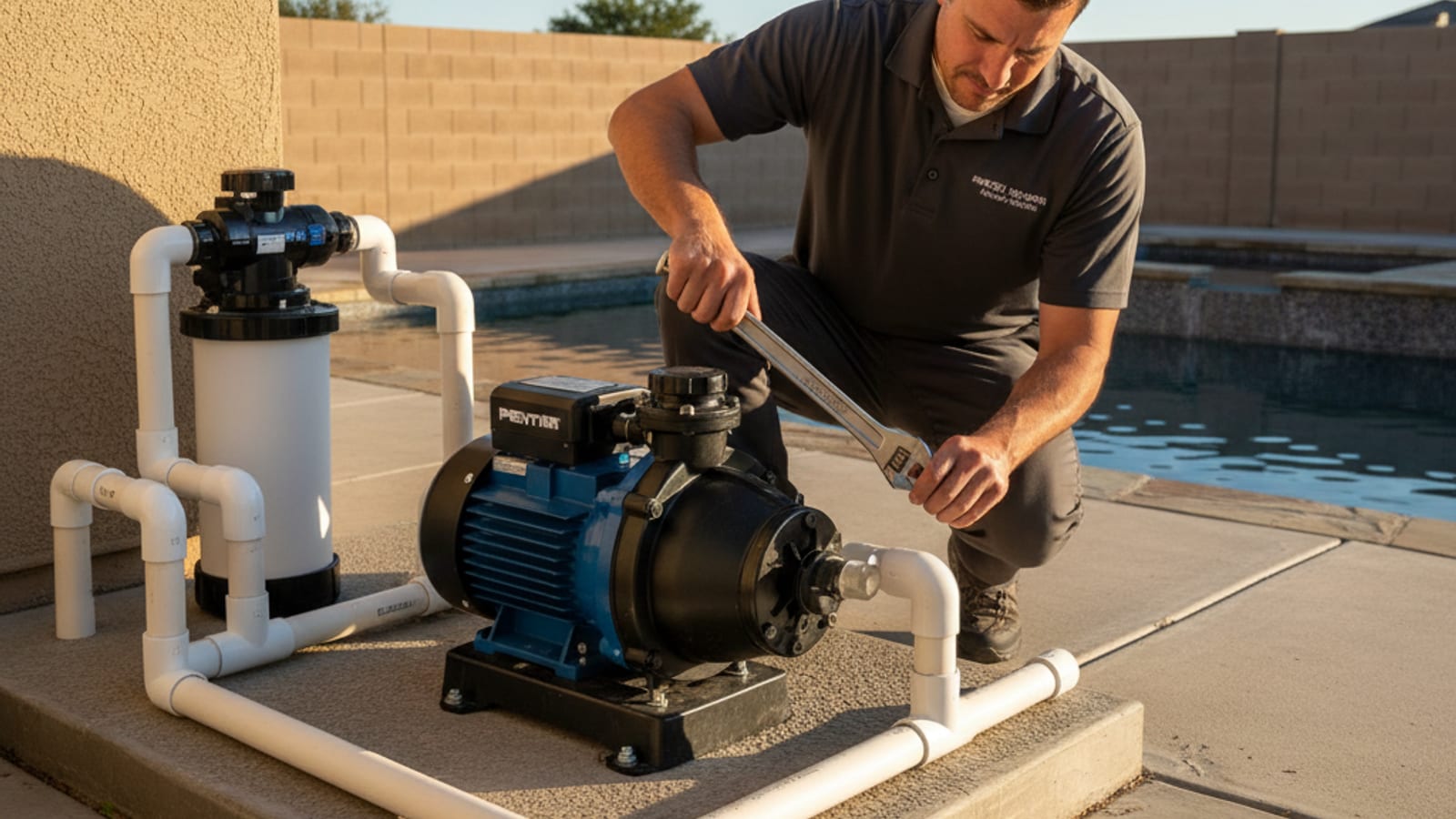
Heads up before you read: Splash Pro Pools keeps pools clean; pool repair is a different trade. Call (858) 400-6757 and we’ll match you with a local pro who handles it.
El Cajon pump work is usually a capacitor at $150 to $250, a motor rebuild at $450 to $650, or a variable-speed replacement at $1,800 to $2,500 installed. Helix water in El Cajon, Fletcher Hills, and Granite Hills often runs 16 to 20 grains per gallon, which scales seals first. Splash matches the repair. Call (858) 400-6757.
Why El Cajon’s Hard Water Is Your Pump’s Worst Enemy
You hear “hard water” all the time. You see the white spots on your shower door. But what does it actually mean for your expensive pool equipment?
In technical terms, our water in El Cajon, Fletcher Hills, and Granite Hills runs between 16 and 20 grains per gallon (gpg). Anything over 10 is considered “very hard.” So we’re basically dealing with liquid rock. This “rock” is mostly dissolved calcium carbonate.
When your pool water evaporates under that hot summer sun, the calcium gets left behind. As the concentration gets higher and your pH drifts up, that dissolved calcium turns back into a solid. It’s a process called scaling, and it creates a rough, white crust on your tile, in your heater, and all through your pump.
Here’s how that scale attacks your pump specifically:
-
The Impeller: This is the spinning part inside the pump that actually moves the water. Calcium scale loves to build up on the impeller’s veins. As it gets thicker, it throws the whole assembly off-balance. This imbalance creates vibration, which puts a ton of stress on the motor bearings and the shaft seal. Worse, the buildup chokes the flow of water, making your pump work harder to do less. Your energy bill goes up, and the pump runs hot.
-
The Shaft Seal: This is the most critical seal in the whole pump. It sits on the motor shaft and keeps water inside the “wet end” of the pump from getting into the “dry end” where the electrical motor lives. The seal is made of two super-smooth faces, one ceramic and one spring-loaded, that press against each other to form a watertight barrier. Hard water is brutal on this seal. The gritty calcium particles act like sandpaper, scratching and scoring those perfectly smooth faces. Once the seal is compromised, water starts to drip, drip, drip right onto the motor shaft.
-
The Motor Bearings: Once that shaft seal fails, it’s the beginning of the end. Water travels down the shaft and gets right into the motor’s two bearings. These bearings are packed with grease and designed to stay dry. The moment water gets in, it washes out the grease and starts to cause rust. That’s when you hear the noise. First, it’s a high-pitched whine. Then, as the bearings corrode and fall apart, it becomes a horrible grinding or screeching sound. This is your pump screaming for help. If you ignore it, the bearings will eventually seize completely, and the motor will burn out.
Hard water doesn’t cause a pump to fail overnight. It’s a slow, steady assault. It’s why a five-year-old pump in El Cajon often looks and sounds like a ten-year-old pump somewhere else.
The Telltale Signs Your Pump Is Crying for Help
Most people call us when the pump is making a racket they can hear from inside the house. But there are a few other signs that trouble is brewing. Catching them early can be the difference between a simple repair and a full, costly replacement.
The Screeching or Grinding Noise
This is the most common call we get. If your pump sounds like a box of rocks or a dying blender, it’s almost always the motor bearings. As noted earlier, this happens after the shaft seal fails and lets water into the motor. The noise is caused by the metal ball bearings grinding around inside their housing without any grease.
Don’t let it run like this. The heat and friction can damage the motor windings, and if the bearings seize, you could be looking at a much more expensive fix. Turn it off and call a pro.
The Hum of Death
You go to turn on the pump, and all you hear is a low “hmmmmmm.” The shaft might try to turn a little and then stop. This usually points to one of two things:
- A Bad Capacitor: The capacitor is a small cylinder, usually on top of the motor, that gives the pump an extra electrical “kick” to get it started. They wear out over time, especially in our East County heat. This is a best-case scenario. A capacitor replacement is a quick and inexpensive fix.
- A Seized Motor: This is the worst-case scenario. The bearings are so rusted and destroyed that the motor shaft is frozen in place. You might be able to turn it by hand (with the power off!), but it won’t have enough power to start on its own. This is a sign of a catastrophic bearing failure.
Puddles Under the Pump
A little bit of water is not a big deal, right? Wrong. Any water leaking from the center of the pump, right where the motor connects to the plastic housing, is a sign of a failed shaft seal. This is the leak that kills the bearings. You might also see leaks from the main lid O-ring, the drain plugs, or the plumbing fittings, but a leak from the middle is the one that signals an internal problem that needs immediate attention.
It Won’t Prime or Move Water
If the pump is running but your pool jets are weak or there are no bubbles, the pump isn’t moving water. You might look in the pump basket and see it’s only half full of water. This is called losing prime. It can be caused by a simple air leak on the suction side, like a bad O-ring on the lid.
But in El Cajon, the cause is often a clogged impeller. Leaves and debris can get past the pump basket and jam it up. More often, it’s a solid ring of calcium scale that has built up inside the impeller, choking off the flow. The motor is spinning, but the water has nowhere to go.
The Repair vs. Replace Question in East County
Okay, so your pump is broken. The big question is, do you fix it or replace it? The answer depends on the pump’s age, the specific problem, and your budget.
When to Repair Your Pump
A repair makes sense when the core of the pump, the motor and the housing, are still in good shape. If your pump is less than 7 or 8 years old, a repair is usually the most cost-effective option.
Common repairs handled all the time include:
- Capacitor Replacement: A 15-minute job. If this is the only problem, it’s a no-brainer.
- Seal and Bearing Replacement: This is the most common major repair. Pros call it a “motor rebuild.” The motor comes apart, the old, noisy bearings get pressed out, new high-quality bearings go in, and the shaft seal and all the relevant gaskets and O-rings get replaced. This can give a good motor another 5-7 years of life.
A good repair should solve the problem without breaking the bank. It’s about replacing the worn-out parts, not the whole unit. This is the bread and butter of our pool pump repair El Cajon service. We believe in fixing things when it makes sense for the homeowner.
When It’s Time for a New Pump
Sometimes, a repair just doesn’t make sense. We will always tell you straight up when you’d be better off putting your money towards a new unit.
It’s time to replace if:
- The Motor is Fried: If the windings are shorted or the shaft is damaged beyond repair, the cost of a brand new motor is often 70-80% of the cost of a whole new pump. At that point, it’s better to start fresh.
- The Plastic Housing is Cracked: The “wet end” of the pump can develop cracks from age, sun exposure, or water pressure issues. You can’t patch these effectively.
- It’s an Old Single-Speed Energy Hog: This is a big one. If you have an old single-speed pump (like an old Hayward Super Pump or Pentair WhisperFlo), and it needs a major repair, you are almost always better off upgrading. California law (Title 20) requires that most new and replacement pumps be variable-speed pumps (VSPs).
A pool pro had a customer up in the Granite Hills area, beautiful view of the valley. Their old WhisperFlo was making a terrible racket. The hard water scale had just chewed up the shaft seal, water got into the bearings, and the motor was toast. The motor could have just been replaced, but looking at their SDG&E bill and the age of the pump, the pro showed them the math on a new Pentair IntelliFlo VSF. They were hesitant about the upfront cost, but now they’re saving about $70 a month on electricity. The pump is so quiet they can actually sit on their patio and hear the birds in the morning.
A new VSP like a Pentair IntelliFlo, a Jandy FloPro, or a Hayward TriStar is a smart investment in El Cajon. They use way less electricity because you run them at a low speed for longer, instead of blasting a single-speed pump for a few hours. The energy savings on your SDG&E bill are real, and they often pay for the pump in just a couple of years.
What a Real Pool Pump Repair Looks Like
There’s a right way and a wrong way to fix a pump. The wrong way is to just slap new parts in. The right way involves a careful diagnosis and a clean, professional installation.
Here’s what a typical repair looks like:
- Diagnosis: First, the tech listens. The pump runs (if possible) to hear the noise and identify the problem, the capacitor gets checked with a multimeter, and the pro inspects for leaks and cracks. No guessing.
- Disassembly: Power gets shut off at the breaker, then the pump is carefully disassembled. The motor separates from the wet end. Close attention goes to the state of the old seal, and the impeller gets checked for clogs or calcium buildup.
- The “Hard Water” Reveal: This is where the pro shows you what’s been going on: the white, crusty scale on the impeller and the rust stains on the motor shaft from the leaking seal. Seeing the evidence of hard water damage makes it clear why regular maintenance and proper chemistry are so important.
- The Fix: A special tool called a bearing puller removes the old bearings from the motor shaft without damaging it. The shaft and motor housing get cleaned thoroughly, then the new, sealed bearings get pressed on. A new, high-quality shaft seal kit goes in, taking care not to touch the ceramic and carbon faces with bare fingers.
- Reassembly and Testing: The motor gets reassembled and attached to the wet end. All the O-rings and gaskets are replaced, lubricated with a silicone-based lubricant to ensure a perfect seal. After reconnecting the plumbing and electrical, the power comes back on, the pump gets primed, and everything’s checked for leaks. It runs long enough to confirm it’s whisper quiet and running smoothly.
A balanced pool is a happy pool, and a happy pool is much kinder to its equipment. It’s a key part of the weekly pool service in El Cajon homeowners rely on. Keeping that calcium in check from the start is the best way to make your new or newly repaired pump last.
Frequently asked questions
How much does a typical pool pump repair cost in El Cajon?
It really depends on the problem. A simple capacitor replacement might be $150-$250. A full motor rebuild with new bearings and seals typically runs from $450 to $650. If you need a full replacement with a new variable-speed pump, you're usually looking at $1800-$2500 installed.
Can I prevent El Cajon's hard water from damaging my new pump?
Yes, you can. The key is maintaining proper water chemistry. This means keeping your pH and alkalinity in the correct range and, most importantly, managing your Calcium Hardness level. Using a quality sequestering agent or scale inhibitor can also help keep calcium in solution so it doesn't build up on your equipment.
My pump is loud. Does that mean I automatically need a new one?
Not at all. In fact, a loud, screeching noise is one of the most common repairs pros handle. It's almost always the motor bearings, which can be replaced. As long as the rest of the pump is in good shape, a bearing and seal job is far more cost-effective than a full replacement.
Are variable-speed pumps really worth the cost with our high SDG&E rates?
Absolutely. With SDG&E's tiered rates, a traditional single-speed pump can easily push you into the most expensive electricity tiers. A variable-speed pump running at a low RPM for more hours uses dramatically less energy, which can save you $50-$100 a month during the summer swimming season in El Cajon.
Need this done in San Diego County?
For repair and renovation work like this, we hand you to our trusted partner, Del Rancho Pools.