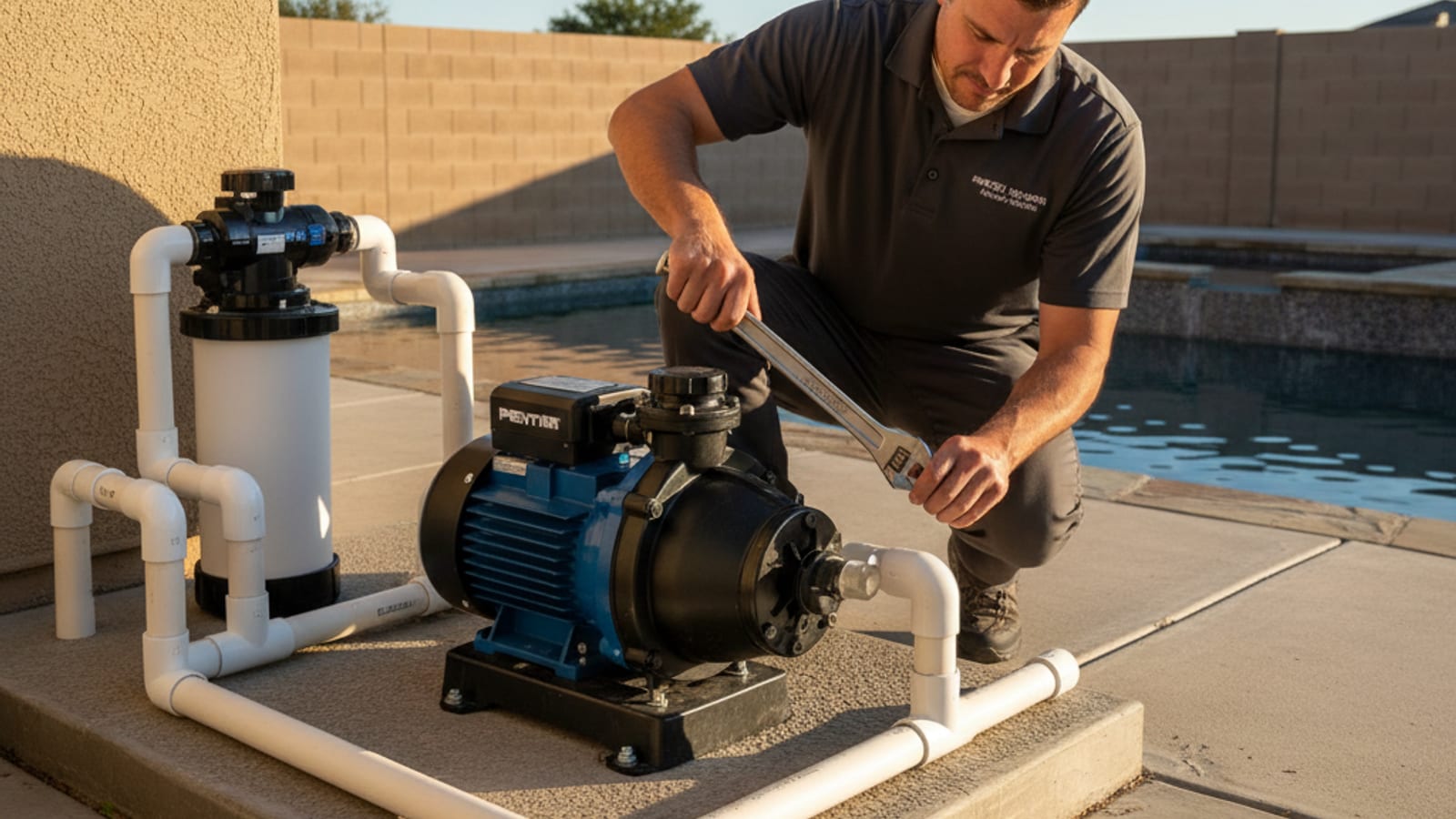
One thing to flag: Splash Pro Pools does not take this work on. It goes to a vetted local pool repair pro, reachable at (858) 400-6757.
If you have a pool in Del Mar, you know the salt air isn’t just tough on your car’s paint job; it’s brutal on your pool equipment. That fine mist that rolls in off the ocean is the number one enemy of your pump’s motor, and it works faster than you’d think.
Your pool pump is the heart of your whole system. It’s the tireless workhorse that circulates water, keeping it clean, clear, and safe. When it stops working, everything else stops too. No circulation, no filtration, no heating. Your beautiful backyard oasis quickly turns into a green, cloudy headache. Here in coastal North County, pumps face a unique set of challenges that you just don’t see in places like Poway or Escondido. We’ll walk through what we see every day, from the Flower Hill neighborhood to the homes overlooking Torrey Pines.
Why Del Mar Pool Pumps Have It Rough
Working on pools from Solana Beach to La Jolla, I can tell you that a pump in Del Mar lives a harder life than one just a few miles inland. It’s not just one thing; it’s a combination of factors that team up to wear down your equipment.
The Salt Air and Sand Combo
The biggest issue is the marine layer. That damp, salty air is incredibly corrosive. It gets into every crack and crevice of your pump’s electric motor. The bearings inside a motor are sealed, but they aren’t invincible. Over time, microscopic amounts of moisture seep in, corrode the steel, and cause the bearings to fail. That’s when you start hearing that high-pitched whine or a loud grinding noise.
Then there’s the sand. Living near the beach is great, but on windy days, fine sand gets blown everywhere, including into your pool. While your skimmer baskets and filter catch most of it, some of that abrasive sand gets pulled through the pump. It acts like sandpaper on the inside of your pump, especially on the impeller. A worn-down impeller can’t move water efficiently, leading to poor circulation and higher energy bills.
San Diego’s Hard Water Problem
On top of the coastal issues, we have our notoriously hard water. The water from the Santa Fe Irrigation District runs about 10-12 grains per gallon (gpg). That’s firmly in the “hard” category. Hard water is full of dissolved minerals, mostly calcium and magnesium.
When your pool water evaporates, it leaves these minerals behind. They build up as a crusty white scale on your tile, in your salt cell, and inside your equipment. Inside your pump, this calcium scale can build up on the shaft seal. This is the critical seal that keeps water inside the “wet end” of the pump and away from the electric motor. When calcium damages this seal, you get a drip. It might seem small at first, but that constant drip of chlorinated, salty water onto the motor is a death sentence for the bearings.
High-Performance Pool Systems
Many homes in Del Mar don’t have a simple pool and spa combo. They have infinity edges, waterfalls, in-floor cleaning systems, and attached spas with jet boosters. These complex setups require powerful, often sophisticated, variable speed pumps to run correctly.
These systems are fantastic when they work, but they put a lot of demand on the equipment. More features mean more plumbing, more valves, and more potential points of failure. A pump running a negative edge and a spa isn’t just circulating water; it’s managing a complex hydraulic system. When something goes wrong, it takes a bit more know-how to diagnose than a simple leak on a standard setup.
Common Del Mar pump failures, 92014 to the coast
Salt air and extra plumbing on negative-edge and spa combos repeat the same failures. Here is what usually shows up.
The Loud Hum: Motor Won’t Start
You go to turn on your pump, and instead of the familiar whir of water moving, you hear a loud, low-pitched hum. The motor is getting power, but it’s not turning.
- The Cause: Most of the time, this is a bad capacitor. The capacitor is like a battery that gives the motor a jolt to get it spinning. They wear out over time, especially with the heat we get. Another possibility is that the motor itself is seized. The bearings have corroded and locked up, or debris is jammed in the impeller, preventing it from spinning.
- What to Do: First, turn off the power at the breaker. A humming motor is pulling a lot of electricity and can overheat. You can try to see if the shaft at the back of the motor will spin by hand (with the power off!). If it spins freely, your problem is likely the capacitor. If it’s completely stuck, the motor bearings are probably shot.
- The Fix: A capacitor replacement is a relatively quick and inexpensive repair. If the motor is seized, you’re looking at a motor replacement or a full new pump.
The Screeching or Grinding Noise
This is the sound that makes you run outside to see what’s wrong. It’s a high-pitched screech or a low, gravelly grinding that you can hear from inside the house.
- The Cause: This is the classic sound of failing motor bearings. The grease inside the sealed bearings has broken down or been washed away by water, and now you have metal grinding on metal. This is the pump’s final cry for help.
- What to Do: Shut the pump off immediately. Running a pump with bad bearings will quickly lead to total motor failure and can even be a fire risk if it overheats.
- The Fix: The only fix is to replace the motor or the entire pump. It’s not possible to just replace the bearings in most modern pool motors; you have to replace the whole unit.
The Puddle: Pump Is Leaking Water
You notice a puddle of water under your pump that never seems to dry up. Leaks can come from a few different places, and where it’s leaking from tells you a lot.
- The Cause: The most common and most serious leak is from the shaft seal, right between the motor and the plastic pump housing. This is the one that drips directly onto the motor. Other causes can be a cracked pump housing (from age or something falling on it), a bad o-ring on the pump lid, or loose drain plugs.
- What to Do: Figure out exactly where the water is coming from. If it’s coming from the seam where the motor bolts to the pump housing, it’s the shaft seal. Don’t ignore this!
- The Fix: Replacing a shaft seal and all the other o-rings in the pump is a standard repair. We call it a “pump tune-up.” If the housing itself is cracked, you’ll likely need a new pump, as replacement housings can be almost as expensive as the whole unit.
The Weak Flow: Pump Is Running but Not Moving Water
The motor is on, but you’re not seeing much action at the jets. The water in the skimmer isn’t moving, and your pool cleaner is just sitting at the bottom of the pool.
- The Cause: This is a suction or flow problem. The list of suspects is long, but it’s usually one of three things:
- A major clog: Your skimmer and pump baskets are overflowing with leaves or debris. Or, worse, the impeller itself is clogged with something small that got through the basket, like palm tree debris or a small toy.
- A suction-side air leak: There’s a crack or a bad seal in the plumbing before the pump. This causes the pump to suck in air instead of water. You’ll often see lots of air bubbles in your pump basket or coming out of the return jets.
- A closed valve: Someone may have turned a valve the wrong way, cutting off water flow from the pool.
- What to Do: Start with the easy stuff. Clean out all your baskets. Check the pump lid o-ring to make sure it’s clean and seated properly. Check your filter pressure; if it’s high, the filter needs cleaning or backwashing.
- The Fix: If it’s a clog, we can usually clear it. If it’s an air leak, we have to find it and patch it. This can sometimes be tricky, but it’s a very common repair.
Repair or Replace? The Del Mar Homeowner’s Dilemma
This is the big question. Do you spend a few hundred dollars fixing your old pump, or invest in a new one? There’s no single right answer; it depends on the age of your pump, the cost of the repair, and your long-term plans.
Last spring, I was at a home up in the hills off Via de la Valle. The owner had a beautiful negative edge pool, but their Jandy variable speed pump was screaming. The bearings were shot, a classic victim of moisture from the marine layer getting past a worn seal. The water’s hard, around 11 gpg there, so the shaft seal had calcified and failed, letting water into the motor.
We talked it over. A motor replacement would be about $800. But the pump was 8 years old, and the new Title 20 energy standards meant a direct motor replacement wasn’t the best long-term play. He opted for a new Pentair IntelliFlo VSF. The upfront cost was higher, but the energy savings and warranty made sense for his setup. Plus, the new pump is so quiet you can stand right next to it and have a normal conversation, which his HOA and neighbors definitely appreciate.
Here’s a simple breakdown to help you decide:
-
Consider a Repair If:
- Your pump is less than 5 years old.
- The repair cost is less than half the price of a new, comparable pump.
- The problem is simple, like a bad capacitor, a leaky seal, or a clogged impeller.
- The rest of the pump (the plastic housing, basket, and lid) is in good shape.
-
Consider a Replacement If:
- Your pump is over 8-10 years old. Motors and seals have a finite lifespan.
- The motor is shot. A new motor can cost 60-70% of a whole new pump, and you’re still left with all the old plastic parts.
- The pump housing is cracked or warped.
- You have an old, single-speed pump. This is the biggest reason to upgrade. California’s Title 20 regulations now require energy-efficient variable speed pumps (VSPs) for most new installations. A VSP can save you 50-90% on your pump’s electricity usage, paying for itself in just a couple of years on your SDG&E bill.
Deciding between the two can be tricky, which is why we offer specific pool pump repair Del Mar diagnostics to give you a clear picture of your options.
Keeping Your New Pump Happy in the 92014
Whether you repair your old pump or install a new one, you want it to last as long as possible. A little preventative care goes a long way, especially in our coastal environment.
- Clean Your Baskets: This is the easiest and most important thing you can do. Check your skimmer and pump baskets at least once a week, more if it’s windy. A full basket restricts water flow and makes the pump work way too hard.
- Listen to Your Equipment: You know what your pump sounds like when it’s running normally. If you hear a new noise, a change in pitch, a rattle, a screech, don’t ignore it. Catching a problem early, like a failing bearing, can save you from a more expensive failure down the road.
- Maintain Proper Water Chemistry: This is huge. Water that is balanced is not only better for swimmers, it’s better for your equipment. Keeping your pH and alkalinity in the right range helps prevent scale buildup from our hard water, which protects your pump’s seals, your heater’s heat exchanger, and your salt cell.
- Protect It From the Elements: Make sure your pump has good ventilation so the motor doesn’t overheat. At the same time, try to shield it from direct rain and, most importantly, from sprinklers. Getting the electric motor wet is never a good idea.
Of course, the best way to avoid surprise repairs is with a consistent maintenance schedule. Our Del Mar pool service plans always include a full equipment check on every visit, so we can spot small issues before they become big, expensive problems.
Frequently asked questions
How much does a typical pool pump repair cost in Del Mar?
It varies widely. A simple fix like a capacitor or a seal kit might run $250-$450. A full motor replacement is more involved, typically costing $700-$1000. If you need a brand new variable speed pump, installation usually starts around $1,800 and can go up depending on the model and plumbing complexity.
My HOA has noise rules. What's the quietest pool pump?
Modern variable speed pumps (VSPs) are the way to go. Brands like Pentair (IntelliFlo) and Jandy (Pro Series) are incredibly quiet when running at the lower speeds needed for daily filtration. Compared to an old single-speed pump, the difference is night and day.
Can the salt from my saltwater pool damage my pump?
The salt itself inside the plumbing is perfectly fine. The danger comes when there's a leak. If the shaft seal fails, the salty water that drips onto the electric motor is extremely corrosive and will destroy the bearings and other metal components much faster than regular water.
How long should a pool pump last in a coastal area like Del Mar?
A well-maintained pump should give you 8 to 12 years of service. The motor is almost always the first major component to fail, usually due to bearing failure from the constant exposure to our damp, salty air. The plastic "wet end" of the pump can last much longer if it's protected from the sun.
Need this done in San Diego County?
For repair and renovation work like this, we hand you to our trusted partner, Del Rancho Pools.