A note on scope: this is leak detection work, which sits outside what Splash Pro Pools does. Call (858) 400-6757 and we’ll match you with a vetted local pro who covers it.
You notice the water line is low again. You filled it two days ago. San Marcos summers are hot, but this feels like more than sun and wind at work. That suspicion, and acting on it quickly, is the difference between a $300 repair and a $3,000 one.
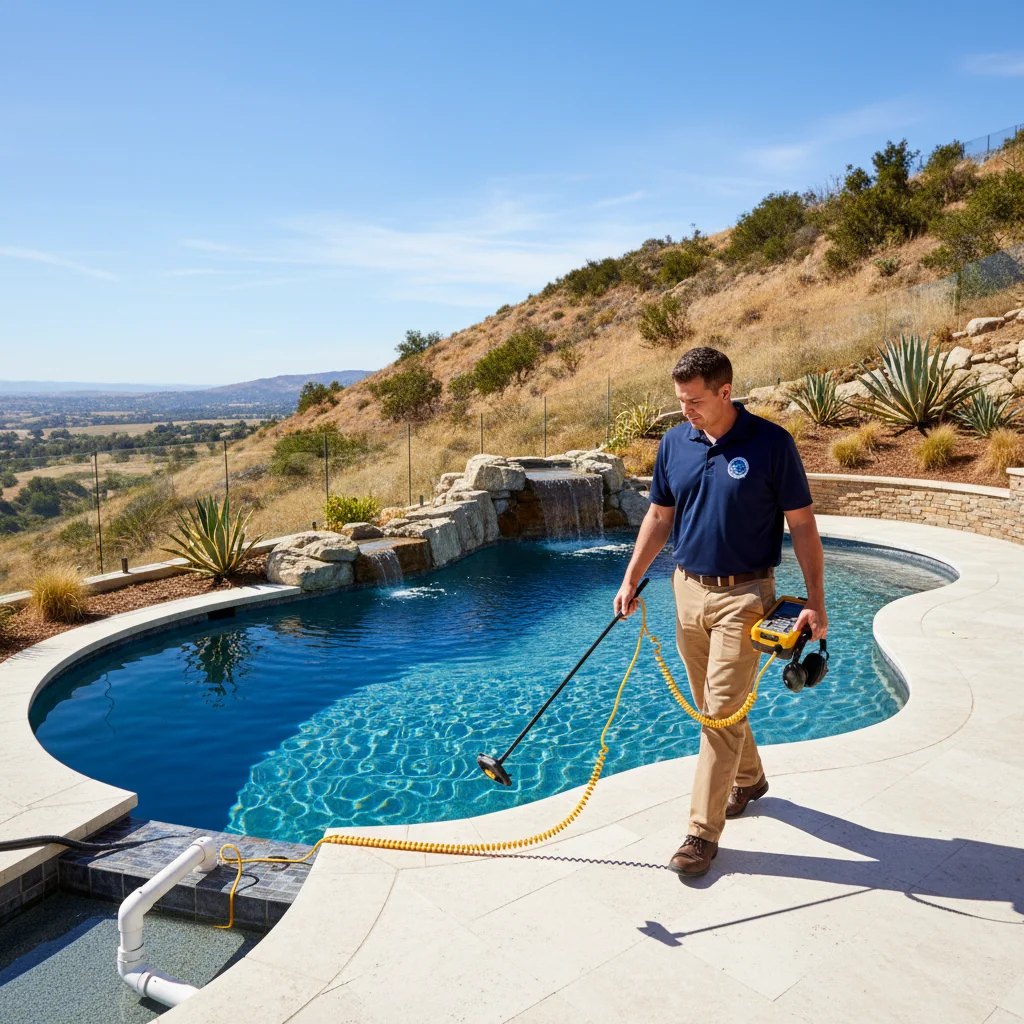
How to know it’s a leak and not just San Marcos heat
San Marcos sits inland, away from the marine layer that buffers coastal cities like Encinitas. Summer temperatures routinely hit the mid-90s, and a Santa Ana wind event can push evaporation rates well above what coastal pool owners ever see. That context matters, because the first thing homeowners get wrong is assuming any water loss is normal.
A rough rule: up to 1 to 1.5 inches per week is evaporation in summer. Two inches or more, especially mid-week when temperatures haven’t been exceptional, is a red flag.
The bucket test is the right first move. Set a filled bucket on a pool step, mark both water levels, and wait 24 hours with the autofill turned off. If the pool drops more than the bucket, something is leaking, not evaporating.
Watch your water bill alongside that test. The San Diego County Water Authority breaks down regional water rates by district. San Marcos sits in the Vallecitos Water District. A pool losing even half an inch per day adds up to thousands of gallons monthly. If your bill jumped without a clear reason, that’s your second clue.
Also watch for:
- Soggy or unusually green grass near the pool equipment pad
- Air bubbles returning through the return jets
- The autofill running more often than it used to
- Deck sections that feel soft or have started to crack and separate
Any two of those signs together and it’s time to stop monitoring and start testing.
Where San Marcos pools tend to leak first
San Marcos has a lot of slope-built pools, homes on graded hillside lots in communities like San Elijo Hills, La Serena, and Twin Oaks Valley. Those pools carry unique stress loads. Soil shifts on cut-and-fill pads, and over time the shell and plumbing move in ways a flat-lot pool doesn’t.
That means the most common failure points in San Marcos look slightly different from what shows up closer to the coast.
Shell cracks at the bond beam
The bond beam, the structural top of the pool shell, takes thermal expansion stress every day. Inland heat cycles are wider than coastal ones: cool nights, scorching afternoons. That repeated expansion and contraction opens hairline cracks, especially on older pools with traditional plaster. Water wicks out slowly. You might not see it, but it’s there.
Skimmer throat separation
The plastic skimmer body is cast into the concrete shell. Over years, micro-movement between dissimilar materials creates a gap right at the throat. It’s one of the most common single sources of pool leakage pros find across all San Diego County inspections. A dye test finds it in seconds.
Underground plumbing fittings
Slope-built pools often have plumbing runs that travel downhill to the equipment pad. Fittings at elbows and tees, buried under the deck, can weep for years before anyone notices. Pressure testing the plumbing system isolates exactly which line is losing pressure.
Return line O-rings and light niches
Return fittings and underwater light fixtures have rubber gaskets that degrade. Chlorine chemistry, UV exposure, and temperature swings all accelerate that breakdown. These are quick fixes once found, the challenge is confirming that’s where the water is going.
If you’ve already ruled out the obvious and you’re comparing notes with a neighbor who had a similar problem, our pool leak detection guide for Encinitas covers several of the same failure points that apply across North County.
The pressure-test and dye-test process explained
On a leak detection appointment in San Marcos, the pro doesn’t guess. The work follows a systematic process that narrows the source methodically.
Step 1: Visual inspection. The tech walks the full deck, checks the bond beam, skimmers, returns, lights, and the equipment pad, looking for staining, efflorescence, deck separations, or anything that telegraphs where water is escaping.
Step 2: Pressure testing the plumbing. Each plumbing line gets plugged and pressurized, the suction side and return side separately. A line that won’t hold pressure has a leak somewhere along its run. That usually isolates it to a section, which guides the repair.
Step 3: Dye testing the shell. With the pump off and the water still, a syringe of colored dye goes near every suspect area, skimmer throats, return fittings, light niches, visible cracks. Dye that gets pulled toward a gap confirms the leak location visually, in real time.
Step 4: Evaluation and report. You get a clear summary of what was found, where it is, and what fixing it involves. No vague language. You’ll know whether it’s a $250 skimmer repair or something that needs a plumbing excavation.
Our pool leak detection and repair service covers all of this. Pros bring the same process to every North County city we serve.
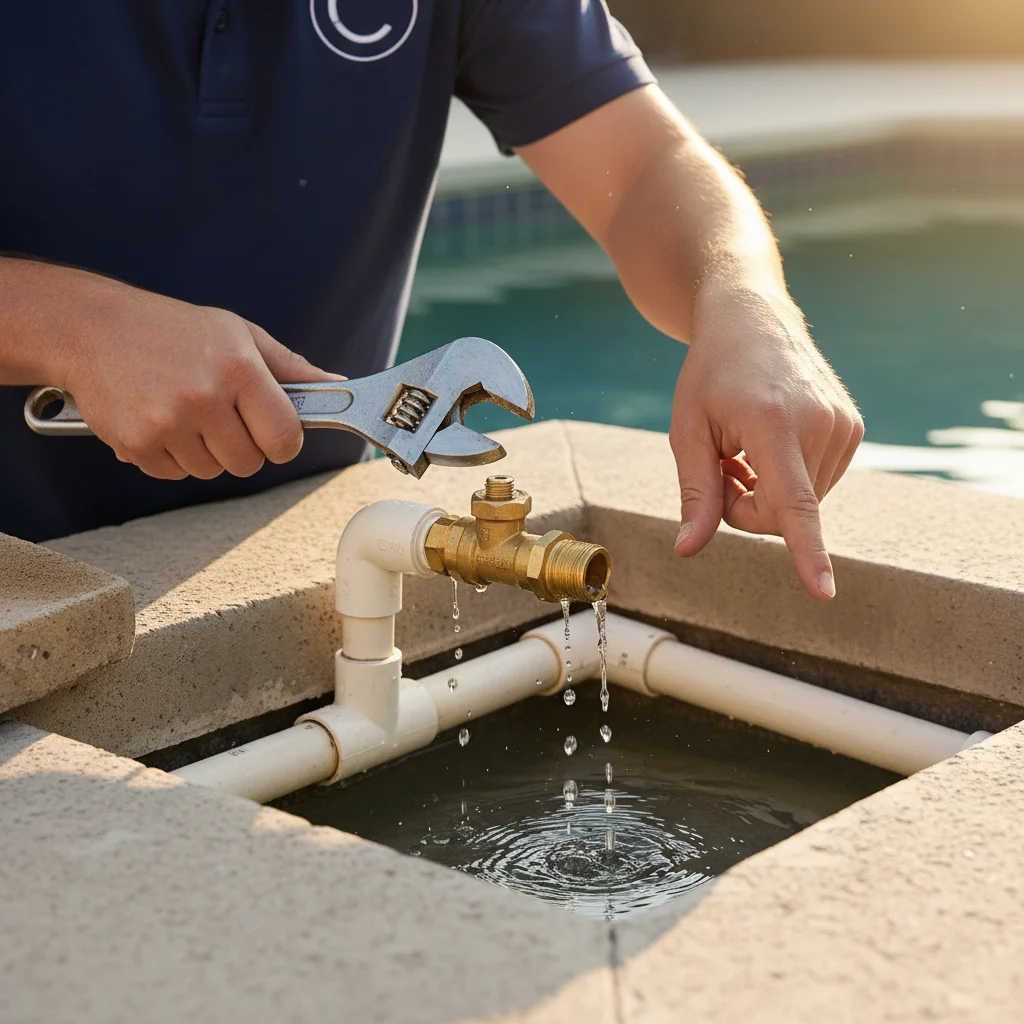
Typical repair costs in 2026
Prices vary by what’s leaking and how accessible it is. Here’s what to expect in the San Marcos market this year, based on current labor and material rates.
Leak detection only: $150 to $350. Some companies roll this into the repair cost if you book both together, ask upfront.
Skimmer repair or replacement: $200 to $600. A skimmer throat seal is on the low end. Full skimmer replacement involving cutting and patching concrete is on the high end.
Shell crack injection: $200 to $500 per crack, depending on length and location. Epoxy injection into a bond beam crack is usually straightforward. A crack on the floor near a main drain takes more care.
Return fitting and light niche reseals: $150 to $400. Typically the easiest and least expensive fixes once confirmed.
Underground plumbing repair: $400 to $1,500 or more, depending on depth, length of the affected run, and how much deck needs to be cut. Slope-built pools can have deeper plumbing runs, which affects labor time.
Full plumbing reroute (worst case): $2,000 to $5,000+. This is rare, but when a corroded or root-damaged lateral line needs full replacement, the cost climbs.
The EPA WaterSense program notes that a single leak dripping at one drip per second wastes about 3,000 gallons per year. Pool leaks of even modest size dwarf that figure quickly, so the repair math almost always favors acting fast.
When to monitor another week vs. booking now
A single unusual drop after an exceptionally hot, dry, windy weekend, monitor it. Run the bucket test. Watch for a few days. That’s reasonable.
Book a professional inspection when any of these are true:
- Your bucket test confirms the pool is losing more water than the bucket
- You’re adding water more than twice a week in mild weather
- Your water bill increased without a clear explanation
- You see wet soil or green patches near the equipment pad
- The autofill runs almost continuously
Don’t let a slow leak run for months while you weigh whether it’s worth calling. The water cost alone adds up fast. More importantly, leaking water under a slope-built deck or into the hillside behind it can undermine the deck slab or the soil supporting the shell, turning a $400 repair into a structural conversation.
When to call us
Pool leak detection isn’t a DIY job once you’re past the bucket test. Pressure-testing plumbing lines and using dye correctly requires equipment and experience, doing it wrong can mean missing the actual source or, worse, introducing air into a pressurized system. A licensed, insured pool service professional protects you and your property. You can verify any contractor’s license at the CSLB license lookup before anyone sets foot on your deck.
If your San Marcos pool is losing water and you’re done guessing, we’re ready to help. Call us at (858) 400-6757 and we’ll connect you with a vetted local pool pro.
Frequently asked questions
How much water can a San Marcos pool lose to evaporation alone?
During inland summer heat waves, a pool in San Marcos can lose 1 to 1.5 inches per week to evaporation, sometimes touching 2 inches during a Santa Ana event. Anything beyond that range, especially on cooler or overcast days, warrants a bucket test.
What is a bucket test and how do I do it?
Fill a 5-gallon bucket with pool water to about an inch from the top. Set it on a pool step so it's partially submerged. Mark the water line inside the bucket and on the pool wall. Wait 24 hours without running the autofill. If the pool drops more than the bucket does, you likely have a leak.
How long does a professional leak detection appointment take?
Most residential pool leak inspections in San Marcos take 2 to 4 hours. A straightforward pressure test on the plumbing lines and a dye-test sweep of the shell can often pinpoint the source in a single visit.
What does pool leak detection cost in San Marcos in 2026?
Detection alone typically runs $150 to $350 depending on pool size and how many systems need testing. Minor crack injection repairs start around $200 to $400. Plumbing line repairs range from $400 to $1,200 depending on depth and access.
Does a pool autofill mask a leak?
Yes, and that's one of the most common reasons San Marcos homeowners don't notice a leak for months. The autofill keeps the water level steady while your water bill quietly climbs. Turning off the autofill valve for 24 to 48 hours before doing a bucket test will give you an accurate reading.
Need this done in San Diego County?
For repair and renovation work like this, we hand you to our trusted partner, Del Rancho Pools.