Before you read on: this sits outside what Splash Pro Pools does. We hand it to a vetted local leak detection pro, reachable on (858) 400-6757.
You’re adding water to your Oceanside pool more often than you used to, but the level keeps dropping. Salt air, warm days, and the fact that sandy coastal soil swallows leaked water without a trace, all of it makes pinning down a pool leak here harder than almost anywhere else in San Diego County.
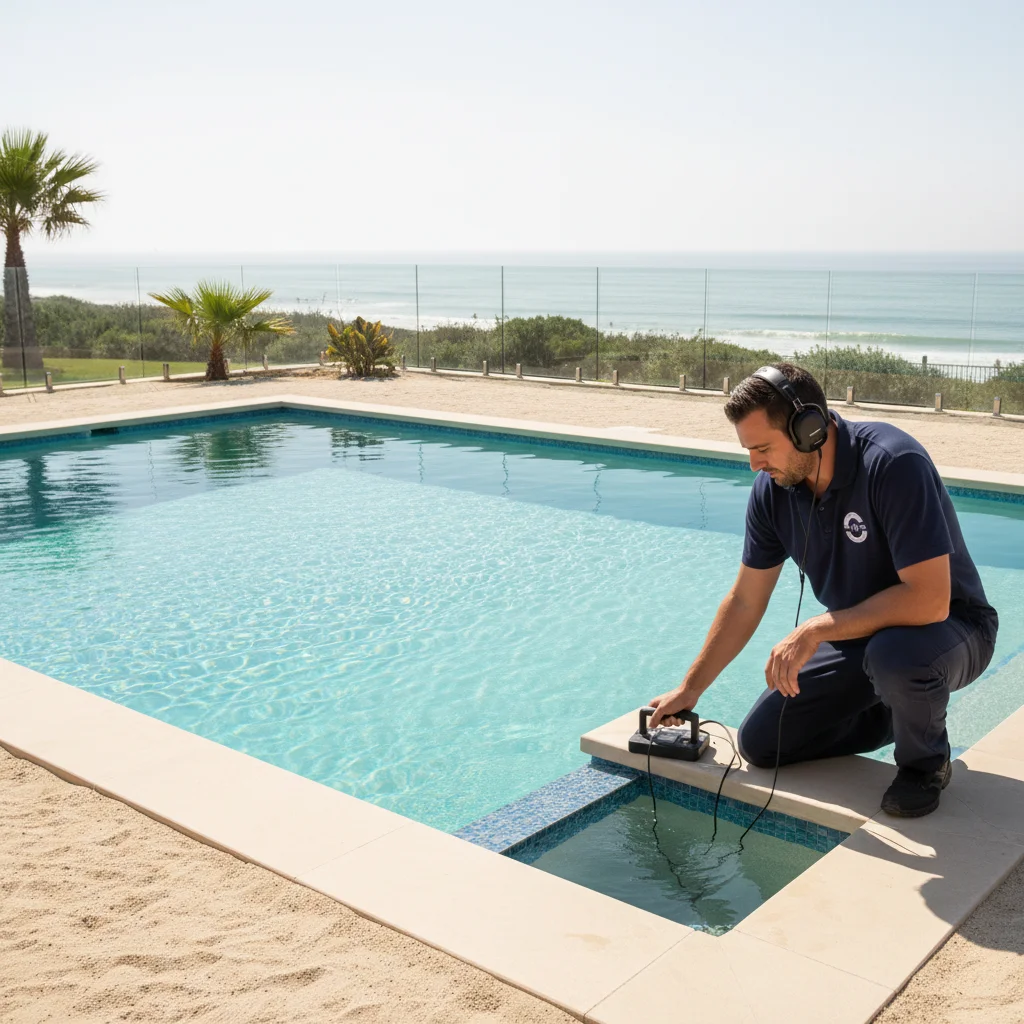
How Oceanside’s coastal conditions hide pool leaks
Oceanside sits right on the coast. That’s great for your lifestyle and brutal on your pool’s plumbing. Three things work against you here that don’t affect pools the same way even fifteen miles inland.
Salt air corrosion. The marine layer that rolls in most mornings carries salt. Over years, it eats at metal fittings, light conduit, and the junction points where PVC meets metal hardware. A fitting that looks fine from the outside can be cracking internally, leaking a few gallons a day at the equipment pad or underground.
Sandy, fast-draining soil. Much of Oceanside, especially neighborhoods west of I-5 and near Camp Pendleton’s southern boundary, sits on sandy or loamy soil. When a pipe leaks underground, that water drains away fast. There’s no soggy patch in the yard to tip you off. By the time the loss is obvious, the water table under your deck may already be compromised, quietly washing away the compacted base that keeps everything level.
High evaporation rates. On a dry, breezy June day in Oceanside, a pool can lose a quarter-inch of water to evaporation, roughly 50 to 75 gallons. That’s before any actual leak. So when owners start noticing they’re topping off twice a week instead of once, many assume it’s just the heat and the wind. It’s an easy mistake, and it costs them months of extra water loss.
For context, we’ve written about how pool leak detection in Encinitas deals with bluff-side soil instability, which is a different problem. In Oceanside, the challenge is invisibility, the leak is happening, but the environment hides every symptom.
Evaporation vs. real leaks: the bucket test the right way
The bucket test is the right first step. Most pool owners have heard of it, but the details matter.
What you need: a 5-gallon bucket, a marker or tape, and 48 hours.
Step one, same water, same exposure. Fill the bucket with pool water to about an inch from the top. Set it on the second step of the pool so it’s sitting in water, not on the deck. Mark the water level inside the bucket and the pool water level on the bucket’s outside. That way both surfaces experience the same evaporation conditions.
Step two, pump off, 24 hours. Let the pool sit without the pump running for a full day. Mark the levels again.
Step three, pump on, 24 hours. Restart the pump and let it run normally for another 24 hours. Mark the levels a final time.
Reading the results: If the pool water drops more than the bucket in either cycle, you’ve got a leak. If pool loss is greater with the pump running, the leak is likely in the plumbing or equipment, pressure is pushing water out somewhere. If loss is equal in both cycles but still more than the bucket, the shell itself is suspect.
One honest caveat: the bucket test tells you that you have a leak, not where. A pool losing a half-inch a day past normal evaporation can represent 75 to 100 gallons, that’s real money on your San Diego County Water Authority bill, and it adds up fast. Once the test confirms a leak, the next step is professional detection.
Acoustic and pressure-test process step by step
Professional pool leak detection isn’t one test, it’s a sequence that narrows the possibilities until we know exactly where to dig, patch, or reline.
Visual inspection first
We start above water. Equipment pads in Oceanside take a beating from salt air, so we check every fitting, valve, union, and pump housing for signs of weeping water or mineral deposits that indicate past drips. We also check the skimmer, returns, and main drain grates for cracks.
Pressure testing the lines
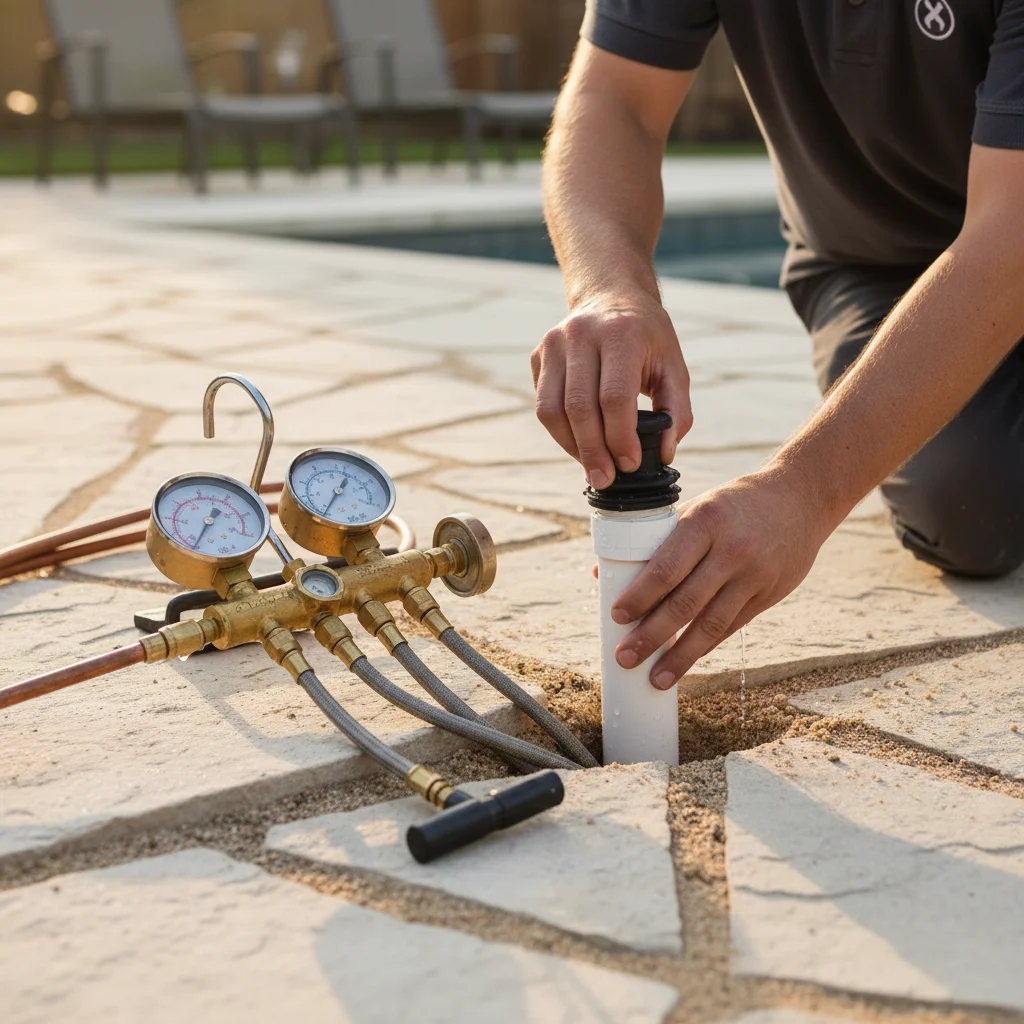
We isolate each line, returns, skimmer, main drain, cleaner port, and plug them individually. We then pressurize each line with air and watch the gauge. A line holding pressure is intact. A line that drops tells us exactly which run is compromised. For Oceanside pools, we pay particular attention to the line runs closest to the equipment pad because that’s where salt-air corrosion most often causes joint failures.
Acoustic listening
For leaks in the shell or underground lines, we use acoustic detection equipment. The tool picks up the sound of water escaping under pressure, a sound that’s inaudible to the ear but registers clearly on the sensor. In sandy soil, this matters more than anywhere else because there’s no visual evidence at the surface. The acoustic reading lets us mark the leak location before we ever break ground or decking.
Dye testing
For suspected shell cracks, fitting leaks, or light niches, we inject dye near the area with the pump off. If there’s a breach, the dye gets pulled toward it. It’s slow work but definitive.
This four-step sequence is the same approach described in our pool leak detection service page, and it’s the only way to be confident before any repair begins.
Common Oceanside leak repair costs in 2026
Costs vary based on where the leak is and how it’s repaired. Here’s a realistic range for what Oceanside pool owners typically see.
Skimmer leaks, The skimmer body or the connection between the skimmer and the shell is one of the most common leak points in older Oceanside pools. Repair usually involves removing the skimmer faceplate, resealing or replastering the throat, or replacing the skimmer body entirely. Cost: $300-$700 depending on access and skimmer condition.
Return line and fitting leaks, If pressure testing finds a failed union or cracked fitting at the equipment pad or in-wall, a licensed plumber or pool contractor can often repair it without trenching. Cost: $200-$500 for accessible fittings. Underground line repairs requiring trenching typically run $800-$2,000 depending on depth and run length.
Shell cracks (structural), Hairline cracks in plaster are often cosmetic, but cracks that travel through the shell and into the gunite need hydraulic cement or epoxy injection. Cost: $400-$1,200 depending on size and access.
Light niches, The conduit behind pool lights is a frequent leak source. Gasket replacement or conduit sealing: $200-$450. Full niche replacement: $600-$1,200.
The EPA’s WaterSense program estimates that even a small pool leak, half an inch per day, wastes over 10,000 gallons a year. At Oceanside water rates, that’s a real number on your bill. The cost of detection almost always pays for itself.
When to call us
Don’t wait for your next scheduled service visit if you’re losing water daily, your water bill has jumped without explanation, or you’re hearing the pump run longer than usual to maintain pressure. Sandy soil means there’s no visible sign of where the water is going, it’s already moving away from the pool, possibly undermining your deck or coping.
A leak that’s ignored for three months in Oceanside can turn a $400 skimmer repair into a $3,000 deck stabilization project. Call us at (858) 400-6757 and we’ll connect you with a vetted local pool pro.
Frequently asked questions
How much water loss per day is normal for an Oceanside pool?
A pool can lose up to a quarter-inch per day to evaporation in Oceanside's coastal climate. That's roughly 50-75 gallons for a standard 15,000-gallon pool. Anything beyond that warrants a bucket test and possibly a professional inspection.
Can sandy soil around my pool make a leak worse?
Yes. Sandy, well-draining soil common near Oceanside's coast lets leaked water disperse quickly, so you won't see soggy ground or obvious wet spots the way you might with clay soil inland. That makes leaks easier to miss until water loss becomes significant.
How long does a professional pool leak detection take?
A full acoustic and pressure-test inspection typically takes two to three hours. If we find the leak and it's a straightforward repair, a fitting, a skimmer, or a return line, we can often fix it the same visit.
Does salt air really damage pool plumbing in Oceanside?
It accelerates corrosion on metal fittings, pump housing, and any exposed metal at the equipment pad. Over time, corroded fittings can crack or separate at joints, creating leaks that start small and grow quietly for months.
What's the first thing I should do if I think my Oceanside pool is leaking?
Run a bucket test for 24 hours with the pump off, then 24 hours with the pump on. If the pool loses more water than the bucket during either cycle, call a leak detection specialist. Don't wait, sandy soil means the water is already migrating away from the shell, possibly washing out the base under your deck.
Need this done in San Diego County?
For repair and renovation work like this, we hand you to our trusted partner, Del Rancho Pools.