A note on scope: this is leak detection work, which sits outside what Splash Pro Pools does. Call (858) 400-6757 and we’ll match you with a vetted local pro who covers it.
Pool leak detection in La Mesa is best handled quickly, because the area’s expansive clay soil can turn a minor crack into a structural problem within a single wet season. Most service visits wrap up in two to four hours, and repair costs typically run $200 to $2,500 depending on what’s leaking and where. For a full breakdown of what you’ll pay, see our guide to pool leak detection cost in San Diego County.
You notice your pool is losing water faster than usual, but you’re not sure if it’s just the San Diego heat or something worse. In La Mesa specifically, that question matters, because the geology under your yard can turn a small crack into a serious, expensive problem if you wait too long. Here’s what you need to know to make a smart call fast.
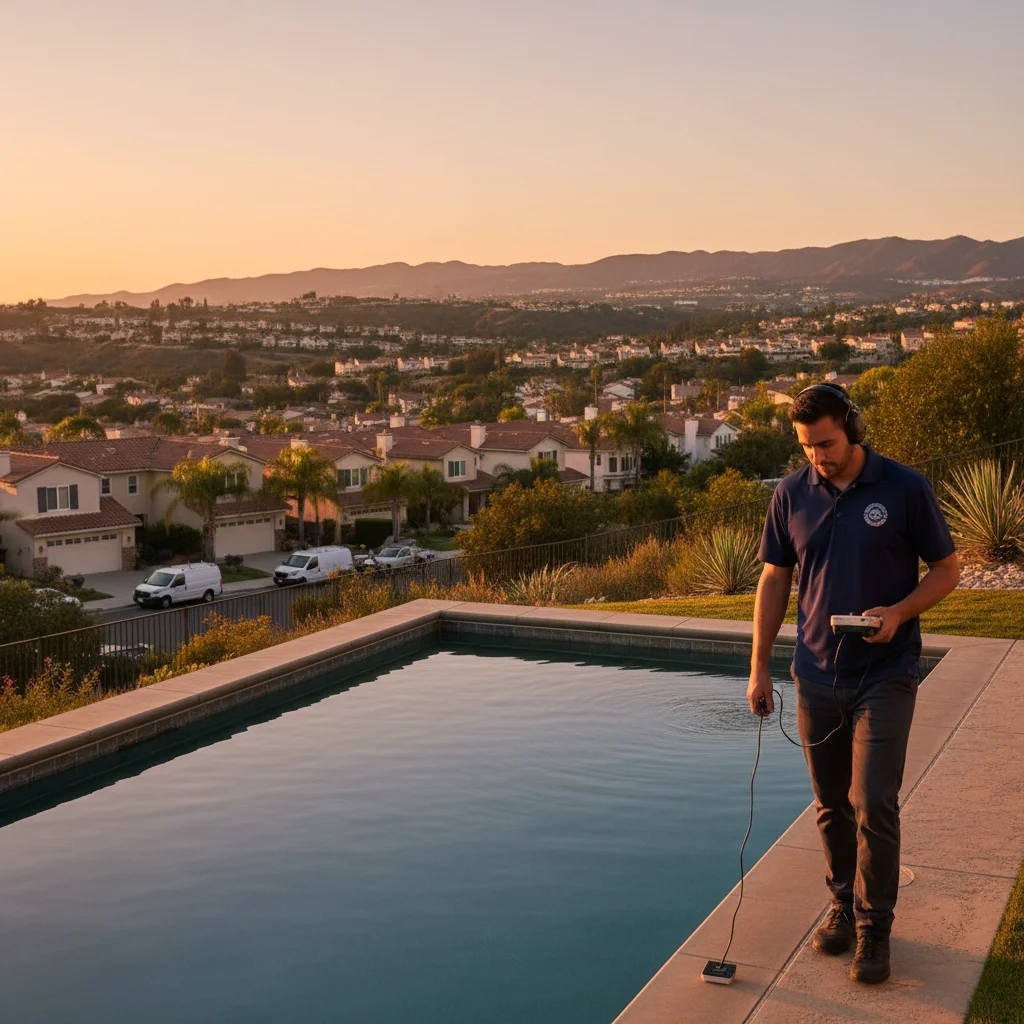
Pool leak detection in La Mesa: evaporation or a real leak?
San Diego’s low humidity and consistent sun mean evaporation is genuinely significant here. The San Diego County Water Authority notes that outdoor water use, including pools, accounts for a large share of residential consumption, and a meaningful chunk of that is just natural evaporation.
A simple test helps you separate the two. Fill a bucket with pool water and set it on the top step or a bench inside the pool. Mark the water level on both the bucket and the pool wall with tape or a marker. Wait 24 hours without running the auto-fill. If the pool drops noticeably more than the bucket does, you’ve got a leak.
As a rough guide, losing more than a half-inch per day in La Mesa’s climate is a red flag. That’s roughly 125 to 150 gallons per day for an average 15,000-gallon pool. At current San Diego water rates, a slow leak can add $50 to $150 or more to your monthly bill, and that’s before any structural damage.
The bucket test is reliable for catching leaks above about a quarter-inch per day. Slower leaks, or leaks that only show up when the pump runs, need professional equipment to find.
One other clue: check whether the loss rate changes when equipment is on versus off. If your pool drops faster with the pump running, the leak is likely in the pressurized return lines. If it drops at the same rate regardless, suspect the shell, fittings, or skimmer.
Why La Mesa’s clay soil makes shell cracks worse
La Mesa sits on a mix of decomposed granite and expansive clay, the same geology that causes driveway heaving and foundation issues throughout the area’s older hillside neighborhoods. When clay absorbs water it expands. When it dries out, it contracts. That cycle puts lateral and vertical stress on whatever’s buried in it, including pool shells and underground plumbing lines.
Many La Mesa pools were built in the late 1960s and 1970s, when gunite and plaster were applied to a generation of backyard pools across San Diego’s suburban hills. Fifty-plus years of soil movement adds up. Common failure points in these older pools include:
Shell cracks around fittings and returns
The spots where plumbing penetrates the shell are natural weak points. Soil movement widens stress fractures that started as hairline cracks decades ago.
Main drain and skimmer separations
The main drain sits at the deepest point of the pool, right where groundwater pressure and soil expansion do the most work. Skimmer bodies in 1970s pools were often set in concrete collars that shift independently from the shell.
Underground return and suction lines
Older pools used rigid PVC and occasionally galvanized steel lines that have no flexibility. Clay expansion can shear joints or collapse pipe sections entirely, and the problem can sit 18 inches underground without any visible sign on the surface.
If your La Mesa pool is original to a home built before 1985, it’s worth scheduling a thorough inspection through the pool leak detection service rather than waiting for water loss to become obvious. The earlier you catch a structural issue, the less invasive, and less expensive, the repair.
What a leak-detection visit looks like
When a pro comes out to a La Mesa property, the visit starts at the equipment pad and works outward. Here’s the actual sequence.
Equipment and visual inspection first. The tech checks the pump, filter, and heater for weeping fittings, wet insulation, or calcium deposits that indicate long-term dripping, and looks at the plumbing runs that are visible before touching anything underwater.
Pressure testing the plumbing lines. The pool returns and suction lines get plugged, then each run is pressurized individually. A line that won’t hold pressure has a crack or failed joint somewhere along its length. This step shows where to focus before anyone gets in the water.
Dye testing at the shell. With the pump off, a small amount of non-staining dye is introduced near suspected areas, around fittings, the skimmer throat, main drain cover, and any visible cracks. If there’s a void, the dye pulls toward it. It’s a low-tech step that’s still one of the most reliable ways to confirm an active leak point.
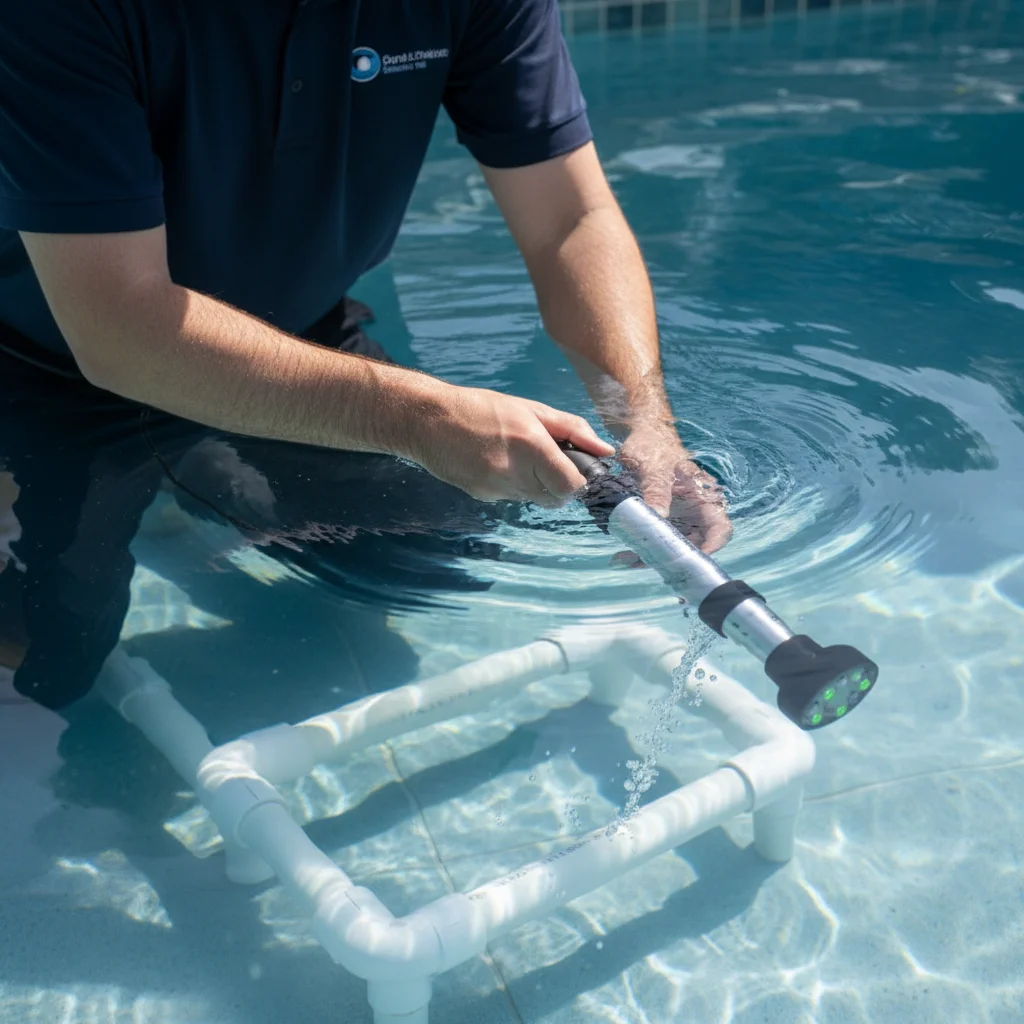
Electronic listening on underground lines. For buried plumbing, pros use acoustic detection equipment that amplifies the sound of water escaping under pressure. This pinpoints the leak’s location within a foot or two, so any excavation is targeted rather than exploratory.
After detection, the pro walks you through exactly what was found, where it is, and what repair options look like. No surprises.
Common La Mesa leak repair costs
Repair costs vary a lot depending on what’s leaking and where. Here are realistic ranges based on typical La Mesa pool work, not guarantees, since every situation is different.
Skimmer repair or replacement: $200 to $600. Skimmer bodies crack at the throat and at the plumbing connection. In many cases the skimmer can be resealed; in older pools it often needs full replacement.
Shell crack injection: $300 to $800 depending on length and location. Surface cracks that haven’t penetrated through the shell are often repaired with hydraulic cement or epoxy injection. Cracks that have compromised structural integrity may require a more involved pool repair approach.
Underground plumbing repair: $800 to $2,500+. The range here is wide because it depends on depth, access, and how much decking needs to be cut. Targeted excavation based on acoustic detection keeps this cost manageable compared to exploratory digging.
Return and fitting re-plumbing: $400 to $1,200. Failed fittings at the returns or main drain are common in 1970s pools and are usually straightforward to address once detected.
The EPA WaterSense program estimates that a pool losing just 1/4 inch per day wastes roughly 45,000 gallons per year. At San Diego water rates, fixing a leak typically pays for itself within a season.
It’s worth noting that any contractor doing structural repair work in California should hold a current C-53 Swimming Pool Contractor license or a C-36 Plumbing Contractor license for pipe work. You can verify credentials through the CSLB license lookup before hiring anyone.
If your pool ends up needing more than just leak repair, say the plaster is failing around the crack zones, the pros we connect you with handle pool leak detection and structural repairs together so you’re not coordinating two separate contractors.
When to monitor vs. when to call immediately
A few situations where waiting a week to monitor is reasonable: you just had heavy rain and the water table is temporarily elevated, you recently added water and aren’t sure what the baseline is, or the loss is right at the evaporation threshold and inconsistent day to day.
Call us now if you see any of these: water loss consistently above a half-inch per day, wet soil or soft spots around the pool deck, a sudden jump in water loss with no change in weather, visible cracks in the shell or coping, or your auto-fill running constantly to keep up. These signs mean the problem is active and worsening.
When to call us
Professional pool leak detection in La Mesa isn’t a DIY job once you’re past the bucket test. Pressure testing, acoustic equipment, and dye work done incorrectly can mask a leak rather than find it, and in La Mesa’s clay soil, a missed leak doesn’t stay small. Call us at (858) 400-6757 and we’ll connect you with a vetted local pool pro.
Frequently asked questions
How much water loss per day is normal for a La Mesa pool?
Evaporation typically accounts for 1/4 to 1/2 inch of water loss per day in San Diego's dry climate. Anything more than that, especially if it's consistent, points to a real leak rather than evaporation.
Can clay soil actually crack a pool shell?
Yes. La Mesa's expansive clay soil swells when wet and shrinks when dry. That repeated movement creates stress on the shell and plumbing over time, and it's a leading cause of structural cracks in older pools throughout the area.
How long does a professional leak detection visit take?
Most residential pool leak detection visits in La Mesa take two to four hours. Complex situations, multiple suspected leak points or older pools with original plumbing, can take longer.
Will you need to drain my pool to find the leak?
Usually not. Most leak detection work happens with the pool full and operating. In some cases plumbing lines get tested under pressure, but a full drain is rarely necessary just for detection.
What if the leak is in the underground plumbing?
Electronic listening equipment and pressure testing pinpoint underground pipe leaks without tearing up your deck blindly. Once located, repairs are targeted, excavation only happens where the problem actually is.
How fast can you find a pool leak in La Mesa?
Most pool leak detection visits in La Mesa are completed in two to four hours. The visit starts at the equipment pad, pressure-tests the plumbing lines, runs dye tests at suspected shell points, and uses acoustic equipment on buried lines. By the end of the visit you'll know exactly where the leak is and what repair options look like. Call (858) 400-6757 and we'll route it to a local pool pro.
Need this done in San Diego County?
For repair and renovation work like this, we hand you to our trusted partner, Del Rancho Pools.