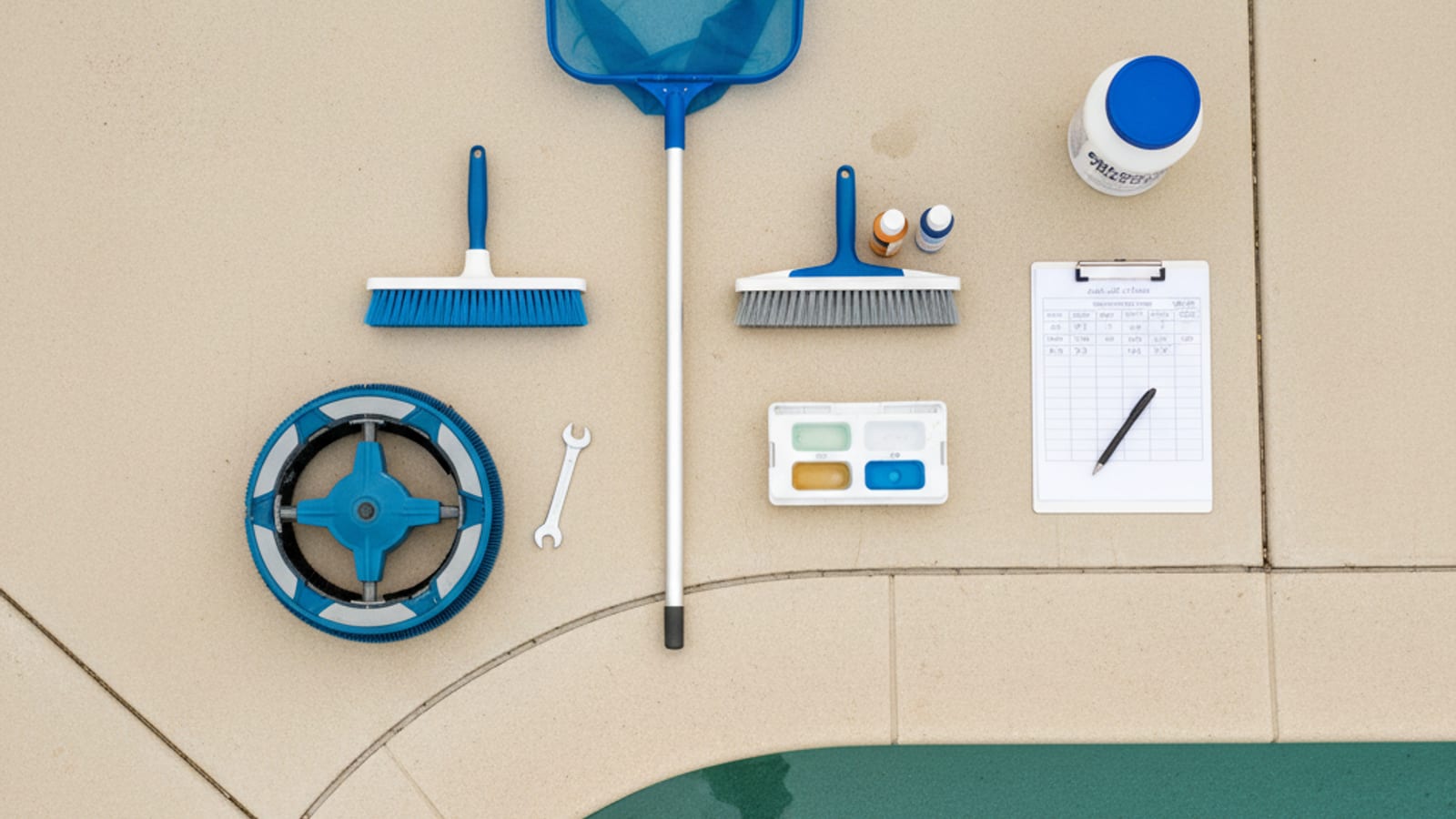
August startups here often come in with cyanuric acid already too high. That is a San Diego pattern, not an Arizona or Florida average. The readings that matter are on the test kit and the SDG&E bill, not a national spreadsheet.
Here are the San Diego numbers that actually move a weekly bill.
The Big Three: Chemicals, Costs, and Time
You can boil down pool ownership to these three things. Getting a handle on the real-world numbers for each is the first step to a stress-free pool.
The Chemical Count
Your pool is a big chemistry experiment, and you have to keep adding ingredients. The amount you use changes dramatically between a cool May Gray morning and a blistering hot Santa Ana day in September.
-
Chlorine: This is your sanitizer, the main workhorse. For a standard 15,000-gallon pool, you can expect to use about two gallons of liquid chlorine a week in the middle of summer. In January, that might drop to just a half-gallon. We see a lot of homeowners rely on 3-inch tablets, and while they’re convenient, they are the number one cause of high Cyanuric Acid (CYA), which we’ll get to later. They constantly add stabilizer to the water, and you can’t get it out without a drain.
-
Muriatic Acid: Our municipal water all over the county is alkaline, meaning it has a high pH. Chlorine is most effective when your pH is between 7.4 and 7.6. To keep it there, you’ll be fighting a constant upward drift. Most pools need about a quart of muriatic acid every week in the summer. If you have a plaster pool with a water feature you run often, you might even use more.
-
Salt (for Saltwater Pools): When you first convert a 15,000-gallon pool, you’ll need around 400 pounds of salt to get started. After that, the salt doesn’t evaporate. You only lose it from splash-out, backwashing, or a leak. Many salt pools need one or two 40-pound bags a year to keep levels right.
-
Other Stuff: You’ll also need alkalinity increaser (baking soda, basically) and maybe some calcium chloride, depending on your water source. But chlorine and acid are your weekly staples.
The Real Cost Breakdown
This is where the rubber meets the road. What does it actually cost to keep a pool sparkling in San Diego?
-
The DIY Route: If you’re doing it yourself, you’re looking at a few different bills.
- Chemicals: Budget between $60 and $100 a month. It will be higher in the summer and lower in the winter.
- Electricity: This is the big one, thanks to SDGE. An old single-speed pump running 8 hours a day can add $150 or more to your monthly bill. A modern variable-speed pump is a game-changer, often running on low speed for longer, which might only cost you $50 to $80 a month. About 90% of the pump repairs we do are on older, inefficient single-speed models.
- Water: You’ll lose about a quarter-inch of water a day to evaporation, more when it’s hot and windy. This adds up. It’s not a huge cost, but it’s not zero either.
-
The Pro Service Route: When you hire a company like us, you’re not just paying for chemicals. You’re buying back your time and getting an expert pair of eyes on your equipment every single week. Our weekly pool cleaning handles the water chemistry, cleaning, and equipment checks. You still pay for electricity and water, but you avoid the weekend trips to the pool store and the headache of storing acid in your garage. More importantly, you have someone who can spot a small problem before it becomes a thousand-dollar disaster.
The Time You Can’t Get Back
The biggest hidden “cost” of DIY pool care is time. It’s not just the 15 minutes it takes to test and dose chemicals. It’s the whole process:
- Skimming leaves and debris (10 mins)
- Brushing the walls and steps (15 mins)
- Emptying the skimmer and pump baskets (5 mins)
- Testing the water and calculating chemical additions (10 mins)
- The weekly or bi-weekly drive to the pool store (30-45 mins)
- Hauling heavy jugs of chlorine and acid from your car to the backyard.
When you add it all up, you’re spending at least an hour or two every week on pool chores. For many San Diego families, that Saturday morning time is better spent at the beach or a kid’s soccer game.
San Diego’s Water Problem: The TDS Creep and What It Costs You
Here’s a number that almost no DIY pool owner tracks: Total Dissolved Solids, or TDS. It’s the measure of everything dissolved in your water: minerals, salts, chemical residue, dust, everything.
Our tap water in San Diego isn’t pure. It starts with a TDS level of 400 to 600 parts per million (ppm) right out of the hose. Every single thing you add to your pool, chlorine, acid, shock, algaecide, conditioner, is a solid that dissolves and raises that number. It never goes down.
After a few years, your TDS level will “creep” up past 2,500 ppm or higher. When this happens, a few bad things start to occur:
- Your chemicals become less effective. You’ll find yourself using more and more chlorine to get the same result.
- The water can look dull or hazy, even when balanced.
- You might get stubborn staining on your plaster.
- The water can taste salty, even in a non-salt pool.
We had a new client in the hills of Escondido, right off Del Dios Highway. He’d been caring for the pool himself for about five years and was getting frustrated. The water was always cloudy, he had a persistent algae problem in one corner, and his family was complaining that the water felt “weird.” We tested his water, and the TDS was nearly 4,500 ppm. The water was just old and full. There was no amount of shock or clarifier that could fix it.
The only solution is to drain the pool and start over. For him, this was a tough pill to swallow. It meant a water bill and a few hundred dollars for the drain, refill, and chemical startup. But once we did it, his pool looked incredible. His chemical usage dropped by almost 40%, and the water felt silky smooth again.
The statistic we see in the field is this: the average San Diego pool needs to be drained and refilled every 3 to 5 years. It’s not a sign of failure, it’s just a necessary part of pool maintenance in our region because of our hard, mineral-rich water.
How Equipment Failures Skew the Numbers
Your monthly budget for chemicals is predictable. The four-figure repair bill that comes out of nowhere is not. A huge part of our job is preventative maintenance to catch these things early, but equipment doesn’t last forever.
-
Pumps: A standard single-speed pump motor will typically last 5 to 7 years in our climate. A variable-speed pump can last longer, but the electronic drive is a common point of failure, and that part alone can be an $800 repair. Statistically, we see about 1 in 10 pools on these routes needing a major pump repair or full replacement in any given year.
-
Filters: This is a big maintenance item. If you have a cartridge filter, which is very common in communities like Carmel Valley and 4S Ranch, those filter cartridges need to be replaced every 12 to 24 months. A set of four new cartridges for a standard filter runs between $300 and $500. For D.E. filters, the internal grids can tear, and for sand filters, the sand itself needs to be completely replaced every 5-7 years.
-
Heaters: Heaters can be the most frustrating piece of equipment. They sit unused for months, and then when you want to heat the spa for a party, they won’t fire up. Rodents love building nests inside them over the winter, chewing through wires. Igniters, sensors, and pressure switches are all common and relatively inexpensive parts to fail. But if a heat exchanger or a motherboard goes, you could be looking at a repair that costs more than half the price of a new unit.
A smart homeowner puts aside a little money each year for eventual equipment repairs. A good rule of thumb is to budget an extra $400 to $600 per year for this “what if” fund.
Putting It All Together: What’s a “Normal” Year Look Like?
So, let’s add it all up. What does a full year of pool ownership cost? Let’s use a hypothetical 15,000-gallon plaster pool in Tierrasanta as an example.
Typical Annual DIY Costs:
- Chemicals (Chlorine, Acid, etc.): $900
- Electricity (Variable-Speed Pump): $1,200
- Water (Evaporation & Splash-out): $200
- Equipment Repair Fund: $500
- Filter Cartridge Replacement (pro-rated): $200
Total Estimated DIY Cost Per Year: ~$3,000 That breaks down to about $250 a month, plus your time.
When you look at it that way, professional service makes a lot of sense. A typical weekly service plan covers the labor, transportation, and most of the essential chemicals. You still have the utility and repair costs, but the biggest variable, the chemistry, is handled by a pro. This prevents the costly mistakes that come from improper water balance, like stained plaster or burned-out equipment.
This is the reality of owning a pool in our city. But with the right approach, it’s completely manageable and worth every penny on a hot day. We’ve been providing pool service in San Diego, CA for two generations, and we’ve seen it all. The numbers don’t lie, but knowing which numbers to watch is the real secret.
Frequently asked questions
How much does it cost to maintain a pool in San Diego per month?
For a DIY approach, budget $80-$120 for chemicals and another $80-$150 for electricity from SDGE. Professional weekly service, which includes most chemicals and all labor, typically runs from $160 to $220. This doesn't include water or eventual equipment repairs.
How often do you really need to drain a pool in San Diego?
Because our tap water has high mineral content, most pools need to be drained and refilled every 3 to 5 years. This resets your Total Dissolved Solids (TDS) and cyanuric acid (CYA) levels, making your chemicals work more effectively and the water feel better.
Is a saltwater pool cheaper to maintain here than a chlorine pool?
The monthly chemical cost can be slightly lower since you aren't buying chlorine constantly. However, the salt cell needs to be replaced every 3-5 years, which can cost $700-$1,200. Over the life of the equipment, the total costs are surprisingly similar.
What's the number one mistake San Diego pool owners make?
Using chlorine tablets as their primary sanitizer without monitoring cyanuric acid (CYA). By mid-summer, the CYA level gets so high it binds all the free chlorine, a condition called chlorine lock. The pool looks hazy or green even though a test strip says there's chlorine in the water.
Need professional help in San Diego County?
Splash Pro Pools connects San Diego homeowners with pool pros for the work in this post.