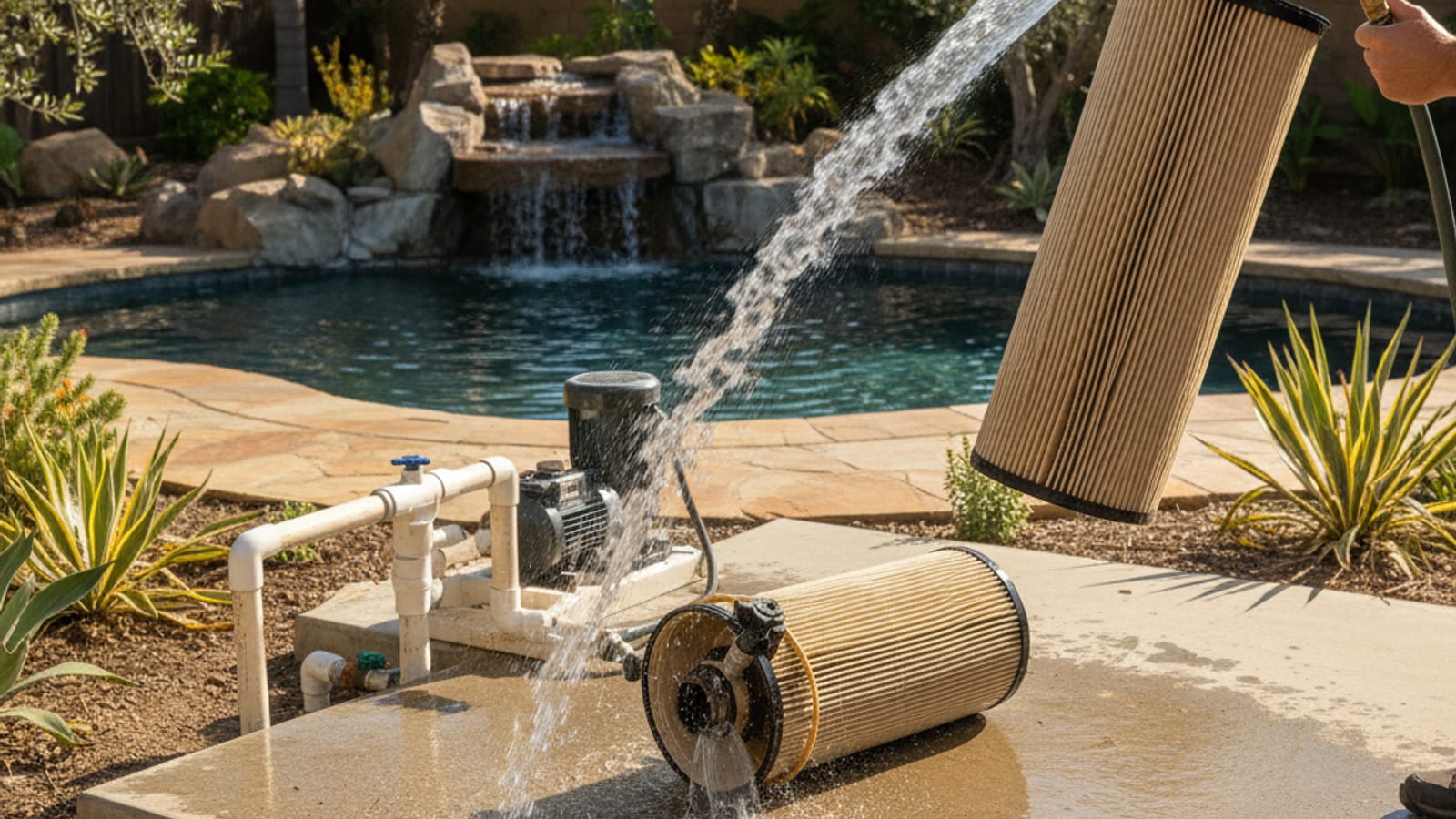
Encinitas cartridge filters usually need a deep clean every 3 to 4 months, and D.E. grids need a full teardown at least once a year, because salt spray plus dust packs the media faster than inland routes. A garden hose does not dissolve that scale. Splash matches pool filter cleaning in Encinitas. Cleaning is (760) 642-1256. Repair is (858) 400-6757.
Why Encinitas Pool Filters Are Different
You can’t treat a pool in Olivenhain the same way you’d treat one in a less coastal area. It’s a specific set of environmental challenges that put a ton of stress on your equipment. If you feel like you’re fighting a losing battle to keep your water clear, it’s probably not you. It’s the environment.
The Salt Air and Dust Combo
That beautiful ocean breeze we love? It carries a fine aerosolized salt. This salt lands on everything, including your pool water. On its own, it’s not a huge deal. But it mixes with the fine dust that blows in, especially during Santa Ana conditions, and creates a sticky, fine particulate that your filter has to catch.
This salty gunk is particularly tough on cartridge filters. It gets deep into the fabric pleats and won’t come out with a simple spray from the garden hose. For DE and sand filters, it can gum up the media, reducing its effectiveness. On top of that, the salt air is relentlessly corrosive. It eats away at the metal bands, clamps, and bolts that hold your filter tank together. Techs see filter clamps so rusted they were unsafe to open, all because they weren’t checked and lubricated during regular cleanings.
Our Famous “Liquid Rock” Water
San Diego County has notoriously hard water, and the water serving Encinitas from the Olivenhain and San Dieguito districts is no exception. Water hardness typically runs between 10 and 14 GPG (grains per gallon) here. This means our water is loaded with dissolved minerals, primarily calcium carbonate.
As your pool water evaporates, these minerals get left behind, becoming more and more concentrated. This calcium wants to come out of the water and stick to surfaces, a process called scaling. Your filter media is a prime target. Calcium scale can turn the pleats of a cartridge filter into something that feels like cement. It can clog the microscopic pores on DE filter grids, making them useless. Once this happens, no amount of backwashing or hosing off will fix it. The filter is essentially choked from the inside out, your pump pressure skyrockets, and your water quality plummets.
Local Landscaping and High Use
Encinitas is full of beautiful, mature landscaping. But those gorgeous bougainvillea, jacaranda trees, and palms drop a constant stream of fine debris. The tiny flowers and pollen are murder on a filter system. They break down quickly and slip right through the skimmer basket, ending up as a layer of sludge inside your filter tank.
Plus, let’s be honest, we use our pools a lot here. From family get-togethers in Village Park to post-golf dips near Encinitas Ranch, our pools see a high bather load. Every person that gets in the pool leaves behind sunscreen, lotions, hair products, and natural body oils. All of that has to be removed by the filter. A filter that’s already struggling with salt, dust, and calcium just can’t keep up.
How Pool Filters Get Cleaned for Encinitas Homes
The right way to clean a filter depends entirely on what kind of filter you have. A quick hose-down is rarely the answer, especially with our water. Here’s a look at the three main types and what it really takes to get them clean in our coastal environment.
Cartridge Filters: The Water-Wise Favorite
These are probably the most common filters in Encinitas, especially in newer homes. They’re popular because they filter out smaller particles than sand filters and don’t require backwashing, which is a big plus for water conservation.
- The Problem: The polyester pleats are a magnet for oils and calcium. A simple hosing might get the surface dirt off, but it just pushes the greasy, calcified gunk deeper into the fabric. After a few “cleanings” like this, the cartridge is effectively ruined. The water pressure stays high even after you clean it, and the flow to your pool is terrible.
- The Process: This is a two-step deep clean. First, the filter gets un-banded and the cartridges get a thorough rinse to remove loose debris. Then they soak in a specialized filter cleaning solution that breaks down all the oils and lotions. After that soak, they get rinsed again and, if needed, a mild acid bath. This second step is crucial for dissolving the calcium scale that’s embedded in the pleats. The tech finishes by inspecting the tank o-ring and re-lubricating it to ensure a perfect seal, preventing air leaks. This process can make a cartridge that a homeowner thought was toast perform like new again.
DE Filters: The Clearest Water, If You Do the Work
Diatomaceous Earth (DE) filters provide the best filtration, hands down. They can trap particles down to 3-5 microns, which is why pools with DE filters have that incredible “sparkle.” But they are also the most labor-intensive.
- The Problem: Backwashing is only a temporary fix. It flushes out some of the dirty DE, but a layer of oil and calcium-caked DE always remains on the filter grids. Over time, this layer builds up, strangling water flow and requiring you to backwash more and more frequently, which wastes a ton of water.
- The Process: A real DE filter cleaning involves a full teardown. The tank gets drained, the clamp unbolted, and the entire grid assembly lifted out. It’s heavy and messy. The assembly comes apart, separating each of the eight grids. Each grid is then individually sprayed down with a high-pressure nozzle to remove all the old DE and grime. Every single one gets inspected for rips or holes, because even a small tear will allow DE powder to blow back into your pool. If the grids are badly scaled, they get a cleaning bath just like cartridges. Then it all gets reassembled, the right amount of new DE powder added through the skimmer, and the system checked for proper operation.
Take a client up in the hills of Olivenhain, right off Manchester Avenue. He had this huge, beautiful pool, but it was always just a little bit cloudy. He was getting frustrated, backwashing his DE filter every single week while his water bill went through the roof. When the tech asked when the filter had last been taken apart, he just shrugged. Turns out, the previous “pool guy” had never done it. The grids came out completely caked with years of sunscreen oil and a rock-hard layer of calcium scale. A full breakdown and deep clean fixed it. The difference was immediate. His water was crystal clear in 24 hours, and his pump pressure stayed low for the next six months. He ended up saving water, electricity, and a lot of frustration.
Sand Filters: The Low-Maintenance Option
You don’t see as many sand filters in newer Encinitas homes, but they’re still out there. They are simple and require the least frequent major service.
- The Problem: Over time, oils and calcium build up in the sand. This can cause the sand to clump together, and the water will start carving a path, or “channel,” right through it. When this happens, the water isn’t getting filtered at all. Our hard water can also calcify the top layer of sand, basically turning it into a chunk of concrete.
- The Process: Regular backwashing is the primary maintenance, but it’s not a cure-all. Every 3-5 years (sometimes sooner here), the sand needs to be completely replaced. It’s a back-breaking job that involves scooping out hundreds of pounds of old, wet sand and hauling it away, then carefully refilling the tank with new filter sand. For yearly maintenance, a special sand filter cleaning chemical can help break down the oils and loosen the clumps to extend the life of the sand between changes.
What to Look For: Signs Your Filter Needs Help
Your pool will tell you when its filter is struggling. You just have to know what to look for. Ignoring these signs doesn’t just lead to a green pool; it can cause expensive damage to your other equipment.
- High Pressure Gauge Reading: This is the number one sign. On top of your filter is a pressure gauge. After a professional cleaning, the tech notes the “clean” pressure (usually 10-20 PSI). When the pressure rises 10-15 PSI above that clean number, it’s time for another cleaning. A gauge that’s always high means the filter is clogged.
- Weak Water Flow: Are your return jets barely trickling out water? Is your automatic pool cleaner moving slowly or not at all? This is a classic symptom of a clogged filter. The pump is trying to push water, but it can’t get through the dirty filter media, so the flow to the entire system drops off.
- Cloudy or Green Water: If you’ve balanced your chlorine and pH but the water is still hazy, your filter isn’t doing its job. It can’t pull out the fine, suspended particles that cause cloudiness. This also creates a perfect environment for algae, because poor circulation means your chlorine isn’t getting distributed effectively.
Waiting too long is a costly mistake. A clogged filter forces your pump to run under immense strain, which dramatically increases your SDG&E bill and can burn out the motor years ahead of its time. A new variable speed pump can cost over $2,000 to install. In contrast, regular filter cleanings are one of the most affordable and effective ways to protect your entire equipment pad. It’s a core part of any good pool service in Encinitas, because it prevents bigger, more expensive problems down the road. And if you’d rather handle upkeep yourself, our guide to pool supplies in Encinitas covers what to keep on hand and where to get it.
Frequently asked questions
How often should I clean my pool filter in Encinitas?
For a cartridge filter in our coastal area, a full deep cleaning every 3-4 months is a good rule of thumb. For DE filters, plan on a complete teardown and grid cleaning at least once a year, with backwashing as needed in between. The extra load from salt air, dust, and hard water means filters in this area need more frequent attention than they would elsewhere.
Can't I just hose off my cartridge filter myself?
You can, but a garden hose only removes the loose, surface-level debris. It won't break down the greasy buildup from sunscreens and oils or dissolve the hard calcium scale that clogs the filter's pores. A professional cleaning uses specific solutions to address these issues, restoring your filter's performance and extending its life.
My HOA in Leucadia is strict about water waste. Is a DE filter a bad choice?
Not at all. While backwashing does use water, a properly maintained DE filter actually saves water in the long run. A full professional grid cleaning once or twice a year drastically reduces the need for frequent backwashing, meaning you'll use far less water than someone who is constantly backwashing a poorly maintained filter.
What's included in a professional Encinitas filter cleaning?
The tech fully disassembles the filter, whether it's a cartridge, DE, or sand unit, deep cleans the media, inspects O-rings and manifolds, lubricates seals, reassembles, and tests pressure. Splash matches that visit. Cleaning is (760) 642-1256.
Need professional help in San Diego County?
Splash Pro Pools connects San Diego homeowners with pool pros for the work in this post.