Pool clarifier vs flocculant is a filter question, not a bottle question. Swim University (updated July 26, 2026) puts it this way: clarifier clumps fines so the filter can catch them; flocculant clumps them until they sink, then a manual vacuum sends them to waste. A matched local pool pro picks the product that matches the tank on the pad.
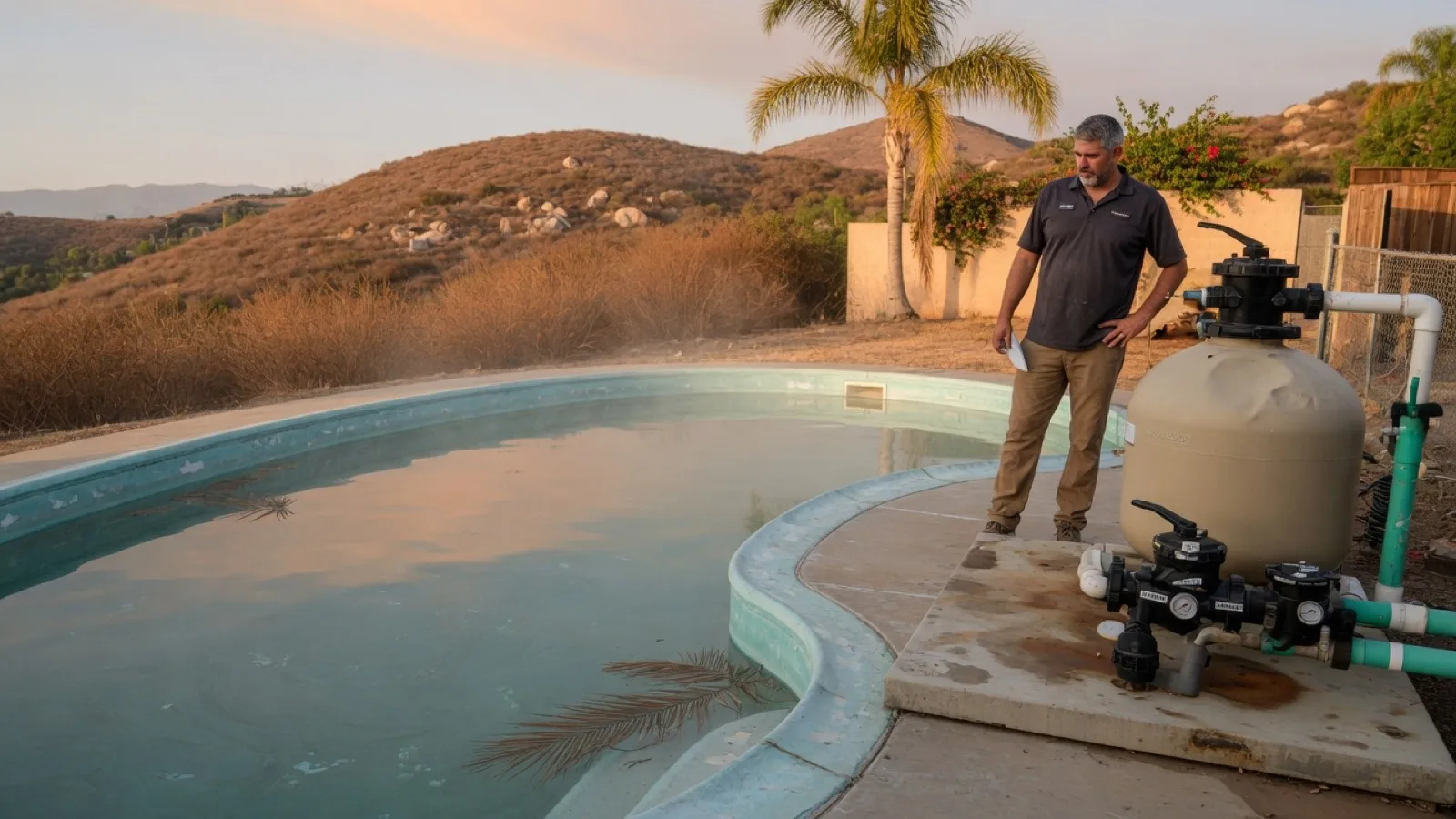
Clarifier rides with the filter
Clarifier is the slower, lower-labor path. The pump stays on. The clumps stay in the water column until the sand, DE, or cartridge media can hold them. Swim University says that is the right tool for mild haze, and it works with any common filter setup.
It does not kill algae. It does not drop hardness. It does not replace a clean filter. If the gauge is already high, a clarifier just packs the media faster. The cleaning walkthrough is on pool filter cleaning. Sand and DE waste cycles sit on how to backwash a pool filter.
Floc sinks, then someone vacuums
Floc is the faster, heavier path. Swim University: set the multiport to recirculate so floc never enters the media, balance pH, add the labeled dose, run about two hours, then shut the pump off for at least eight hours. Vacuum the blanket with a manual hose on waste. An automatic cleaner will not do this job.
Cartridge pads usually cannot floc. There is no waste setting. Forcing that sludge through a cartridge wrecks the next week’s pressure reading.
Vacuum-to-waste is a discharge. Inside City of San Diego limits, San Diego Municipal Code §43.0304 and §43.035(e)(3) keep that water out of the storm drain. The City’s February 2016 fact sheet wants pH 7 to 8, dechlorinated water, and a legal sewer or landscape path. Other cities set their own rules.
Pick the tool after the kit, not before
The CDC home-pool page (May 10, 2024) still wants pH 7.0 to 7.8 and free chlorine at least 1 ppm, or 2 ppm with cyanuric acid. Swim University wants pH 7.4 to 7.6 before floc. That is a tighter band inside the CDC range, not a second standard.
A La Jolla cartridge pad with light haze is a clarifier job. An El Cajon sand filter after a dead algae dump is often a floc-and-waste job, then a refill. The seven-cause walkthrough is on cloudy pool water. The algae kill itself is on how to shock a pool.
When to call us
Call when the water will not clear after chemistry is in range, when someone wants to floc a cartridge tank, or when a waste hose is aimed at a gutter. A matched local pool pro will name the filter type, the discharge path, and the product that actually belongs on that pad.
Frequently asked questions
What is the difference between pool clarifier and flocculant?
Swim University (updated July 26, 2026) says clarifier clumps tiny particles so the filter can catch them, and flocculant clumps them so they sink to the floor for a manual vacuum to waste. Clarifier works with the pump running. Floc needs still water after a short recirculate, then a waste setting.
Can I use flocculant with a cartridge filter?
Swim University says you cannot, unless the pad is plumbed to bypass the filter when you vacuum. Most San Diego cartridge tanks have no waste port. Clarifier is the filter-side product on those pads.
How long does flocculant take?
Swim University puts floc at 1 to 2 days to clear, with 8 to 16 hours of sit time before vacuuming. It recommends adding at dusk and letting the pool sit overnight with the pump off.
Where does vacuum-to-waste water go in San Diego?
Inside City of San Diego limits, San Diego Municipal Code §43.0304 and §43.035(e)(3) ban pool water and filter backwash from the storm drain. A matched pro sends that waste to a legal sewer connection or absorbing landscape, not the gutter. Other cities write their own rules.
Should I clarifier a green pool first?
Clarifier and floc are particle tools, not sanitizer. The CDC still wants free chlorine at least 1 ppm in a pool, or 2 ppm with cyanuric acid, and pH 7.0 to 7.8. Fix the chemistry, then pick the clearing method.
Need professional help in San Diego County?
Splash Pro Pools connects San Diego homeowners with pool pros for the work in this post.