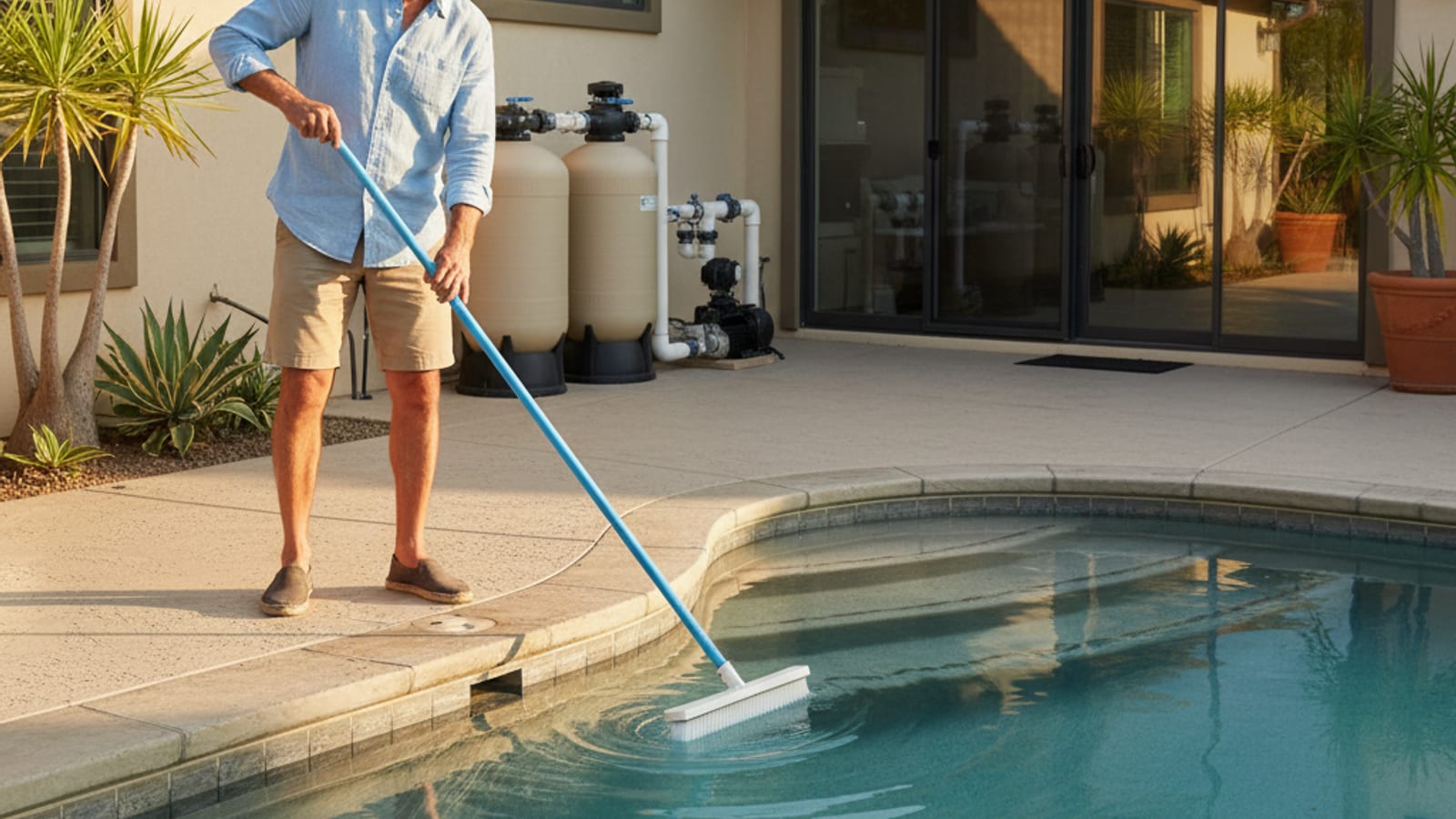
Knowing how to vacuum a pool manually starts with connecting a weighted head to your skimmer line and guiding it across the floor to pull up what your circulation misses. Manual vacuuming earns its place after a heavy Santa Ana wind event, when dust and leaf litter settle faster than a robotic cleaner can keep up, or when algae starts settling on the plaster. For daily upkeep, most San Diego homeowners lean on an automatic cleaner instead. Our guide to the best robotic pool cleaners in San Diego covers that side of the job. But when a pool needs a fast, thorough clean, a manual vacuum still does something automatic equipment can’t. Gravity pulls dense debris, sand, heavy silt, dead algae, straight to the floor, and your pump’s normal circulation can’t lift it back up to the skimmers. Pushing a vacuum head directly over that debris pulls it into the suction line where it belongs.
The tools required for manual pool vacuuming
You need four things: a telescopic pole, a weighted vacuum head, a flexible vacuum hose long enough to reach the deepest corner of the pool, and a vacuum plate if your pool doesn’t have a dedicated vacuum port. The plate is a plastic disc that fits over the skimmer basket, letting you draw suction through the basket itself. That matters because pulling water through the basket first catches eucalyptus leaves and twigs before they travel underground and jam the pump impeller. A pool built with a wall-mounted vacuum port skips the plate; the hose plugs straight into that fitting.
The vacuum head itself should match your pool’s surface. Concrete and plaster pools call for a heavier head with small wheels, which keep the suction gap evenly spaced above the floor. Vinyl liner pools need a head lined with soft nylon brushes instead. Hard wheels can scratch and tear a vinyl liner under sustained suction.
The hose has two distinct ends. A swivel cuff rotates freely and attaches to the vacuum head, which keeps the hose from tangling as you push the pole around the pool. The other end is a fixed, solid cuff that plugs into the skimmer plate or the wall’s vacuum port.
How to vacuum a pool step by step
Snap the swivel end of the hose onto the vacuum head, then attach the head to your telescopic pole. Lower the pole into the water until the head rests flat on the floor, and lean the pole against the coping while you handle the loose end of the hose.
Next comes the step that trips up most first-timers: bleeding the air out of the hose. Trapped air breaks suction at the pump and stops water flow entirely. Take the free end of the hose and feed it down into the water, hand over hand, until it’s fully submerged. Air bubbles will erupt from the open end as water pushes the trapped air out of the ribbed tubing. Once water spills steadily from the hose end instead of bubbles, the line is primed.
Some homeowners prime the hose a different way, using a return jet. Hold the free end against a return jet while the pump runs, and the water pressure blasts air out through the opposite end still attached to the vacuum head. Once bubbles stop rising from the head, the line is primed, and you move the hose from the return jet to the skimmer quickly, before air works its way back in.
With the line primed, push the solid end through the skimmer opening underwater and seat it firmly on the vacuum plate over the basket. The pump grabs the solid column of water and creates suction at the head almost immediately.
Move the head across the floor in slow, overlapping lines, the way you’d mow a lawn. Rushing the pass stirs fine dirt up into the water column faster than suction can pull it away. Work from the shallow end down the slope toward the deep end, and spend extra time on steps, swimouts, and corners, where debris settles first.
Multiport valves: filter versus waste settings
A sand or diatomaceous earth filter usually runs through a multiport valve, and that valve gives you two real choices when vacuuming.
| Valve setting | Where the water goes | When to use it |
|---|---|---|
| Filter | Through the filter media and back to the pool | Routine weekly cleaning, light dirt and leaves |
| Waste | Bypasses the filter and exits the system entirely | Dead algae or heavy mud after a storm |
Vacuuming to waste keeps fine, silty debris from clogging the filter grids, since the water bypasses the tank and exits through the backwash line. The tradeoff is water loss: dumping to waste can drop your water level several inches in a matter of minutes, so plan to top off with a garden hose while you work. San Diego Municipal Code section 67.3803(e) lists overfilling a pool as a prohibited water-waste practice at all times, drought or not, so watch the level and shut off the fill hose once water reaches the middle of the skimmer tile. The city also bars discharging pool water into the storm drain system under Municipal Code sections 43.0304 and 43.035(e)(3); route waste water to an absorbing landscape area or a legal sanitary sewer connection instead.
Troubleshooting common manual vacuum problems
A vacuum head that floats up off the floor almost always points to trapped air. Check the hose connections first; a hairline crack in a plastic cuff will pull air into the line and break your prime. If every connection is sealed, the head itself may be too light for the debris load, and clip-on lead weights can solve that.
Cloudy water during a cleaning session usually means you’re moving too fast; slow the sweeping motion and let suction do the work. If the water was already cloudy before you started, that points to an early algae bloom or unbalanced chemistry rather than technique. The CDC’s home pool guidance recommends keeping pool pH between 7.0 and 7.8, since chlorine kills germs more slowly above 7.8, so it’s worth testing the water before spending an hour vacuuming a pool that’s chemically out of balance.
Losing suction partway through the job usually means a full basket. Stop the pump, check the skimmer basket, and clear it if leaves have choked the flow. If the skimmer basket is clear but suction is still weak, check the pump basket next; small debris like pine needles can slip past the skimmer plate and pack into the pump housing. Shut off power at the breaker before opening the pump lid, and clear the basket to restore full flow to the impeller.
When to hand the pole to a professional
Some jobs go past what a standard manual vacuum should handle alone. A pool that’s turned green needs chemical treatment before a hose ever gets attached, since pushing live algae through the filter just spreads spores back into clean water. Our green pool cleaning guide for San Diego walks through the right chemical sequence first.
If a pool won’t hold suction no matter how carefully the hose gets primed, that usually points to an underground plumbing leak or a failing pump seal, and that’s a repair job, not a vacuuming problem. Splash Pro Pools connects San Diego homeowners with local, independent pool pros who handle both the diagnosis and the routine upkeep that keeps these issues from starting in the first place. If pushing a pole every Saturday isn’t how you want to spend a weekend, weekly pool cleaning covers the vacuuming along with the rest of the maintenance routine, logged and checked on a schedule. Homeowners anywhere in the county can find a matched pool service pro in San Diego. Call (858) 400-6757 to get connected.
Frequently asked questions
How often should I vacuum my pool manually?
Vacuum manually whenever dirt or leaves build up on the floor faster than your circulation clears them. Most San Diego backyards need a thorough manual pass about once a week. A pool running a robotic cleaner daily may only need manual attention in the tight corners once a month.
Why does my pool vacuum keep losing suction?
Suction usually breaks because air is entering the line or a basket is full. Trapped air in the vacuum hose is the most common cause. Submerge the whole hose slowly and let it fill with water before connecting it to the skimmer or vacuum port.
Can I vacuum algae on the filter setting?
Live or recently killed algae is small enough to pass through standard filter media and return to the pool. Vacuum algae on the waste setting instead, so it leaves the system through the backwash line rather than recirculating.
Do I need a special vacuum head for a vinyl liner?
Yes. Vinyl pools need a vacuum head with soft nylon brushes instead of hard wheels. A wheeled head built for concrete or plaster can scratch or tear a vinyl liner under suction.
How long does it take to vacuum a standard pool?
A standard residential pool takes roughly 25 to 40 minutes to vacuum thoroughly, in line with a standard weekly service visit. A larger pool, or one with heavy leaf drop, takes longer.
Frequently asked questions
How often should I vacuum my pool manually?
Vacuum manually whenever dirt or leaves build up on the floor faster than your circulation clears them. Most San Diego backyards need a thorough manual pass about once a week. A pool running a robotic cleaner daily may only need manual attention in the tight corners once a month.
Why does my pool vacuum keep losing suction?
Suction usually breaks because air is entering the line or a basket is full. Trapped air in the vacuum hose is the most common cause. Submerge the whole hose slowly and let it fill with water before connecting it to the skimmer or vacuum port.
Can I vacuum algae on the filter setting?
Live or recently killed algae is small enough to pass through standard filter media and return to the pool. Vacuum algae on the waste setting instead, so it leaves the system through the backwash line rather than recirculating.
Do I need a special vacuum head for a vinyl liner?
Yes. Vinyl pools need a vacuum head with soft nylon brushes instead of hard wheels. A wheeled head built for concrete or plaster can scratch or tear a vinyl liner under suction.
How long does it take to vacuum a standard pool?
A standard residential pool takes roughly 25 to 40 minutes to vacuum thoroughly, in line with a standard weekly service visit. A larger pool, or one with heavy leaf drop, takes longer.
Need professional help in San Diego County?
Splash Pro Pools connects San Diego homeowners with pool pros for the work in this post.