Emergency green pool recovery starts with testing the water, restoring circulation, brushing affected surfaces, filtering suspended material, and rebalancing the pool. The treatment changes with the algae load and the condition of the pump and filter. In San Diego, any discharged water also needs a lawful destination.
What a pool pro checks before adding treatment
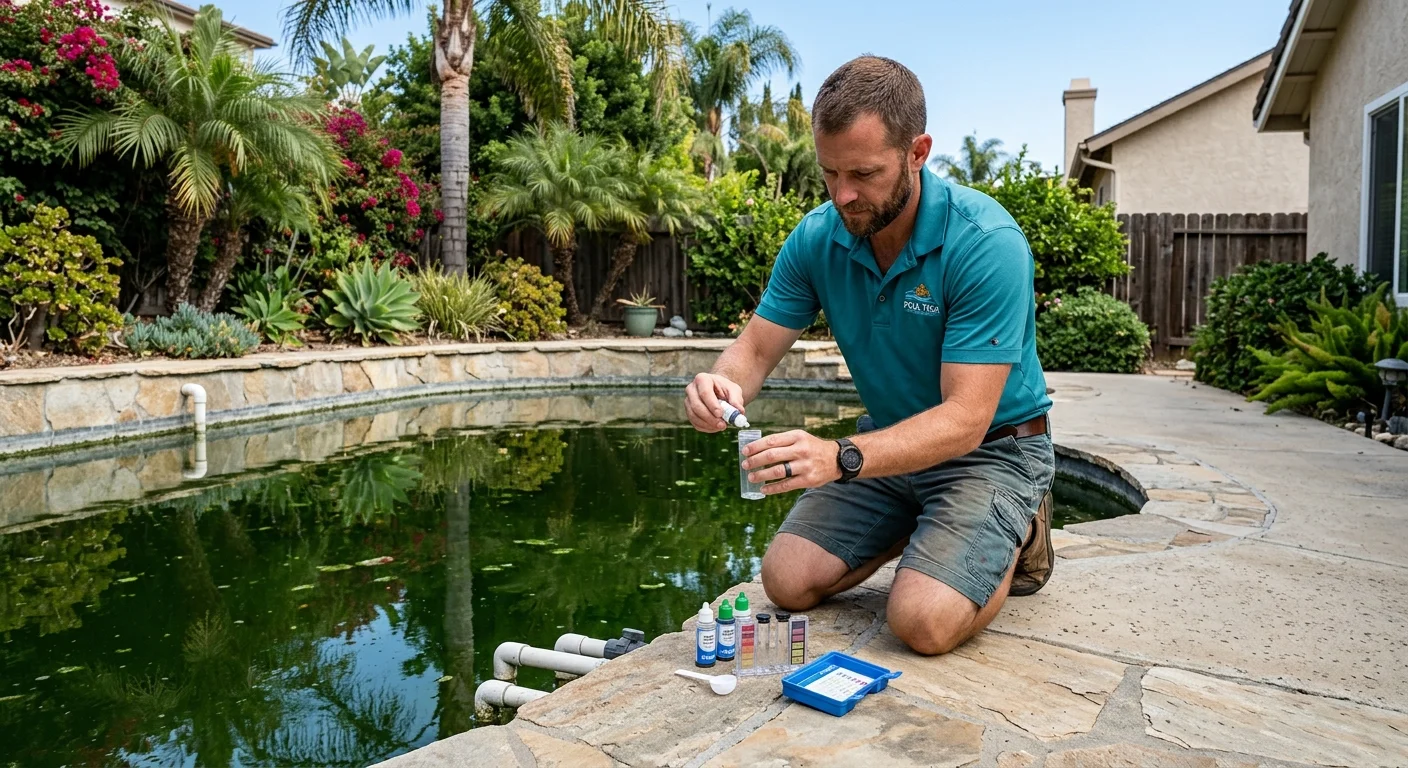
A pool pro first determines what failed, what still works, and what the water needs. Adding treatment before that inspection can leave the real problem untouched.
The pro starts with the pool itself. The water’s color and visibility show how much suspended material may need removal. The walls, steps, corners, and shaded areas reveal where growth has settled. Debris in the skimmer or on the floor can also restrict circulation. A windblown Tierrasanta yard may present a different cleanup than a sheltered Point Loma courtyard.
Equipment gets inspected before the treatment plan takes shape. The pro checks whether the pump primes, water returns to the pool, and valves direct flow correctly. The filter’s condition and pressure help show whether it can handle the material that brushing will release. A damaged pump or blocked flow changes the order of work.
Water testing provides the chemical starting point. The CDC’s healthy swimming guidance recommends a pool pH of 7.0 to 7.8 and at least 1 ppm free chlorine. Pools using cyanuric acid or stabilized chlorine need at least 2 ppm. Above pH 7.8, chlorine kills germs more slowly. Below 7.0, water can corrode pipes and equipment.
Sunlight, sweat, dirt, and swimmer waste consume chlorine. A Santee pool sitting in direct afternoon sun may lose chlorine differently than a shaded pool. Stabilizer buildup can also change how treatment behaves. Our guide to why pool water turns green explains those causes, while the pool algae treatment guide shows how growth can appear across different surfaces.
How circulation, brushing, and filtration work together
Green pool recovery works as a loop: circulate treatment, loosen attached growth, filter the released material, then retest. Skipping one part leaves the others carrying too much of the load.
Circulation spreads treated water through the pool. The pump pulls water through the skimmer and drains, sends it across the filter, and returns it through the wall fittings. Dead spots behind steps, near benches, or around tight corners may receive less movement. Those areas need direct brushing and close inspection.
Brushing breaks growth away from plaster, tile, grout lines, ladders, and fittings. That material enters the water, which can make the pool look cloudier during treatment. The visual change doesn’t automatically mean recovery has failed. It can mean attached material is now suspended and available for filtration.
The filter then separates suspended material from circulating water. Its ability to keep doing that depends on its condition and the amount of debris entering it. A heavily loaded filter restricts flow, so the pro monitors pressure and cleans or services the unit as its design requires. Backwashing isn’t interchangeable with cartridge cleaning, and the discharged water needs proper handling.
This cycle may repeat because one pass doesn’t expose every affected surface. The pro brushes, circulates, filters, and tests again. Each new reading guides the next step. That measured process is the core of a professional green pool recovery service, especially when the pool has moved beyond routine care.
Why some green pools need equipment work first
A green pool with weak or stopped circulation needs equipment attention before chemistry can work evenly. Treatment added to stagnant water can’t move reliably through the plumbing or reach every surface.
The problem may begin at the pump. A pump that won’t prime, loses prime, hums without moving water, or leaks at a connection can interrupt the recovery loop. Low water at the skimmer can also draw air into the system. The pro traces the path from the pool to the pump before deciding what needs service.
The filter creates another possible bottleneck. A dirty cartridge, loaded filter medium, damaged internal part, or incorrect valve position can reduce flow. Return jets may show little movement even while the motor runs. That distinction matters because a running motor doesn’t prove the system is circulating enough water for recovery.
Plumbing and controls can affect the plan too. Closed valves, blocked suction, timer faults, and damaged fittings can keep a working pump from doing its job. The pro isolates the fault before adding more treatment. That prevents repeated chemical additions from masking a mechanical problem.
Equipment repair crosses into regulated contractor work. Ask the pro for a license number and confirm it through the California Contractors State License Board. Splash Pro Pools connects homeowners with licensed, independent local professionals. For stalled pumps, failed controls, or severe water problems, our emergency pool service can help you find the right local pro.
How pros judge when the water has recovered
Pros judge recovery through water readings, surface inspection, circulation, and filtration performance. Color is useful, but it isn’t the finish line.
A pool can look blue while its chlorine or pH remains outside the recommended range. It can also look cloudy after brushing has suspended material that was attached to the walls. The pro compares current test results with earlier readings and watches how the water responds as it circulates.
The CDC recommends testing chlorine and pH at least twice per day, and more often during heavy use. DPD test kits are more accurate than test strips. Those readings matter because sanitizer performance changes with pH, stabilizer, and contaminants in the water.
Clear-looking water also doesn’t show how quickly every germ responds to chlorine. Under CDC test conditions of 1 ppm free chlorine, pH 7.5, and 77°F, E. coli is killed in under one minute. Cryptosporidium takes about 10.6 days. Cyanuric acid lengthens those germ-kill times. Appearance alone can’t replace measured chemistry.
The pro also checks whether brushing still releases visible material from walls, steps, and corners. Return flow should remain consistent as the filter collects debris. Rapid pressure changes or another loss of circulation can point back to the equipment rather than the water.
Once the pool’s chemistry is back in range, surfaces no longer show active growth, and circulation remains steady, the pro can explain the next maintenance steps. Don’t treat a color change as automatic approval to swim. Use current test results and the matched pro’s instructions.
What San Diego owners should know about discharged water
Green pool water can’t simply run into a San Diego gutter. The destination depends on the property’s jurisdiction, the water’s condition, and whether it contains salt or treatment residue.
Inside City of San Diego limits, San Diego Municipal Code §§43.0304 and 43.035(e)(3) make it illegal to discharge pool, spa, fountain, pond, or filter-backwash water into the city’s storm drain system. The city’s fact sheet says penalties can reach $10,000 per day per incident.
The city identifies narrow conditions for prepared pool water entering a storm drain. The water must be dechlorinated, at ambient temperature, and have a pH from 7 to 8. It must also be free of algae, algaecides, debris, and suspended solids. Saline water can’t enter city storm drains or gutters unless the prepared water travels through a pipe or concrete channel directly to a naturally saline water body.
A green pool doesn’t meet the algae-free condition in its untreated state. Recovery work should therefore account for any wastewater created during filter cleaning, backwashing, or draining. Backwash and acid-cleaning waste may never enter the city storm drain. Backwash must reach the sanitary sewer through a legal connection with a pH from 7 to 8.
City guidance also allows gradual landscape irrigation when the soil absorbs the water without runoff or erosion. Draining to the sanitary sewer requires approval from the City of San Diego Public Utilities Department. A pro can plan the work around those limits instead of sending a hose toward the street.
Those city rules don’t automatically apply throughout San Diego County. The San Diego County Water Authority has 22 retail member agencies, and local water service isn’t controlled by one countywide utility. Homeowners outside City of San Diego limits should confirm discharge requirements with their city’s stormwater program and local water agency before releasing pool water.
When to call us
A dark green pool, stalled circulation, or recurring algae needs a licensed local pro when testing and routine cleaning no longer correct the problem. Splash Pro Pools will match you with an independent professional who can inspect the water and equipment.
Call us at (760) 642-1256 and we’ll connect you with a licensed local pool pro.
Frequently asked questions
Can a green pool recover on a fixed schedule?
No. The algae load, water chemistry, circulation, and equipment condition determine the treatment sequence. The pool needs testing and inspection before a pro can judge the work involved.
Can chemicals alone clear a green pool?
Chemistry is only one part of recovery. Water must circulate, algae must be brushed from surfaces, and the filter must remove suspended material.
Does a green pool always need to be drained?
No. Treatment can proceed in the existing water when the equipment can circulate and filter it. If water must be discharged, the applicable local rules determine where it can go.
How does a pro know the pool has recovered?
A pro checks chlorine and pH, inspects the surfaces, confirms circulation, and watches how the filter handles suspended material. Clear-looking water alone isn't enough.
Need professional help in San Diego County?
Splash Pro Pools connects San Diego homeowners with pool pros for the work in this post.