A San Diego commercial pool is a Title 22 public pool. One bad chemistry reading can close it the same day San Diego County Environmental Health inspects. HOA, hotel, apartment, and gym pools all count. Splash matches licensed commercial service. Call (858) 400-6757.
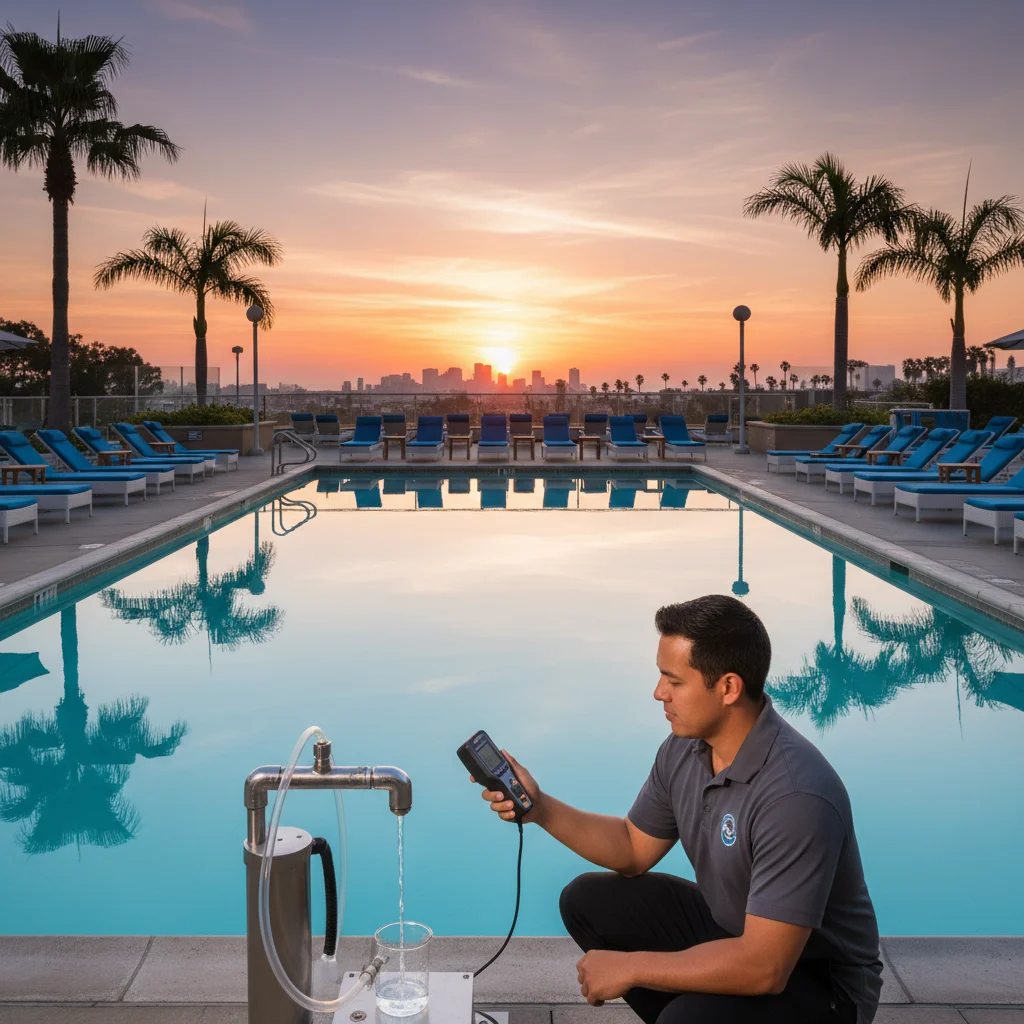
What “commercial” really means under California Title 22
Most people assume “commercial pool” just means a big pool. It doesn’t. Under California Health and Safety Code Section 116025 and the Title 22 regulations that flow from it, any pool accessible to multiple people outside a single household is a public pool. That includes:
- The heated lap pool at a Mission Valley gym
- A six-unit condo complex in Pacific Beach with a shared spa
- A 400-room hotel in Downtown San Diego
- An HOA pool in Rancho Bernardo serving 300 families
Title 22 sets the floor for water chemistry, equipment standards, signage, bather load calculations, and recordkeeping. San Diego County Environmental Health then layered its own inspection program on top. The county can close a pool the same day they find a violation. That’s not a hypothetical, it happens.
The chemistry requirements alone are meaningfully stricter than what a residential pool service needs to maintain. Free chlorine must stay between 1.0 and 10.0 ppm for chlorinated pools, pH between 7.2 and 7.8, and cyanuric acid (if used outdoors) can’t exceed 100 ppm. Total alkalinity and calcium hardness have defined ranges too. Every one of those parameters needs to be tested, logged, and defensible the moment an inspector walks through the gate.
Working with an unlicensed provider here isn’t just a compliance risk, it creates direct liability exposure. You can verify any contractor’s California license at the CSLB license lookup before you sign anything.
HOA, hotel, gym, and apartment pool requirements
The regulations are the same on paper, but the operational reality is very different depending on what kind of facility you run.
HOA pools
HOA pools typically see predictable bather loads, busy on summer weekends, quiet on weekday mornings in January. The challenge is governance. Most HOA boards aren’t pool experts, and turnover on boards means institutional knowledge disappears. A good commercial pool service provider keeps the paper trail clean so that whoever is currently on the board can hand an inspector everything they need in under two minutes.
San Diego County also requires that every public pool post its most recent inspection report. That document needs to exist and be current.
Hotel and resort pools
Hotel pool service in San Diego runs on a different clock than residential work. Hotel pools can have bather loads that spike dramatically on check-in days and during events. High bather load burns through chlorine fast and sends pH upward. A pool that was balanced at 7 a.m. can be out of spec by noon if the hotel is hosting a conference. That’s why commercial pool service at hotels almost always involves daily or twice-daily service visits, not the weekly schedule that works for a residential pool.
Spa and hot tub features attached to hotel pools carry their own requirements, spa and hot tub service for commercial facilities is regulated separately, and the turnover rate requirements for hot tubs (30 minutes in California) are far more demanding than for pools.
Gym and fitness center pools
Indoor pools at gyms face different chemistry challenges because there’s no UV degradation of chloramines, the combined chlorine compounds that cause that “pool smell” and irritate swimmers’ eyes. Managing chloramines in an indoor environment requires more aggressive breakpoint chlorination and often better ventilation. Outdoor gym pools in San Diego’s climate have more UV exposure working in their favor, but year-round use means there’s no off-season to reset.
Apartment pools
An apartment complex with a pool that’s open to all tenants is a public pool. Full stop. Even a small eight-unit building with a modest plunge pool falls under county jurisdiction if it’s accessible to multiple tenants. Many apartment owners don’t know this until their first inspection.
Daily logs, chemical automation, and inspection prep
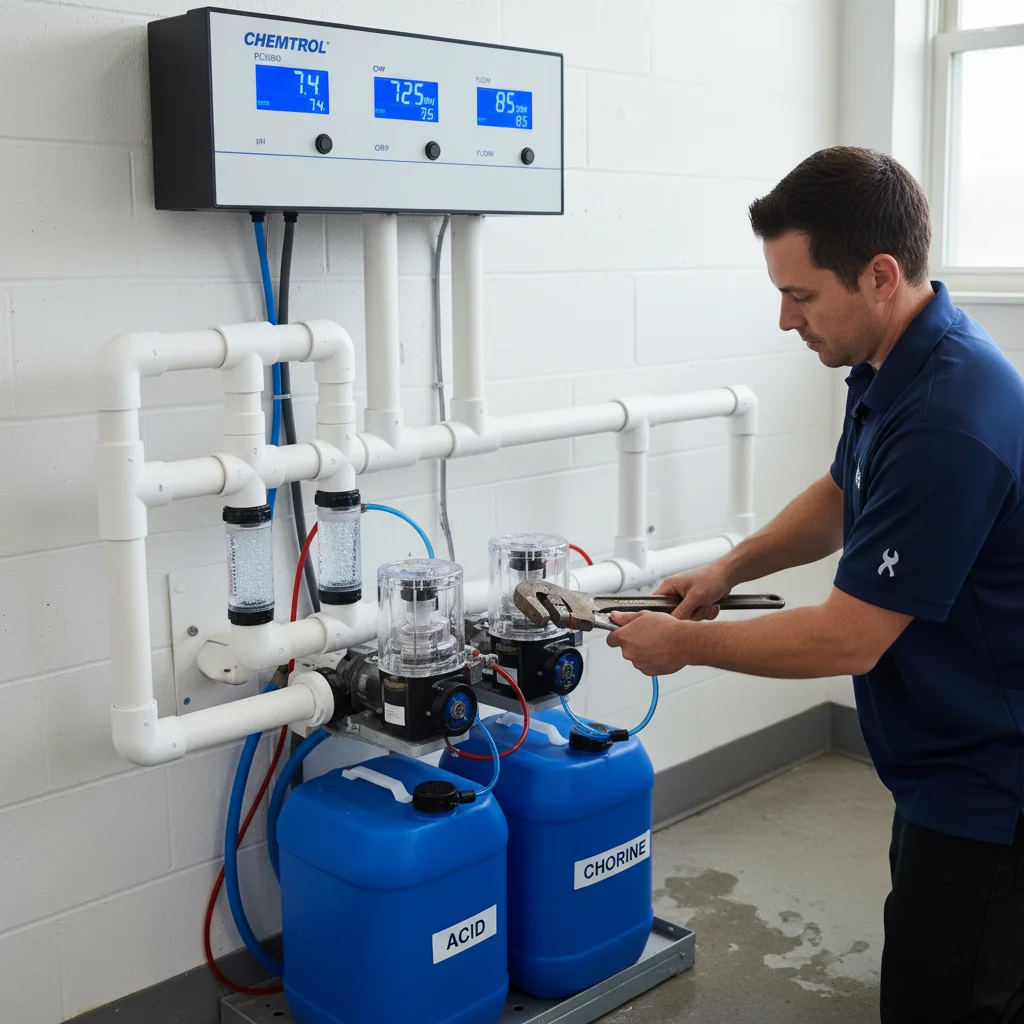
Logs are where most commercial pool compliance failures happen. Title 22 requires that chemical readings be recorded at each service visit. For a high-bather-load facility, that may mean logs need to reflect multiple daily entries. Paper logs work, but they’re vulnerable to gaps, illegible handwriting, and disputes during inspections.
Digital service records are used on every commercial route. Each visit generates a timestamped entry with the technician’s name, the chemical readings taken, any chemicals added, and equipment notes. Property managers get access to those records on demand. When a county inspector shows up, announced or not, the documentation is already organized.
Chemical automation
Automated chemical controllers are the most effective way to keep a busy pool in spec between service visits. A controller reads ORP (oxidation-reduction potential, a proxy for sanitizer effectiveness) and pH continuously, then feeds chemicals in small doses as needed. The result is a pool that stays in range around the clock rather than spiking and crashing between technician visits.
For San Diego properties, where summer pool use can be intense and temperatures can push chemistry out of balance faster than expected, automation isn’t a luxury on commercial accounts. It’s the practical answer to a chemistry management problem that manual dosing alone can’t solve. Pros in our network handle pool equipment installation and upgrades including chemical automation systems as part of the commercial setup process.
Inspection prep
A county inspection isn’t something you “get ready for” the week before. Either your records are in order or they’re not. Either your equipment is functioning or it isn’t. The most common inspection failures we see are:
- Chemical logs with gaps of more than 24 hours
- Broken or uncalibrated test equipment
- Inoperable safety equipment (broken shepherd’s hooks, missing ring buoys)
- Faded or missing required signage
- Spa temperature not within the legal maximum of 104°F
Quarterly equipment audits are conducted on all commercial accounts specifically to catch these issues before an inspector does.
What commercial service looks like in San Diego County
Our commercial service area covers San Diego County, from Chula Vista up through Oceanside, and inland to El Cajon and Santee. Each commercial account gets a dedicated technician, not whoever happens to be in the area that day. Consistency matters on commercial routes because the technician builds familiarity with that specific pool’s equipment, quirks, and chemistry patterns.
A typical commercial service visit looks like this:
On arrival: Visual safety check, all required signage present, safety equipment accessible, no visible hazards. This happens before anything else because a hazard found before the technician entered is documented; one found after isn’t.
Water chemistry: The technician tests free chlorine, combined chlorine, pH, total alkalinity, calcium hardness, and cyanuric acid. No parameters get skipped. Each reading goes into the digital log immediately.
Chemical adjustment: Any chemicals needed are added based on the readings. Dosage gets calculated based on pool volume, not guesswork. For pools with automated systems, the technician verifies the controller’s readings match the manual test and calibrates if needed.
Equipment check: Pump pressure, filter differential pressure, heater operation (if applicable), chemical feeder function, and controller set points. Equipment problems that go unnoticed between visits become emergency repairs. Pros in our network catch them while they’re still maintenance items. You can read more about our pool maintenance cost breakdowns for San Diego to understand how proactive service compares to reactive repairs.
Log entry and property manager notification: Anything notable, a pump running hotter than expected, a filter approaching its cleaning interval, a chemical reading that suggests a trend, goes into the report that the property manager receives after every visit.
San Diego’s climate means pools run year-round, which means equipment runs year-round too. Pool equipment on commercial accounts ages faster than on residential pools. Pros in our network track service intervals and flag replacement needs before failure, not after.
How to switch service providers without a compliance gap
Switching commercial pool service providers is not like switching a landscaping crew. There’s a regulatory continuity requirement that property managers need to plan around.
Here’s what a clean transition looks like:
Four weeks out: Notify your current provider in writing. Request copies of all chemical logs for the past 12 months, your most recent county inspection report, and the equipment list with service dates. You’re entitled to these records.
Two to three weeks out: The incoming provider inspects the pool and equipment. They need to know what they’re inheriting, a neglected filter, an aging chemical controller, a pump that’s two months from failure. This isn’t a sales visit; it’s a technical assessment.
One week out: Baseline water chemistry test and equipment calibration by the incoming provider. The pool’s chemistry needs a known starting point before the first service day.
Day one: The new provider takes over with full documentation in hand. There’s no gap in log records, no lapse in service, and no moment where the pool is sitting unmonitored while paperwork changes hands.
What we’ve seen on accounts we’ve taken over: providers who didn’t maintain logs, chemical controllers that hadn’t been calibrated in years, and equipment operating outside manufacturer specs. A compliance gap during a transition is the worst time to discover those problems. The incoming provider requests everything in writing and documents the baseline thoroughly so any pre-existing issues are on record before they become their responsibility.
The San Diego County pool maintenance failure data shows that deferred maintenance is consistently the driver behind emergency service calls and inspection failures. A clean transition that surfaces those issues early is far better than inheriting them silently.
Water conservation is also worth noting for commercial operators. The San Diego County Water Authority provides resources for reducing water use in commercial settings, and high-efficiency variable-speed pumps combined with good water chemistry management (reducing the need for dilution refills) are practical steps with real cost impact over a full year of operation.
When to call us
Commercial pool compliance isn’t optional in San Diego County, and the consequences of a failed inspection, immediate closure, public record, potential liability, aren’t worth the risk of working with a provider who isn’t set up for this kind of work. If your property has a public pool and you’re not confident your current service is keeping logs, testing all required parameters, and maintaining equipment to county standards, that’s the moment to make a change.
Call us at (858) 400-6757 and we’ll connect you with a vetted local pool pro.
Frequently asked questions
What makes a pool 'commercial' under California law?
Any pool available to multiple people who aren't members of a single household, including HOA pools, hotel pools, apartment pools, and gym pools, is classified as a public pool under California Health and Safety Code and regulated by Title 22. This means stricter chemical standards, mandatory recordkeeping, and regular county health inspections.
How often does San Diego County inspect commercial pools?
San Diego County Environmental Health inspects most public pools at least once per year, but pools at hotels, resorts, and large HOAs may receive multiple unannounced inspections. A failed inspection can result in immediate closure until violations are corrected.
Do I need a licensed contractor for commercial pool service in San Diego?
Yes. California requires that commercial pool service technicians work under or as a licensed contractor. You can verify any contractor's license at the CSLB website. Working with an unlicensed provider can void your insurance and create liability exposure during a county inspection.
What is chemical automation, and do commercial pools need it?
Chemical automation uses ORP (oxidation-reduction potential) and pH sensors connected to chemical feed systems to maintain water balance around the clock. California Title 22 strongly favors continuous monitoring for busy public pools, and many county inspectors expect to see it on high-bather-load facilities like hotel pools and HOA pools with over 100 units.
Do you offer hotel pool service in San Diego?
Yes. Splash matches hotel pool service in San Diego: daily or twice-daily visits, chemical logging that satisfies Title 22 recordkeeping, inspection prep, and spa turnover compliance. Hotels with conference traffic or seasonal occupancy swings need a schedule built around actual bather load, not a fixed weekly route.
How long does it take to switch commercial pool service providers?
A smooth transition typically takes one to two weeks. The incoming provider should review your current chemical logs, inspect all equipment, and schedule a baseline water chemistry test before the outgoing provider's last service date. Splash Pro Pools coordinates directly with property managers to keep records current throughout the handoff.
Need professional help in San Diego County?
Splash Pro Pools connects San Diego homeowners with pool pros for the work in this post.